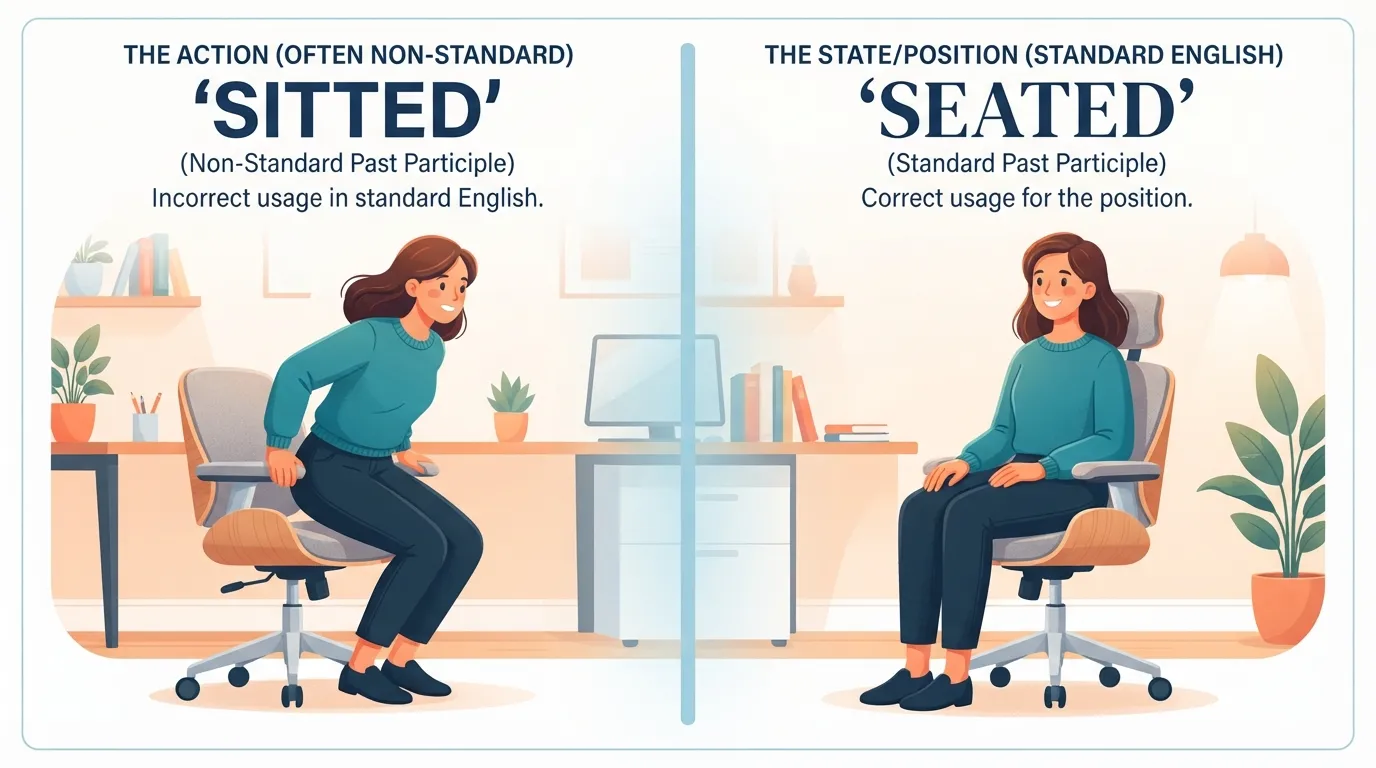
“Seated” is the standard and correct word for being in a sitting position. “Sitted” is usually incorrect in modern standard English.
A teacher asks her students to sit down before class begins. She says, “Please be seated.” A student wonders why they do not say “sitted.” Many English learners ask this exact question.
The keyword sitted or seated appears often in grammar searches, writing questions, and English-learning discussions. People want to know which word sounds natural and which one is grammatically correct.
In this article, we will explain the difference between sitted or seated in simple English. You will learn their meanings, pronunciation, correct usage, examples, history, and common mistakes, how to use the word “seated.” You will also see that “sitted” is a mistake in English.
Pronunciation
Sitted
- US English: /ˈsɪtɪd/
- UK English: /ˈsɪtɪd/
sitted
SIT-id
Give feedback
Seated
- US English: /ˈsiːtɪd/
- UK English: /ˈsiːtɪd/
seated
SEE-tid
Difference Between Sitted or Seated
1. Standard English Usage
Seated is a standard English word.
It is used in writing and speach.
Examples:
- Guest were seated before party.
- Please remain seated during the flight.
Sitted is not usually correct English. Always use the word “sat” for sitting actions in the past.
Examples of incorrect usage:
- I have sitted here for two hours.
- Student were sitted quietly.
You can use “seated” or “sat,” based on the sentence
2. Verb Forms
The verb “sit” is an irregular verb.
Its main forms are:
Verb FormWordPresentSitPastSatPast ParticipleSat
The word “seated” comes from the verb “seat.” The word “seat” follows standard grammar rules.
Its forms are:
Verb FormWordPresentSeatPastSeatedPast ParticipleSeated
Examples:
- I sit on the chair.
- Yesterday, I sat on the chair.
- The teacher seated the students.
3. Meaning of Seated
“Seated” means sitting in a seat.
It can describe a person who is already sitting.
Examples:
- Everyone sat down quietly.
- She remained seated throughout the meeting.
4. Meaning of Sitted
““Sitted” is usually not correct in modern English..
This mistake happens a lot. Learners add “-ed” to the word “sit” by accident.
Examples:
Incorrect:
- He has sitted on the sofa.
Correct:
- He has sat on the sofa.
Incorrect:
- All sitted in the room.
Correct:
- All seated in the buss.
5. Active and Passive Usage
The word “seated” works perfectly in passive sentences.
This is one reason it is common in formal English.
Examples:
- The guests were seated at their tables.
- The children were seated in rows.
“Sitted” does not work in these standard passive structures.
6. Formal English
“Seated” is often preferred in formal situations.
It appears in:
- Official announcements
- Courtrooms
- Meetings
- Restaurants
- Airlines
- Schools
Examples:
- You all, please be seated.
- The committee members sat around the table..
7. Everyday English
People often say “sat” in everyday casual talk. They do not say “seated.”
Both can be correct depending on the sentence.
Examples:
- I sat near the window.
- sat near the window.
The first sounds more natural in casual conversation. The second sounds slightly more formal.
8. Grammar Structure
Use “sat” to show that someone already sat down.
Examples:
- She sat on the bench.
- My friend and I sat down together. We ate our lunch.
Use “sat” for past actions. It shows someone already sat down.
Examples:
- She took a seat on the bench.
- Write clearly using short words.
9. Naturalness in Sentences
Native English speakers naturally use “sat” and “seated.”
They rarely use “sitted.”
Natural examples:
- He sat beside me.
- He was seated beside me.
Unnatural example:
- He was sitted alongside me.
10. Correct Word Choice
Use “sat” to show a past action. It means someone sat down earlier.
Choose “seated” for someone sitting down. Use it to show they stay in their chair.
Examples:
- She sat down after work.
- She was seated in front now.
Nature and Behaviour of Sitted or Seated
Nature of Sitted
Sitted is not used regularly in English (standard).
Many learners think “sit” changes like a regular verb. They make this mistake often.
For example:
- Walk → Walked
- Talk → Talked
- Seat → Seated
The word “sit” is irregular. It does not follow normal rules.
- Sit → Sat → Sat
Adding “-ed” makes the word wrong.
Nature of Seated
“Seated” is a regular verb form.
It comes from “seat,” which means to place someone in a chair or sitting position.
This word describes a person in a chair. They are sitting right now.
Examples:
- The waiter seated the guests.
- The guests were seated comfortably.
“Seated” is common in formal and professional English.
Why People Get Confused About Sitted or Seated
The confusion comes from the similarity between the words “sit” and “seat.”
Both words mean sitting down. They are two different verbs.
The verb “sit” describes the action of being in a sitting position.
The verb “seat” describes placing someone in a chair or giving someone a place to sit.
Many learners assume that every verb takes “-ed” in the past tense. This is wrong. English has many special irregular verbs..
For example:
- Go → Went
- Eat → Ate
- Sit → Sat
The word “sitted” sounds correct. It is a big grammar mistake.
Similarities
Both words are connected to the idea of sitting.
They may appear in sentences about chairs, meetings, classrooms, and positions.
However, only “seated” is a standard English word in this comparison.
Comparison Table
| Feature | Sitted | Seated |
| Standard English | Generally incorrect | Correct |
| Root Verb | Incorrect form of sit | Seat |
| Meaning | Not standard usage | Sitting or placed in a seat |
| Past Form of Sit | No | No |
| Correct Past of Sit | Sat | Not applicable |
| Formal Usage | Not used | Very common |
| Passive Sentences | Incorrect | Correct |
| Everyday Speech | Avoid | Common |
| Example | He sitted down. | He was seated. |
| Recommended Use | No | Yes |
The Origin of the Keyword
The word “sit” has a very old history.
It comes from Old English sittan, which means to sit or remain in a sitting position. It is related to similar words in Germanic languages.
The word “seat” comes from Old English. It is a very old word. It comes from sete, meaning a place for sitting.
Over time, English developed two related verbs:
- Sit: To be in a sitting position.
- Seat: To place someone in a sitting position.
The form “seated” developed naturally from “seat.”
Many learners say “sitted” by mistake. They try to use normal rules on a special irregular verb.
British vs American English
There is no major difference between British and American English regarding “sitted” and “seated.”
Both varieties use:
- Sit
- Sat
- Seated
the word “sitted” is wrong. People in Britain and America never use it.
British English Examples
- Please be seated.
- She sat beside her friend.
American English Examples
- Please remain seated.
- He sat in the back row.
People in America understand the word “seated.” People in Britain understand it too.
Spelling Differences
Words such as “colour” and “color,” there is no British-American spelling difference here.
The correct spelling is always:
Seated
Which One Should You Use?
Use “seated” for a person in a chair. Apply it when someone helps you find your spot.
Use sat when describing the past action of sitting.
For US English
Use:
- I sat down.
- We sat at the table.
For UK English
Use:
- She sat near the door.
- The guests sat down.
For Global English
“Seated” and “sat” are safe choices for international communication.
Avoid “sitted” because many English speakers will consider it incorrect.
Common Mistakes
Mistake 1: Using Sitted as the Past Tense of Sit
Incorrect:
- I sitted on the chair.
Correct:
- I sat on the chair.
Mistake 2: Using Sitted in Passive Voice
Incorrect:
- The students were sitted in rows.
Correct:
- The students were seated in rows.
Mistake 3: Confusing Sit and Seat
Incorrect:
- Please sit the guests.
Correct:
- Please seat the guests.
Mistake 4: Using Seated When Sat Is Better
Sometimes “sat” sounds more natural.
Less natural:
- Yesterday, I was seated on the sofa for three hours.
Better:
- Yesterday, I sat on the sofa for three hours.
Both may be grammatically correct, but the second is more natural for casual speech.
Everyday Usage Examples
In Emails
Correct:
Please be seated before the meeting begins.
Correct:
The guests were seated according to their assigned places.
On Social Media
Correct:
Finally seated and ready for the show!
Correct:
Sat down with a cup of coffee after a long day.
In News Writing
Correct:
The court remained seated as the judge entered the room.
Correct:
The audience was seated before the performance began.
In Formal Writing
Correct:
All participants were seated before the presentation started.
Correct:
The committee members sat together to discuss the matter.
Usage Trends
The word “seated” remains common in formal and professional English.
It is frequently used in:
- Restaurants
- Schools
- Offices
- Courts
- Public transportation
- Events
The word “sat” is more common in everyday conversation.
“Sitted” remains rare and is usually found in learner mistakes, nonstandard writing, or informal online discussions.
Modern English speakers generally prefer simple and natural forms such as “sat” and “seated.”
Metaphors and Similes
The words “sat” and “seated” can also appear in figurative language.
Sat Like a Statue
This means someone remained very still.
Example:
- He sat like a statue during the entire ceremony.
Seated in Power
This can describe someone holding an important position.
Example:
- The king was seated on his throne.
Sat in Silence
This means someone stayed quiet while sitting.
Example:
- She sat in silence and watched the rain.
Connotative Meaning
Positive Meaning
“Seated” can suggest comfort, order, and readiness.
Example:
- Everyone was seated comfortably for the special dinner.
Negative Meaning
“Sat” can sometimes suggest inactivity or waiting.
Example:
- He sat there all day without doing anything.
However, the meaning depends on context.
Neutral Meaning
Both “sat” and “seated” can simply describe a person’s physical position.
Examples:
- She sat near the window.
- She was seated near the window.
Idioms and Proverbs
There are no major English idioms that specifically use “sitted.”
However, “sit” appears in many common expressions.
Sit Tight
Meaning: Wait patiently.
Example:
- Please sit tight while we prepare your order.
Sit Back and Relax
Meaning: Relax and enjoy something.
Example:
- Sit back and relax during the movie.
Sit on the Fence
Meaning: Avoid choosing a side.
Example:
- He continues to sit on the fence about the decision.
Sit Down and Talk
Meaning: Discuss something calmly.
Example:
- We should sit down and talk about the problem.
Literature and Movies
We see people sit down in movies. We read about characters taking seats in books.
Literature
In classic English literature, writers such as William Shakespeare frequently used forms of “sit” in dialogue and descriptions.
For example, Shakespeare’s plays from the late 16th and early 17th centuries often describe characters sitting in royal courts, meeting rooms, or private settings.
The word “seated” is also common in historical and formal writing because it creates a sense of position and dignity.
Movies
The idea of remaining seated appears in many films involving schools, courts, airplanes, theaters, and formal events.
For example:
- School movies often show students sitting in classrooms.
- Historical films frequently show kings and leaders seated on thrones.
These examples show how both words connect with real-life situations and storytelling.
Why This Difference Matters
It is important to know the right words to use because it helps your friends understand you perfectly..
For learners, knowing irregular verbs prevents common mistakes in speaking and writing.
For experts, teachers, editors, and writers, using standard English improves professionalism.
In society, language helps people understand each other. Making a small grammar mistake is okay sometimes. But if you make mistakes all the time, teachers and bosses might think you do not practice enough.
Using “sat” and “seated” correctly shows attention to detail.
Usefulness in Daily Life
This difference is useful in many everyday situations.
At School
- Please remain seated during the exam.
At Work
- The team was seated around the conference table.
Sitting in a Restaurant
- Your table will be seated shortly.
During Travel
- Passengers must remain seated during takeoff.
In Conversation
- I sat on the sofa after dinner.
Knowing these simple differences helps you speak naturally and write correctly.
Situational Preference
Use “sat” when talking about someone sitting down in the past. It is common in everyday English.
Example: I sat near the window.
Choose “seated” for a person in a chair. Use it for someone given a spot. This word appears in school rules. Restaurants use it. Big announcements use it.
Example: The guests were seated near the window.
Never use “sitted” in standard English. When in doubt, use “sat” for past actions and “seated” for formal sentences.
Common Questions
1. Is sitted a correct English word?
No. The word “sitted” is a big mistake. Standard English does not use it. Use “sat” or “seated” instead.
2. What is the past tense of sit?
The past tense of “sit” is “sat.”
Example:
- I sat on the chair yesterday.
3. What is the difference between sat and seated?
“Sat” is the past tense of “sit.” “Seated” comes from “seat” and often describes someone sitting or being placed in a sitting position.
4. Can I say, “I was seated”?
Yes. “I was seated” is grammatically correct.
5. Can I say, “I was sitted”?
No. This is incorrect in standard English.
Correct alternatives:
- I was seated.
- I sat down.
6. Is seated more formal than sat?
Usually, yes. “Seated” is often used in formal, professional, and official situations. “Sat” is common in everyday conversation.
7. Should I use seated in British and American English?
Yes. “Seated” is correct in both British and American English.
Conclusion
The difference between sitted or seated is simple once you understand the verbs behind them. “Sitted” is generally incorrect in standard English. Use the real words “sat” and “seated.” The word “sat” shows a past action. Example: “She sat on the chair.” The word “seated” describes people already in chairs. Example: “The guests were seated.” The word “sitted” is a fake, made-up word. No matter where you live in the world, the rule is the same. Remember this simple tip: Sit → Sat, Seat → Seated. With this rule in mind, you can avoid a common grammar mistake and communicate more clearly in everyday and formal English.

I’m Sultan Sikander, an English language specialist, SEO specialist, digital publisher, and researcher. I create clear, accurate, and well-researched content on English grammar, vocabulary, word meanings, and language comparisons, helping readers understand and use English with confidence.











2 thoughts on “Sitted or Seated: Which Word Is Correct? A Simple Guide”