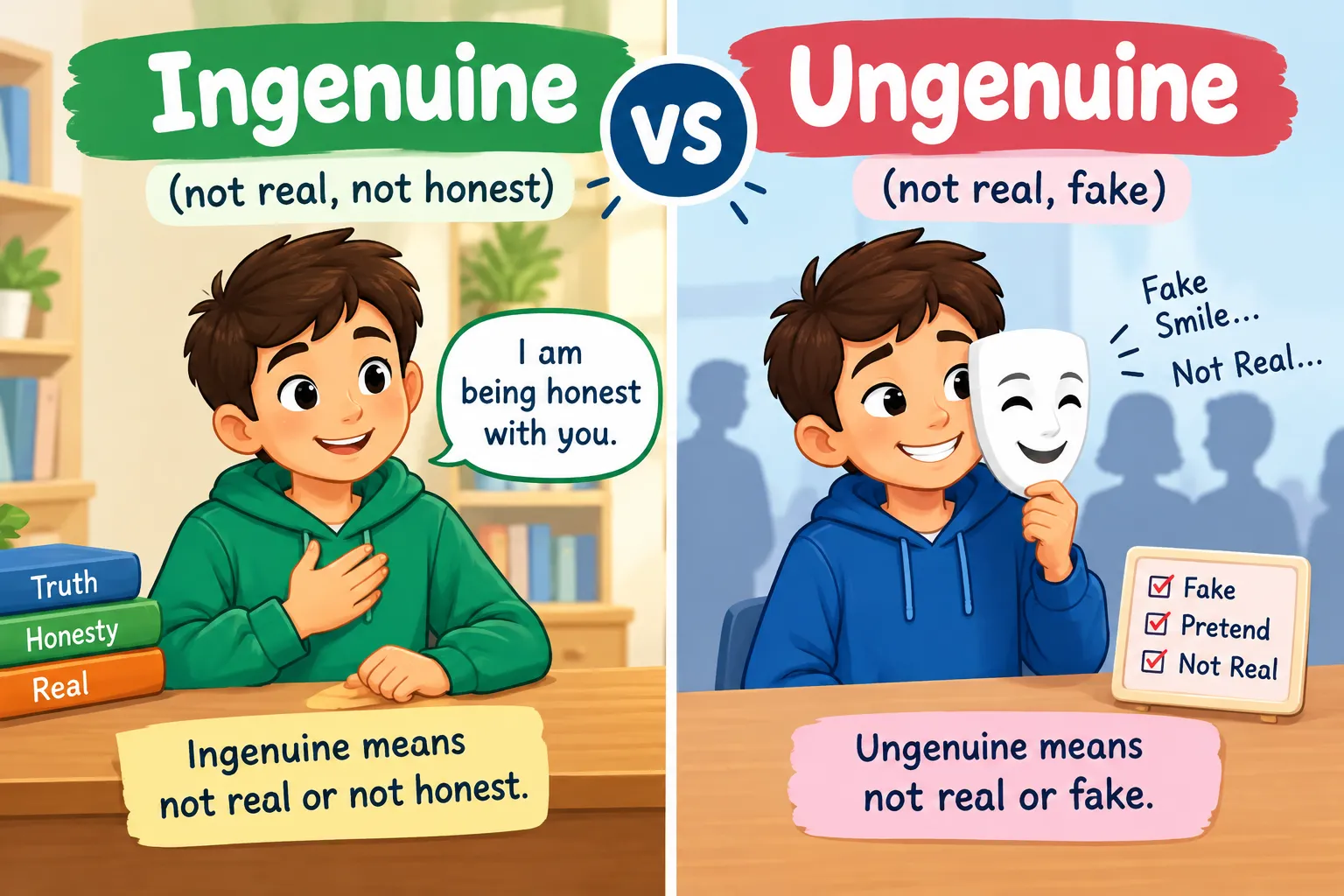
“Ungenuine” is the more recognized English word, but “ingenuine” is also found occasionally. However, “not genuine” or “inauthentic” is usually clearer and more natural.
Imagine buying a watch from a small shop. The seller says it is a real luxury watch. Later, you discover that it is fake. You want to describe the seller’s claim and the watch. Should you say “ingenuine” or “ungenuine”?
This is where many English learners become confused. Both ingenuine and ungenuine are used to describe something that is not genuine or sincere. The word genuine means real, honest, natural, or true. When people add prefixes such as “in-” or “un-,” they try to create the opposite meaning. However, these words are not equally common in modern English.
People search for ingenuine or ungenuine because they want to know which spelling is correct, which word sounds natural, and whether both can be used in formal writing. Understanding this difference helps learners avoid awkward sentences. It also helps writers choose better words for emails, reports, and everyday conversations.
In this article, we will explore the meanings, pronunciation, usage, history, and differences between ingenuine and ungenuine.
Pronunciation of Ingenuine and Ungenuine
Ingenuine
- US English: /ɪnˈdʒɛn.ju.ɪn/
- UK English: /ɪnˈdʒɛn.ju.ɪn/
Ungenuine
- US English: /ʌnˈdʒɛn.ju.ɪn/
- UK English: /ʌnˈdʒɛn.ju.ɪn/
Both words contain the same ending sound as “genuine.”
Read more about:https://suitmean.com/wp-admin/post.php?post=248&action=edit
Difference Between Ingenuine and Ungenuine
1. Meaning
Both words are connected to the opposite of genuine.
Ingenuine usually means not genuine, false, or lacking honesty.
Ungenuine also means not genuine, especially when something appears fake or dishonest.
Examples:
- His ingenuine smile made everyone uncomfortable.
- Her apology sounded ungenuine.
2. Commonness in English
Ungenuine is more commonly recognized than ingenuine.
However, neither word is very common in everyday English.
Examples:
- The word “ungenuine” appears in some dictionaries and writing.
- Many people prefer “not genuine” instead of ingenuine.
3. Natural Usage
Ungenuine can sound natural in some contexts.
Ingenuine may sound unusual or less familiar to many readers.
Examples:
- His interest in the project seemed ungenuine.
- The advertisement felt ingenuine to some customers.
4. Formal Writing
In formal writing, both words should be used carefully.
Writers often choose clearer alternatives such as “inauthentic,” “false,” or “insincere.”
Examples:
- The report described the product as inauthentic.
- The manager believed the employee’s apology was insincere.
5. Prefix Difference
The words use different prefixes.
“Un-” often means the opposite of something.
“In-” can also mean not, but it does not work naturally with every word.
Examples:
- Unhappy means not happy.
- Inaccurate means not accurate.
6. Dictionary Recognition
Ungenuine is more likely to be recognized as a word in English dictionaries.
Ingenuine has limited and less common usage.
Examples:
- A learner may find ungenuine in some word references.
- Ingenuine may appear in informal or unusual writing.
7. Meaning in Relationships
Both words can describe feelings or behavior that are not sincere.
Examples:
- His kindness seemed ungenuine.
- Her ingenuine concern was easy to notice.
8. Meaning in Products
The words can describe products that are fake or not authentic.
However, “counterfeit” or “fake” is usually better for products.
Examples:
- The buyer discovered that the watch was not genuine.
- The seller was accused of selling ungenuine products.
9. Meaning in Emotions
Ungenuine is sometimes used to describe false emotions.
Ingenuine may also be used for the same purpose.
Examples:
- She gave an ungenuine compliment.
- His ingenuine excitement was obvious.
10. Best Alternative Words
Instead of using either word, clearer alternatives are often available.
Examples:
- Not genuine
- Inauthentic
- Insincere
- Fake
- False
- Artificial
For example:
- His smile was not genuine.
- Her apology was insincere.
Nature and Behaviour of Ingenuine and Ungenuine
Nature of Ingenuine
Ingenuine describes something that lacks genuineness. It suggests that a person, action, feeling, or object is not real or sincere.
However, the word is uncommon. Some readers may consider it awkward or nonstandard.
Example:
His ingenuine behavior made it difficult to trust him.
Nature of Ungenuine
Ungenuine also describes something that is not genuine. It is more understandable to many English speakers because the prefix “un-” commonly creates opposites.
Still, it is not as popular as words like “insincere” or “inauthentic.”
Example:
Her ungenuine interest in the meeting was clear.
Why People Get Confused About Ingenuine and Ungenuine
People become confused because English uses different prefixes to create opposite meanings.
For example:
- Happy → Unhappy
- Honest → Dishonest
- Accurate → Inaccurate
- Genuine → Not genuine
Learners may think both “ingenuine” and “ungenuine” are equally correct because both prefixes can mean “not.”
Another reason is that genuine already has a clear opposite in common English: fake, false, or inauthentic.
Comparison Table
| Feature | Ingenuine | Ungenuine |
| Meaning | Not genuine | Not genuine |
| Common Usage | Rare | More recognized |
| Formal Writing | Not usually preferred | Use carefully |
| Everyday English | Uncommon | Uncommon |
| Clear Alternatives | Inauthentic, false | Insincere, fake |
| Prefix | In- | Un- |
| Meaning in Behavior | Not sincere | Not sincere |
| Meaning in Products | Not authentic | Not authentic |
| Recommended for Learners | Avoid if possible | Use with caution |
| Best Choice | “Not genuine” | “Not genuine” |
Similarities Between Ingenuine and Ungenuine
Both words:
- Describe something that is not genuine.
- Can describe fake feelings or behavior.
- Can relate to false products or claims.
- Are less common than simpler alternatives.
- May cause confusion for English learners.
The Origin of Ingenuine and Ungenuine
The word genuine comes from Latin genuinus, meaning natural, real, or authentic.
Over time, English speakers began using prefixes to create opposite meanings.
The prefix “in-” often means “not.” Examples include:
- Incomplete
- Incorrect
- Inactive
The prefix “un-” also means “not” or “opposite of.” Examples include:
- Unfair
- Unkind
- Unusual
Although both prefixes exist in English, they cannot always be added freely to every word. This is why “ingenuine” and “ungenuine” have different levels of acceptance and usage.
British vs American English
There is no major British-American spelling difference between these two words.
Both ingenuine and ungenuine are spelled the same in American and British English.
However, usage preferences may differ slightly.
American English often prefers simple and direct expressions such as:
- Not genuine
- Fake
- Insincere
British English also commonly uses:
- Not genuine
- Inauthentic
- Artificial
Examples
American English:
- His apology did not seem genuine.
British English:
- Her concern appeared insincere.
In both varieties, clear alternatives are usually preferred over unusual words.
Which One Should You Use?
For most situations, use “not genuine” instead of ingenuine or ungenuine.
For US English
Use:
- Not genuine
- Insincere
- Fake
- Inauthentic
For UK English
Use:
- Not genuine
- Insincere
- False
- Inauthentic
For Global English
The safest choice is not genuine because everyone can understand it easily.
Common Mistakes
Mistake 1: Using Ingenuine in Formal Writing
Incorrect or awkward:
- The document contains ingenuine information.
Better:
- The document contains false information.
Mistake 2: Assuming Both Words Are Equally Common
Many learners think both words are widely used.
Better:
Remember that both are uncommon, and simpler words are usually better.
Mistake 3: Using Ungenuine for Every Situation
Ungenuine may not sound natural in all contexts.
Better:
Choose a word that matches the meaning.
- Fake product → Counterfeit
- False emotion → Insincere
- Not real → Inauthentic
Mistake 4: Confusing Genuine With Original
Genuine means real or sincere.
Original means the first or authentic source.
These meanings can overlap but are not always the same.
Everyday Usage Examples
In Emails
- Thank you for your honest feedback. We appreciate genuine customer opinions.
- We noticed that some reviews appeared insincere.
On Social Media
- Fake kindness is easy to notice.
- A genuine smile can make someone’s day better.
In News
- Officials warned consumers about counterfeit products.
- The company denied claims of false advertising.
In Formal Writing
- The study examined authentic human responses.
- The researcher questioned the sincerity of the statement.
Usage Trends
Modern English usually prefers simple words.
People are more likely to say:
- Not genuine
- Fake
- False
- Insincere
- Inauthentic
Instead of using ingenuine or ungenuine.
This is because simple language is easier to understand. It also sounds more natural in conversation and professional writing.
Metaphors and Similes
Although ingenuine and ungenuine are rarely used in figurative expressions, they can describe false appearances.
Metaphor Examples
- His smile was a mask hiding an ungenuine heart.
- The promise was a beautiful painting with no real color.
Simile Examples
- Her concern felt as ungenuine as a copied signature.
- His excitement was like a bright light with no warmth.
These examples show how something can appear real on the outside but lack truth inside.
Connotative Meaning
Positive Meaning
Neither ingenuine nor ungenuine usually carries a positive meaning.
The word “genuine” itself has positive connotations.
Example:
- She gave genuine support to her friend.
Negative Meaning
Both words can suggest dishonesty, falseness, or a lack of trust.
Example:
- His ungenuine apology made the situation worse.
Neutral Meaning
In some cases, the word may simply describe something that is not authentic without attacking a person.
Example:
- The product was identified as not genuine.
Idioms and Proverbs
There are no widely recognized idioms or proverbs using ingenuine or ungenuine.
However, English has several common expressions related to genuineness.
“Actions speak louder than words.”
This means behavior shows the truth better than promises.
Example:
His words sounded kind, but his actions were not genuine. Actions speak louder than words.
“All that glitters is not gold.”
This means something that looks valuable may not be real or good.
Example:
The expensive-looking watch was fake. All that glitters is not gold.
“A wolf in sheep’s clothing.”
This describes someone who appears kind but may have bad intentions.
Example:
His friendly behavior was ungenuine. He was like a wolf in sheep’s clothing.
Literature and Movies
The idea of something being genuine or fake appears often in literature and movies.
Literature
The Great Gatsby by F. Scott Fitzgerald (1925) explores themes of identity, appearance, wealth, and false relationships. The novel shows how people can appear successful while hiding their true selves.
Movies
The Truman Show (1998), an American film, explores the difference between reality and artificial life. The main character discovers that his world is not what it seems.
Another example is The Matrix (1999), an American science-fiction movie that questions reality and appearances.
These works help readers and viewers understand why genuineness matters in life.
Why This Difference Matters
Understanding the difference between ingenuine and ungenuine matters because word choice affects communication.
For learners, using common and natural words improves writing and speaking skills.
For experts, precise language helps avoid confusion in reports, business documents, and professional communication.
In society, genuine behavior builds trust. People depend on honest communication in friendships, workplaces, schools, and communities.
Using unusual words can sometimes distract readers from the main message. Clear language creates better understanding.
Knowing when to use “not genuine,” “fake,” “insincere,” or “inauthentic” makes communication more effective.
Usefulness in Daily Life
These words and their alternatives are useful when discussing:
- Honest behavior
- False promises
- Fake products
- Insincere apologies
- Artificial emotions
- Trust in relationships
- Business honesty
- Online information
For example, if someone gives you false information, you can say:
“The information was not genuine.”
This is clearer than saying:
“The information was ungenuine.”
Situational Preference
In everyday conversations, “not genuine” is the best choice because it is simple and easy to understand. In business or formal writing, use “inauthentic,” “false,” or “insincere,” depending on the situation. If you are describing a fake product, use “counterfeit” or “not authentic.” For a person’s behavior, “insincere” often sounds more natural. Although “ungenuine” may be understood, it is less common. “Ingenuine” is even less familiar to many readers. Choose words based on clarity, audience, and context rather than simply choosing a word that sounds opposite to “genuine.”
Commonly asked questions:
1. Is ingenuine a correct English word?
Ingenuine is found occasionally in English, but it is uncommon and not usually the best choice for modern writing.
2. Is ungenuine a correct word?
Ungenuine is more recognized than ingenuine, but it is still uncommon. Clearer alternatives are often preferred.
3. Which is better: ingenuine or ungenuine?
Ungenuine is generally more familiar, but “not genuine” is the safest and clearest expression.
4. What is the opposite of genuine?
Common opposites include:
- Fake
- False
- Insincere
- Inauthentic
- Artificial
5. Can I use ungenuine in formal writing?
You can, but it may sound unusual. Consider using “inauthentic” or “insincere” instead.
6. Is ingenuine used in American English?
It may appear occasionally, but it is not common in standard American English.
7. What should English learners use?
English learners should use “not genuine,” “fake,” or “insincere” because these words are natural and widely understood.
Conclusion
The words ingenuine and ungenuine both relate to something that is not genuine. However, they are not equally common or natural in modern English. Ungenuine is more recognized than ingenuine, but both words are relatively uncommon. This is why many English speakers prefer simpler alternatives such as “not genuine,” “fake,” “false,” “insincere,” or “inauthentic.” The best word depends on the situation. Use “fake” for products, “insincere” for feelings or behavior, and “inauthentic” for formal discussions about originality or truth. For general writing, “not genuine” is usually the safest choice.

I’m Sultan Sikander, an English language specialist, SEO specialist, digital publisher, and researcher. I create clear, accurate, and well-researched content on English grammar, vocabulary, word meanings, and language comparisons, helping readers understand and use English with confidence.











1 thought on “Ingenuine or Ungenuine: Which Word Is Correct?”