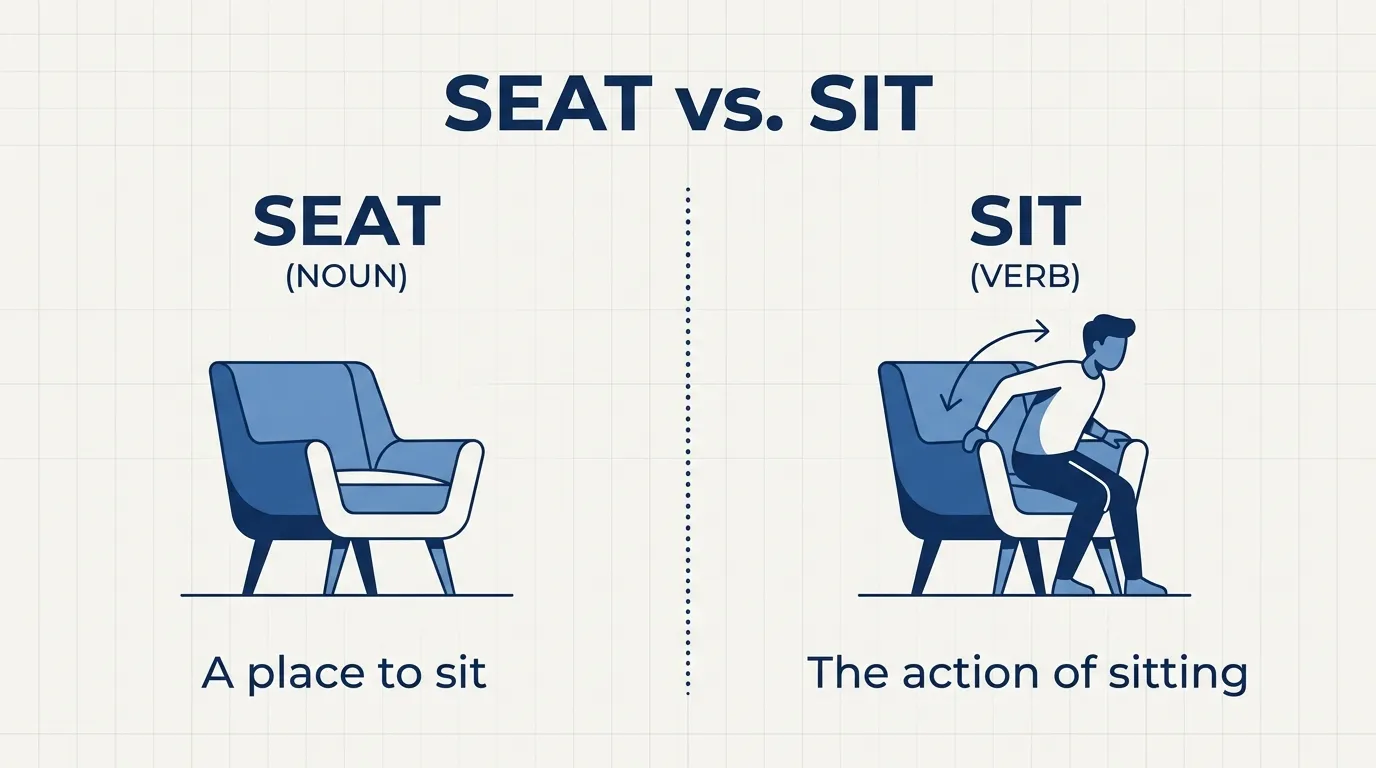
Sit means to lower your body onto a chair or another place, while seat usually means a chair or a place to sit.
Imagine you are in a classroom. Your teacher walks in and says, “Please sit down.” You bend your knees and place your body on a chair. Here, sit is the right word. Now your friend asks, “Is this seat free?” They are asking about the place where a person can sit. Here, seat is the right word. The words seat or sit look and sound close. This can confuse English learners. Both words are linked to chairs and sitting. But they do not work in the same way. Sit is mainly a verb. It tells us what a person does. Seat can be a noun or a verb. As a noun, it means a place to sit. As a verb, it can mean to help someone sit or give someone a place to sit.
People often search for seat or sit because they want to choose the correct word in a sentence. This guide makes that choice easy.
Pronunciation
- Sit
- US: /sɪt/
- UK: /sɪt/
- Seat
- US: /siːt/
- UK: /siːt/
The main sound difference is the vowel. Sit has a short vowel sound. Seat has a long vowel sound.
Read more about: https://suitmean.com/apprised-or-appraised/
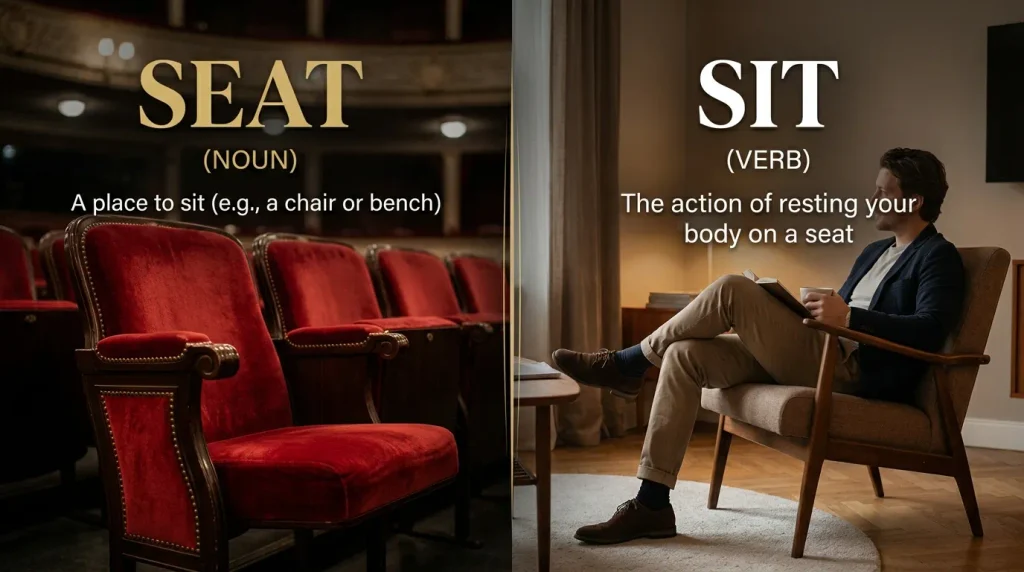
Difference Between Seat or Sit
1. Sit tells us what a person does
Sit is mainly a verb. It tells us that someone is in a sitting position.
Examples:
- Please sit here.
- I like to sit near the window.
2. Seat can mean a place to sit
Seat is often a noun. It means a chair or another place made for sitting.
Examples:
- This seat is empty.
- I found a seat on the bus.
3. Sit describes an action
We use sit when we talk about the act of sitting.
Examples:
- Please sit down.
- The child sat on the floor.
4. Seat can describe a place
A seat is the place where someone sits.
Examples:
- Your seat is near the door.
- Please take your seat.
5. Sit has different verb forms
The forms of sit are:
- sit
- sat
- sat
- sitting
Examples:
- I sit here every day.
- She sat beside me.
6. Seat can also be a verb
As a verb, seat means to give someone a place to sit.
Examples:
- The waiter seated us near the window.
- The teacher seated the students in groups.
7. Sit does not mean a chair
Sit describes an action. It does not name the chair.
Examples:
- Please sit here.
- She wants to sit outside.
We cannot normally say, “Give me a sit.”
8. Seat can refer to one place
A seat can be one specific place.
Examples:
- This seat is taken.
- My seat is in the front row.
9. Sit is common in instructions
We often use sit when giving simple instructions.
Examples:
- Sit down, please.
- Sit quietly during the test.
10. Seat is common in travel and public places
We often use seat when talking about buses, trains, planes, theaters, and stadiums.
Examples:
- My seat is next to the window.
- We booked four seats for the show.
Nature and Behaviour of Seat or Sit
Nature of Sit
Sit is mainly a verb.
It describes a body position or action. A person can sit on a chair, sofa, bench, floor, or bed.
Examples:
- Please sit on the chair.
- The dog sat on the floor.
The word can also have other meanings.
For example:
- The book sits on the table.
Here, sits means that the book is placed there.
Nature of Seat
Seat can be a noun and a verb.
As a noun, it means a place for sitting.
- This seat is comfortable.
As a verb, it means to place or help someone sit.
- The host seated the guests.
Why People Get Confused About Seat or Sit
People get confused because both words are connected to sitting.
They also look similar.
There is another reason. Seat can work as a verb.
For example:
- Please sit down.
- Please seat the guests.
Both sentences are about sitting. But the grammar is different.
A simple trick can help:
Sit = do the action.
Seat = the place, or put someone in a place.
Comparison Table
| Feature | Sit | Seat |
| Main use | Verb | Noun and verb |
| Basic meaning | To rest on a surface | A place to sit |
| Action | Yes | Yes, as a verb |
| Place | No | Yes |
| Past form | Sat | Seated |
| -ing form | Sitting | Seating |
| Common phrase | Sit down | Take a seat |
| Travel use | Less common | Very common |
| Example | Please sit here. | This seat is free. |
| Related word | Sitting | Seating |
Similarities
Both words are linked to sitting.
Both can appear in everyday English.
These words are common in spoken and written English.
Main Difference
Sit usually tells us what someone does.
Seat usually tells us where someone sits or means to place someone in a sitting place.
The Origin of Seat or Sit
Both words are very old English words.
Sit comes from Old English sittan. It has been used for many centuries to describe being in a sitting position.
Seat also has Old English roots. It comes from sǣt, which was linked to a place for sitting. It is related to the same old word family as sit.
This helps explain why the two words look alike.
They have a shared history, but modern English gives them different jobs.
British vs American English
There is no major spelling difference between seat and sit in British and American English.
Both forms are used in the United States and the United Kingdom.
Examples:
US:
- Please sit here.
- Is this seat free?
UK:
- Please sit here.
- Is this seat free?
The main difference may come from local phrases or style.
For example, take a seat is common in both forms of English.
British English Example
- Please take your seat.
American English Example
- Please take your seat.
So learners do not need a different spelling for British and American English.
Which One Should You Use?
Use sit when you mean the action.
- I want to sit down.
- Please sit here.
Use seat when you mean a place to sit.
- This seat is free.
- I need a window seat.
Apply seat as a verb when you mean placing someone in a place.
- The waiter seated us quickly.
For US English, UK English, and global English, these basic rules work well.
Common Mistakes
Mistake 1: Using seat for the action
Wrong:
- Please seat down.
Correct:
- Please sit down.
Mistake 2: Using sit for a chair
Wrong:
- Is this sit free?
Correct:
- Is this seat free?
Mistake 3: Wrong past form
Wrong:
- I sitted there yesterday.
Correct:
- I sat there yesterday.
Mistake 4: Wrong -ing form
Wrong:
- I am seating on the chair.
Correct:
- I am sitting on the chair.
Mistake 5: Confusing “take a seat”
Correct:
- Please take a seat.
Do not say:
- Please take a sit.
Everyday Usage Examples
In Emails
- Please take a seat while you wait.
- You may sit in the meeting room.
On Social Media
- I finally got a window seat!
- I just want to sit and relax.
In News
- Fans took their seats before the game.
- Guests were asked to sit quietly.
In Formal Writing
- The guests were seated in the main hall.
- The committee members sat around the table.
Usage Trends
Both words are very common in modern English.
Sit appears often in daily speech because people talk about sitting every day.
Seat is also common. It appears often when people talk about travel, events, schools, restaurants, theaters, and offices.
Common phrases include:
- sit down
- sit still
- sit here
- take a seat
- front seat
- back seat
- window seat
- seat belt
- seat number
Learners should focus on the meaning and grammar, not on which word is more common.
Metaphors and Similes
Both words can appear in figurative language.
Sit in a metaphor
“An idea sits in my mind.”
This means the idea stays in the person’s mind.
Sit like a statue
“He sat like a statue.”
This means he stayed very still.
Seat of power
“The city became the seat of power.”
Here, seat means the main place where power or authority is based.
Seat of learning
“The university became a seat of learning.”
Here, seat means an important center of learning.
Connotative Meaning
Sit
Sit is usually neutral.
- Please sit here.
It can also sound calm:
- Sit down and relax.
Seat
Seat is usually neutral.
- Your seat is ready.
In some phrases, it can have a more formal meaning:
- a seat of power
- a seat of government
The exact feeling depends on the sentence.
Idioms and Proverbs
Take a seat
This means to sit down.
Example:
- Please take a seat and wait for the doctor.
Sit tight
This means to wait and stay where you are.
Example:
- Sit tight while I check your order.
Sit on the fence
This means to avoid choosing between two sides.
Example:
- He is still sitting on the fence about the plan.
Seat of power
This means a place where power is held.
Example:
- The capital became the seat of power.
Literature and Movies
The words sit and seat appear often in English literature because sitting is a normal human action.
For example, Alice’s Adventures in Wonderland by Lewis Carroll, published in 1865, contains many scenes in which characters sit, stand, and move around. The word sit fits naturally into this kind of story.
In film, words such as sit and seat are also very common.
For example, The Sound of Music (1965), a musical film from the United States, contains everyday dialogue about people sitting and taking places.
These examples show how common both words are in normal English.
Why This Difference Matters
Knowing the difference helps you make clear sentences.
A small word change can change the meaning.
Compare:
- Please sit here.
- This seat is for you.
The first sentence gives an action.
The second sentence names a place.
This difference matters in school, work, travel, and daily talk.
It also helps learners avoid common errors such as “sitted” and “seat down.”
Clear English helps people understand each other. It can make messages, signs, emails, and instructions easier to understand.
Usefulness in Daily Life
You can use these words every day.
At school:
- Please sit down.
- My seat is in the first row.
On a bus:
- Can I sit here?
- Is this seat free?
Restaurant:
- Please sit at this table.
- Your seat is ready.
At a cinema:
- We need to find our seats.
- Let us sit together.
At work:
- Please sit in the meeting room.
- Your seat is near the window.
Situational Preference
Use sit when you talk about what a person does. Use seat when you talk about a place for sitting. For example, say “Please sit here” when you want someone to sit. Say “This seat is free” when you talk about a place. In a bus, plane, or cinema, seat is common because people have assigned places. In daily instructions, sit is more natural. This rule works in American English, British English, and most global English. When you are unsure, ask yourself one question: Am I talking about the action or the place? Action means sit. Place means seat.
FAQs
Is “sit” a verb?
Yes. Sit is mainly a verb.
Example:
- Please sit here.
Is “seat” a noun?
Yes. Seat is commonly a noun.
Example:
- This seat is empty.
It can also be a verb.
Is “sit down” correct?
Yes.
Example:
- Please sit down.
Is “seat down” correct?
No, not in standard English.
Say:
- Please sit down.
What is the past tense of sit?
The past tense of sit is sat.
Example:
- I sat on the chair.
Is “sitted” correct?
No. The standard past form is sat.
Wrong:
- I sitted there.
Correct:
- I sat there.
What is the difference between “take a seat” and “sit down”?
Both can tell someone to sit.
“Take a seat” focuses on taking a place.
“Sit down” focuses more directly on the action.
Conclusion
Sit and seat are easy to confuse because both words are about sitting. But they have different jobs in a sentence.
Sit is mainly a verb. It describes the action of being in a sitting position.
- Please sit here.
- She sat near the door.
Seat is mainly a noun. It means a place where someone can sit.
- This seat is free.
- My seat is near the window.
Seat can also be a verb. It can mean to give someone a place to sit.
- The waiter seated the guests.
Remember this simple rule:
Sit = action.
Seat = place.
The past form of sit is sat, not “sitted.” This is another useful point for English learners.
These rules work in both British and American English. Once you learn the simple difference, choosing between seat or sit becomes much easier.

I’m Sultan Sikander, an English language specialist, SEO specialist, digital publisher, and researcher. I create clear, accurate, and well-researched content on English grammar, vocabulary, word meanings, and language comparisons, helping readers understand and use English with confidence.