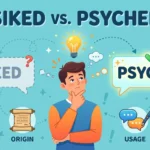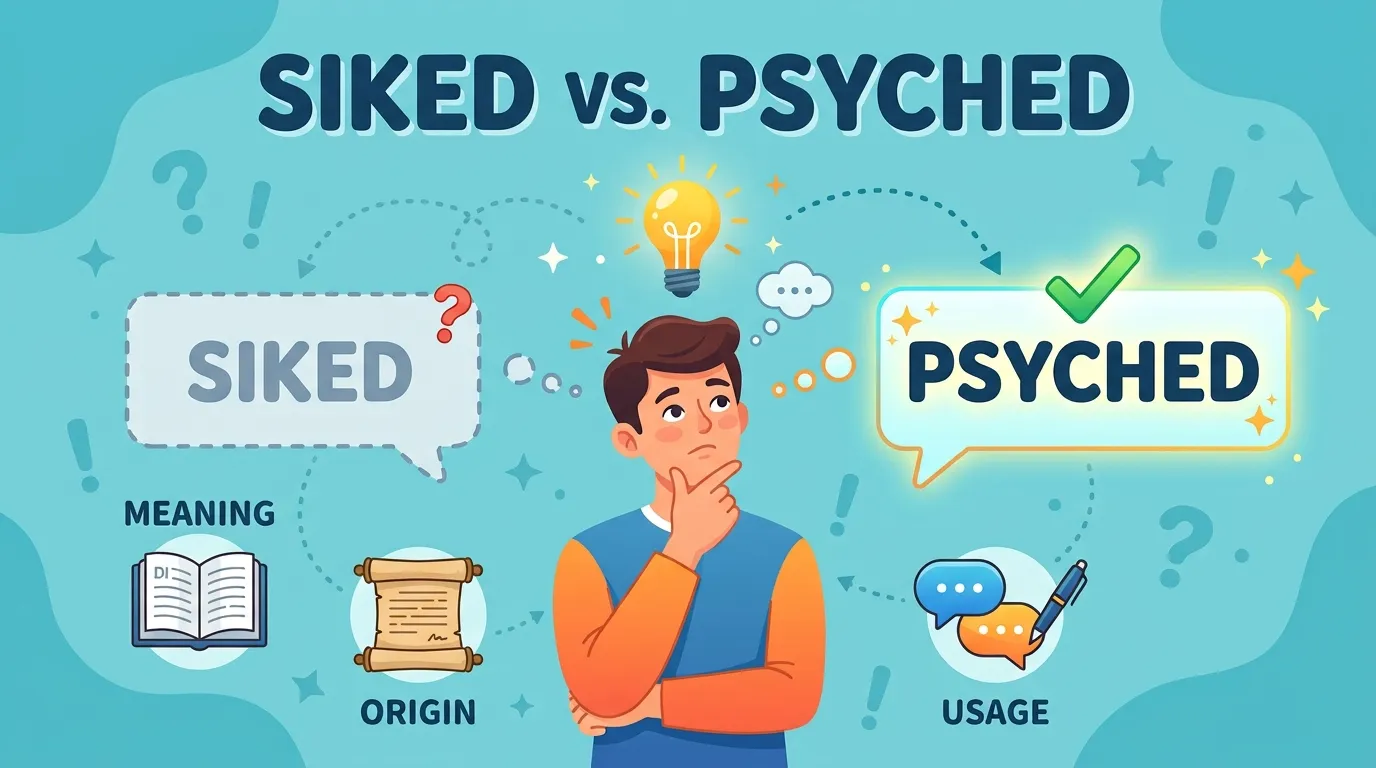
Use “psyched” when you mean excited, eager, or ready for something. “Siked” is not the standard spelling for this meaning.
Imagine your friend tells you that your favorite singer is coming to your city. You are very excited. You text your friend, “I am so siked for the concert!” Your friend may understand you, but the standard spelling is psyched: “I am so psyched for the concert!”
This can feel strange because psyched sounds like “siked.” The first letter p is silent. This is why many people write siked when they hear the word.
The word psyched is an informal adjective. It can mean excited, eager, or mentally ready. Cambridge Dictionary gives psyched as an informal word for “excited.”
People often search for siked or psyched because they are unsure about the spelling. They may see siked in texts, chats, or social media. However, when you mean excited, psyched is the safe standard choice. Siked may appear as a phonetic spelling online or in other word forms, but it is not the standard spelling of psyched.
Pronunciation
Psyched
US: /saɪkt/ UK: /saɪkt/
Siked
When people use siked as a sound-based spelling of “psyched,” they usually mean the same sound: /saɪkt/.
Cambridge Dictionary gives psyched as /saɪkt/.
See more about: https://suitmean.com/jibe-or-jive/
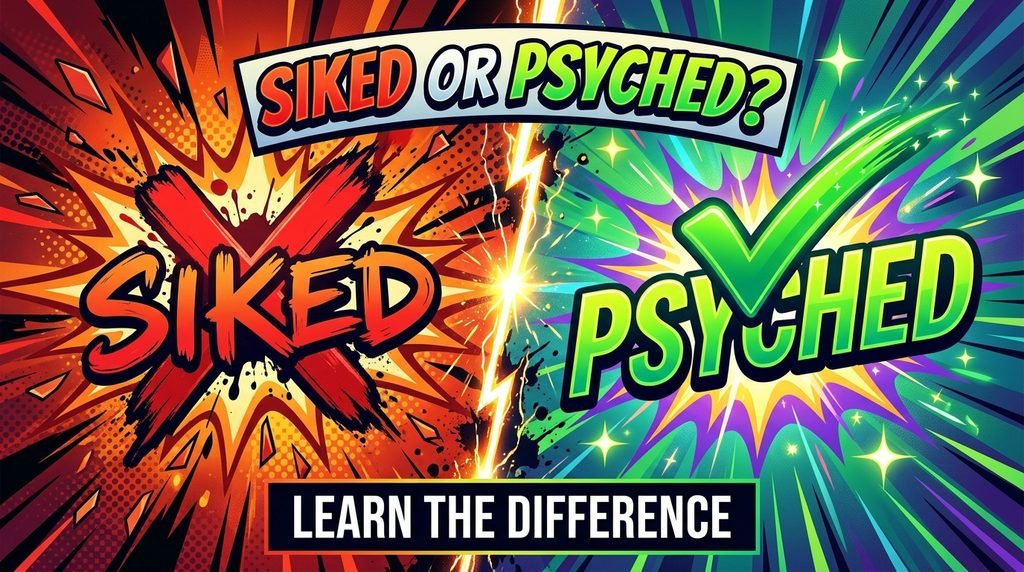
Difference Between Siked and Psyched
1. Standard spelling
Psyched is the standard spelling when you mean excited or mentally ready.
Siked is not the standard spelling for this meaning.
Example 1: I am excited/ psyched for the trip.
Example 2: She is psyched about her new job.
2. Meaning
Psyched can mean excited, eager, or mentally prepared.
Siked does not normally carry this standard meaning.
Example 1: The students were psyched for the school event.
Example 2: He was psyched to play in the final.
3. Sound
The two spellings can look different but sound alike when siked is used as a phonetic spelling.
The strange spelling of psyched causes much of the confusion.
Example 1: I heard “psyched” in the song.
Example 2: She wrote “siked” because that was how the word sounded to her.
4. Silent letter
The p in psyched is silent.
This is common in words that begin with ps.
Example 1: Psychology begins with ps.
Example 2: Psyched also keeps the psych spelling.
5. Word family
Psyched belongs to the psych word family.
Words such as psych, psyche, and psychology have the same historical connection.
Example 1: The coach psyched up the team.
Example 2: She felt psyched before the big test.
6. Formal writing
Psyched is a real English word, but it is informal.
In formal writing, words such as excited, eager, or enthusiastic may sound better.
Example 1: Informal: I am psyched about the event.
Example 2: Formal: I am excited about the event.
7. Text messages
People may write siked in texts because it looks like the sound.
Still, psyched is the standard spelling.
Example 1: I’m psyched for tonight!
Example 2: We’re so psyched to see you!
8. School writing
Students should use psyched if they choose this word in school writing.
Siked can look like a spelling mistake.
Example 1: Correct: The team was psyched for the match.
Example 2: Better for formal school work: The team was excited for the match.
9. Social media
On social media, people may use playful spellings.
You may see siked, but it is often just a sound-based spelling.
Example 1: I’m psyched for the weekend!
Example 2: We are so psyched about the new game!
10. Meaning in a sentence
The easiest test is simple.
If you can replace the word with excited, psyched is usually the right choice.
Example 1: I am psyched for the concert. I am excited for the concert.
Example 2: She is psyched about her trip. She is excited about her trip.
Nature and Behaviour of Siked and Psyched
Nature of Psyched
Psyched is an informal adjective. It describes a person’s feeling or mental state.
It often shows strong excitement.
It can also show that someone is mentally ready for a hard task. Collins gives both “mentally prepared” and “excited” as meanings.
Example: The players were psyched before the game.
Nature of Siked
Siked is not the standard form of psyched when the meaning is “excited.”
It may appear online as a sound-based spelling. Some dictionaries and word sources also record siked in other, unrelated uses connected with sike. Therefore, context matters.
For normal English writing, do not use siked when you mean excited.
Why People Get Confused About Siked and Psyched
The main reason is sound.
Psyched is pronounced /saɪkt/. The p is silent.
So when people hear it, they may think:
“Why is there a p in the spelling?”
They may then write siked because it matches the sound they hear.
English has many words with silent letters. The spelling of psyched also connects it to psych.
A simple memory trick is:
psych → psyched
Think of psych first. Then add -ed.
Comparison Table
| Feature | Siked | Psyched |
|---|---|---|
| Standard spelling | No, not for excitement | Yes |
| Meaning | No standard meaning in this use | Excited or eager |
| Pronunciation | Often meant to sound the same | /saɪkt/ |
| Grammar | Nonstandard spelling | Adjective or verb form |
| Schoolwork | Avoid it for excitement | Correct choice |
| Formal writing | Avoid it | Informal; use with care |
| Text messages | Common spelling mistake | Correct spelling |
| US English | Not standard for excitement | Used, mainly informal |
| UK English | Not standard for excitement | Understood and used |
| Best advice | Do not use it for this meaning | Use it to show excitement |
The Origin of Psyched
The spelling psyched comes from the word psych. The word psych has a long history connected with psychology and the mind. Etymonline records psych as a shortened form connected with psychoanalysis by 1914. Later meanings included “outsmart,” “unnerve,” and mentally prepare someone.
The adjective psyched was first recorded in the mid-20th century. Dictionary.com dates its first recorded use to 1955–60.
The older word family goes back to Greek psychē, linked with ideas such as the soul, spirit, and mind. The same historical family appears in words such as psyche and psychology.
So the spelling is not random.
Think:
psych → psyched
This is why psyched has psy instead of sik.
British vs American English
There is no major spelling change between British and American English for psyched.
Both use:
psyched
The main difference is usage and style.
Cambridge labels psyched as mainly US informal, while Collins also records it in British English as an informal adjective meaning mentally prepared or excited.
American English
I’m psyched for the new work.
British English
I’m psyched about the new project.
The spelling stays the same.
In both forms of English, excited is often a better choice in formal writing.
About “siked”
Do not treat siked as the British spelling of psyched.
It is not like:
color → colour
Instead, psyched is the standard spelling in both major varieties of English.
Which One Should You Use?
Use psyched when you mean excited, eager, or mentally ready.
For US English
I’m psyched for the concert.
This is natural in casual speech and writing.
For UK English
I’m psyched about the match.
This can also be used informally.
For global English
Use psyched if you want this informal meaning.
For formal or international writing, excited, eager, or enthusiastic may be clearer.
Avoid siked when you mean “excited.”
Common Mistakes
Mistake 1
❌ I am siked for the trip.
✅ I am psyched for the trip.
Mistake 2
❌ She is siked about her new job.
✅ She is psyched about her new job.
Mistake 3
❌ We are siked to meet the team.
✅ We are psyched to meet the team.
Mistake 4
❌ He feels siked before the game.
✅ He feels psyched before the game.
Mistake 5
❌ I am very siked about the news.
✅ I am very psyched about the news.
Mistake 6
Using psyched in a very formal sentence.
Better: I am excited to attend the meeting.
Informal: I’m psyched to attend the meeting.
Everyday Usage Examples
In Emails
Casual email: I’m psyched to work with you on this project.
More formal email: I’m excited to work with you on this project.
On Social Media
I’m so psyched for the weekend!
This sounds casual and friendly.
In News
A news story may use psyched when reporting casual speech or a person’s informal words.
In Formal Writing
Use a clearer word such as excited or enthusiastic.
Formal: The students were excited about the science fair.
Informal: The students were psyched about the science fair.
Usage Trends
Psyched is still used in modern English, especially in casual speech, social media, sports, entertainment, and everyday conversation.
Cambridge marks it as informal, and Collins also lists it as informal.
The word is often used with:
- psyched about
- psyched for
- psyched to
- psyched up
Examples:
I’m psyched about the trip.
She’s psyched to start college.
The players were psyched up before the game.
The spelling siked may appear because people write words as they hear them. But it should not replace psyched in standard writing.
Metaphors and Similes
Psyched can be used in creative ways to show strong excitement.
Metaphor
His mind was a firework. He was psyched for the final.
This compares his excitement to fireworks.
Simile
She was as psyched as a child on the first day of summer.
This shows strong excitement.
Another Example
The team was psyched like runners waiting for the starting gun.
The comparison shows energy and readiness.
These are creative uses. They do not change the basic meaning of psyched.
Connotative Meaning
Psyched usually has a positive feeling.
Positive Meaning
It can show joy and excitement.
I’m psyched about my new bike.
Neutral Meaning
It can simply show mental readiness.
The team was psyched for the test.
Negative Meaning
The word itself is usually not negative when it means excited.
However, psych can appear in phrases such as psych someone out, which means to make someone lose confidence or become nervous.
Example: The player tried to psych out his opponent.
So psyched and psych out should not be confused.
Idioms and Proverbs
There is no famous traditional proverb built around psyched.
However, several common expressions use psych.
Psyched up
This means mentally ready or excited.
The players were psyched up before the match.
Psych yourself up
This means to prepare yourself mentally.
I need to psych myself up before the speech.
Psych someone out
This means to make someone nervous or less confident.
The loud crowd tried to psych the player out.
These expressions come from the same psych word family.
Literature and Movies
The word has appeared in books, plays, and movies.
Literature
An early example is the 1914 play Suppressed Desires by George Cram Cook and Susan Glaspell. Historical language research records psyched there in an older sense connected with being psychoanalyzed, not the modern everyday meaning “excited.”
A later children’s fiction example is Psyched! by Dean Hughes, published in 1992. It is part of the Angel Park Soccer Stars series.
Movies
The 2010 American movie The Social Network uses psyched in dialogue. A study of slang in the movie records Mark Zuckerberg using the word while talking about a plan with Eduardo.
The word also appears in movie-related language such as psyched up, where it means mentally ready or excited.
Why This Difference Matters
Knowing the difference helps you write clearly.
If you write siked when you mean psyched, readers may understand you, but they may also see it as a spelling error.
This matters in:
- school work
- emails
- job applications
- websites
- reports
- social media
- business writing
Learning the correct spelling also helps you understand related words.
Psych → psyched
This small link makes the spelling easier to remember.
Good spelling helps people understand your message quickly. It also helps learners build strong English habits.
Usefulness in Daily Life
You may use psyched when talking about:
- a holiday
- a concert
- a sports game
- a new job
- a school event
- a new movie
- a new video game
- a trip
- a party
- a big personal goal
Examples:
I’m psyched for our vacation.
She is psyched about her new school.
We are psyched to see the match.
The children were psyched about the trip.
For formal situations, use excited if you want a more neutral tone.
Situational Preference
Use psyched in casual talks, friendly texts, social media posts, and relaxed conversations. It sounds lively and shows strong excitement. Use excited in school essays, business emails, reports, and other formal writing when you want a simple and neutral word. Avoid siked when you mean excited because it is not the standard spelling for that meaning. If you see sike or siked online, check the context. It may be informal slang or a different word form. The safest rule is simple: psyched for the informal word meaning excited; excited for clear formal writing.
FAQs
Is “siked” a correct spelling of “psyched”?
No. Psyched is the standard spelling when you mean excited or mentally ready.
Does “siked” mean excited?
It may appear online as a sound-based spelling of psyched, but it is not the standard spelling for “excited.”
How do you pronounce “psyched”?
Psyched is pronounced /saɪkt/. The p is silent.
Is “psyched” formal English?
It is a real English word, but it is informal. Excited is often better for formal writing.
Is “psyched” used in British English?
Yes. Collins records psyched in British English as an informal word meaning mentally prepared or excited.
Why does “psyched” have a silent p?
The spelling comes from the psych word family. The historical spelling keeps the ps pattern.
What is the easiest way to remember the spelling?
Remember:
psych → psyched
If you mean excited, choose psyched.
Conclusion
The main difference between siked and psyched is simple. When you mean excited, eager, or mentally ready, use psyched. Siked is not the standard spelling for this meaning.
People often make this mistake because psyched sounds like “siked.” The p is silent, so the spelling can look strange at first. However, the spelling becomes easier when you connect it with psych.
Psyched is an informal English word. It works well in friendly talks, texts, social media, sports, and casual writing. Cambridge and Collins both recognize it as an informal word.
For formal writing, excited, eager, or enthusiastic may be better choices.
Remember the simple rule:
Psych → psyched
So write:
I’m psyched for the concert.
Not:
I’m siked for the concert.
Once you remember the psych connection, this spelling becomes much easier.

I’m Sultan Sikander, an English language specialist, SEO specialist, digital publisher, and researcher. I create clear, accurate, and well-researched content on English grammar, vocabulary, word meanings, and language comparisons, helping readers understand and use English with confidence.