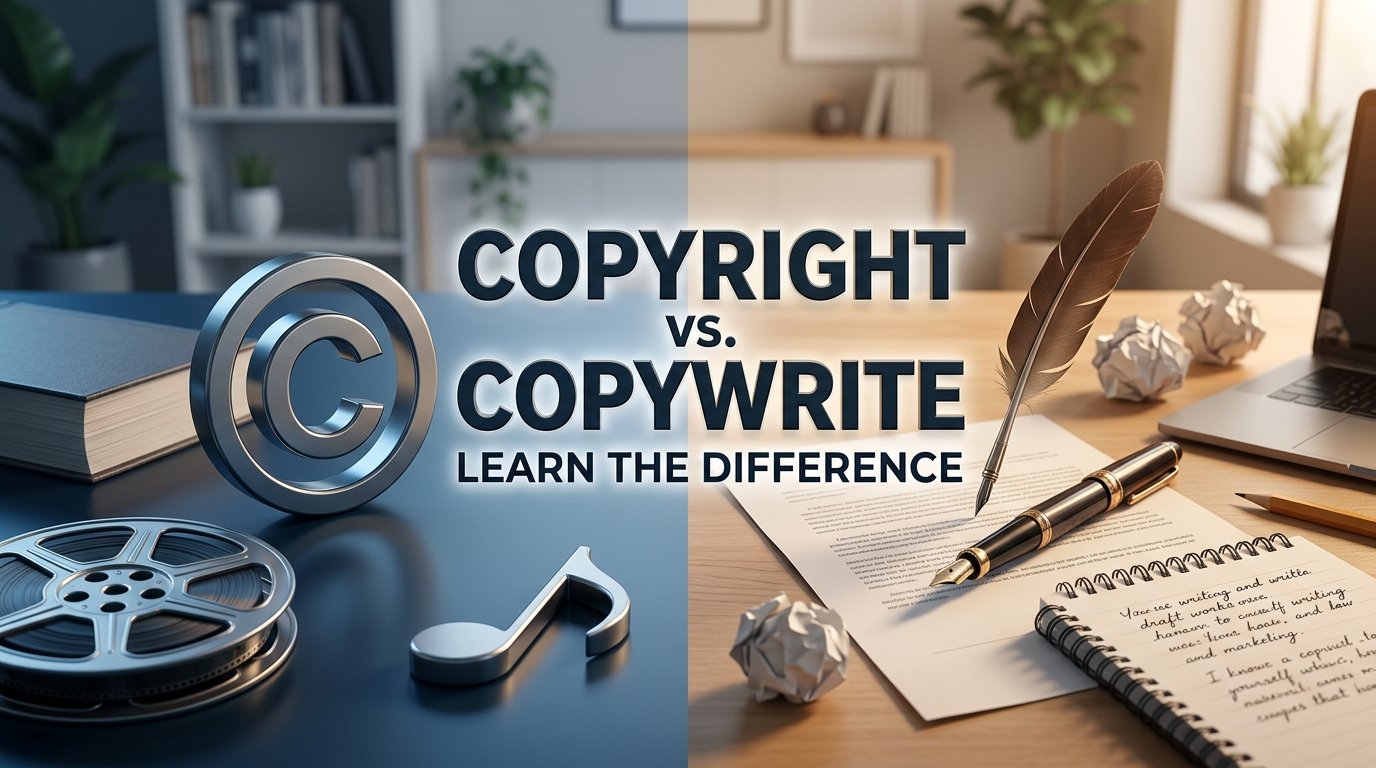
Copyright is the correct word for legal rights over creative work, while copywrite is usually a spelling mistake when people mean those rights.
Imagine a student writes a short story and posts it online. Later, someone copies the story and claims it as their own. The student may want to protect the work. The correct word for this legal protection is copyright. Many people, however, type copywrite because the word contains “copy” and “write.” This creates confusion. Copyright is a legal right that protects original work, such as books, songs, photos, movies, videos, and software. Copywrite is not normally the word you need for this meaning. It is often an incorrect spelling of copyright. People search for copyright or copywrite because the two words look very similar. They may see both forms online and wonder which one is correct. Knowing the difference helps writers, students, bloggers, artists, and business owners spell the words correctly.. It also helps them talk clearly about ownership and creative work.
Pronunciation
- Copyright
- US: /ˈkɑː.pi.raɪt/
- UK: /ˈkɒp.i.raɪt/
- Copywrite
- Usually said like “copy-write” when used as two ordinary words.
copyright (KOP-ee-ryte)
The pronunciation of copyright has three main parts. The stress falls on the first part.
You may know about:https://suitmean.com/discard-or-disgard/
Difference Between Copyright and Copywrite
1. Correct Spelling
Copyright is the standard word for legal protection of creative work.
Copywrite is usually a spelling mistake when someone means copyright.
Examples:
- The photo has copyright protection.
- The book is protected by copyright.
2. Meaning
Copyright refers to legal rights over original creative work.
Copywrite does not normally have this legal meaning.
Examples:
- The artist owns the copyright to the picture.
- The writer registered the copyright for the book.
3. Legal Use
Copyright is a legal term.
Copywrite is not the standard legal term for creative ownership.
Examples:
- The website has a copyright notice.
- The company owns the copyright to its logo design.
4. Creative Work
Copyright can protect many kinds of creative work.
This can include writing, music, art, films, photographs, and software.
Examples:
- The song is protected by copyright.
- The photographer owns the copyright to the image.
5. Use in Writing
Writers often use copyright when talking about their work.
Copywrite should not be used as its replacement.
Examples:
- Please respect the author’s copyright.
- The article has a copyright notice.
6. Use on Websites
Websites often have copyright information.
You may see a copyright notice at the bottom of a page.
Examples:
- © 2026 ABC Media. All rights reserved.
- The website includes a copyright statement.
7. Part of Speech
Copyright can work as a noun or a verb.
Examples:
- The copyright belongs to the author.
- The author copyrighted the work.
Copywrite is not normally used this way to mean legal protection.
8. Business Use
Businesses use copyright to talk about their original content and materials.
Examples:
- The company owns the copyright to its training videos.
- The brand protects its copyrighted images.
9. Spelling Pattern
Copyright combines copy and right.
The word points to a creator’s legal right over a copy or use of creative work.
Examples:
- Remember the ending: -right.
- Do not replace right with write when you mean legal protection.
10. Standard English
Copyright is the accepted word for this legal concept.
Copywrite is commonly seen as an error when used in its place.
Examples:
- Correct: “This image is protected by copyright.”
- Incorrect: “This image is protected by copywrite.”
Nature and Behaviour of Copyright and Copywrite
Nature of Copyright
Copyright is a legal protection. It gives creators certain rights over their original work.
A creator may control how the work is copied, shared, displayed, performed, or used, depending on the law that applies.
Copyright can apply to:
- Books
- Articles
- Music
- Films
- Photographs
- Drawings
- Videos
- Software
Nature of Copywrite
Copywrite is normally not the correct word for legal protection.
People often write it by mistake because copy and write are familiar English words.
There is also a separate phrase, copywriting, which means writing text for advertising or marketing. That is different from copyright.
Why People Get Confused About Copyright and Copywrite
The confusion comes mainly from spelling.
Both words begin with copy. The second part looks similar:
- copyright
- copywrite
Both right and write are common English words. They also sound alike in many accents.
This makes the mistake easy to make.
There is another source of confusion: copywriting is a real word. A copywriter writes advertising or marketing content.
So remember:
Copyright = legal protection
Copywriter = person who writes marketing content
Comparison Table
| Feature | Copyright | Copywrite |
|---|---|---|
| Correct spelling | Correct word | Usually a spelling mistake for copyright |
| Meaning | Legal rights that protect creative work | Writing or creating text, often confused with copywriting |
| Main purpose | Protects original work | Refers to writing content when used informally or incorrectly |
| Word type | Noun and verb | Not the standard word for the legal term |
| Common use | Books, songs, photos, videos, and art | Sometimes used by mistake when discussing writing |
| Legal use | Used in laws and legal documents | Does not mean legal protection |
| Writing use | Refers to ownership and protection of creative work | May be confused with copywriting, which means writing text for ads or marketing |
| Example | This book has copyright protection. | I need to learn copywriting for my business. |
| Similarity | Both contain the word part “copy.” | Both may appear in discussions about written or creative work. |
| Best choice | Use copyright for legal protection. | Use copywriting for writing advertising or marketing content. |
Similarity
Both words contain copy. People use them when they talk about writing or creative work.
Key Difference
The important difference is the ending:
right → copyright
write → usually a spelling error in this context
The Origin of Copyright
The idea of copyright developed as printing made it easier to produce many copies of books.
Modern copyright law grew over several centuries. One important milestone was the Statute of Anne, passed in Britain in 1710. It gave authors a stronger role in controlling the publication of their books.
The word copyright combines copy and right. It describes rights connected with making or using copies of creative work.
Today, copyright laws differ between countries. International agreements also help protect creative works through out world.
British vs American English
There is no normal British-American spelling difference between copyright and copyright.
In British and American English use:
copyright
Examples:
- US: The book is protected by copyright.
- UK: The book is protected by copyright.
The spelling copywrite is not the standard replacement in either variety.
One related word can cause confusion:
- copywriter = a person who writes advertising or marketing text
- copywriting = the work of writing advertising or marketing text
Which One Should You Use?
Use copyright when you mean legal protection for creative work.
For US English, use copyright.
In UK English, use copyright.
For international English, copyright is also the safe choice.
Someone who writes advertisements, use copywriter.
For writing advertising text, use copywriting.
So, in most cases, choose copyright, not copywrite.
Common Mistakes
Here are some common errors:
- ❌ The photo has copywrite protection. ✅ The photo has copyright protection.
- ❌ I own the copywrite of this song. ✅ I own the copyright to this song.
- ❌ This article is copywrited. ✅ This article is copyrighted.
- ❌ She works as a copyright writer. ✅ She works as a copywriter.
- ❌ He studies copywriting law. ✅ He studies copyright law.
Everyday Usage Examples
In Emails
Please make sure we have permission to use this image to avoid copyright issues.
On Social Media
Please do not repost my artwork without permission.
In News
The publisher faced a copyright dispute over the use of the photograph.
In Formal Writing
The author retains the copyright to the original work.
In Business
Our company owns the copyright to this training material.
Usage Trends
Copyright is widely used around the world. It appears in books, websites, software, music, films, education, business, and law.
Copywrite also appears online, but many uses are spelling errors caused by confusion between right and write.
The word copywriting is different. It is common in marketing, advertising, and digital business.
Metaphors and Similes
Copyright itself is a legal idea, but people can explain it with simple comparisons.
Metaphor
Copyright is a shield for creative work.
This means copyright can help protect a creator’s work from certain unauthorized uses.
Simile
Copyright is like a lock on your creative work.
The comparison helps explain the idea of control and protection.
Example
Her copyright worked like a shield for her original artwork.
Connotative Meaning
Positive Meaning
Copyright can suggest:
- Protection
- Ownership
- Creativity
- Fair use of creative work
Example:
Copyright helped the artist protect her original design.
Negative Meaning
In some discussions, copyright may be connected with:
- Disputes
- Claims
- Takedowns
- Legal conflicts
Example:
The company faced a copyright dispute.
Neutral Meaning
In normal writing, copyright can simply describe a legal right.
Example:
The book’s copyright belongs to the publisher.
Idioms and Proverbs
There is no common traditional proverb that directly contrasts copyright and copywrite.
However, some common phrases are closely related to copyright:
“All rights reserved”
This is often seen in copyright notices.
Example:
© 2026 Green Books. All rights reserved.
“Give credit where credit is due”
This common saying is not a copyright rule, but it reminds us to recognize another person’s work.
Example:
Give credit where credit is due when you share someone’s work.
Literature and Movies
Copyright is important in literature because books are creative works.
Many famous writers have had their works published under copyright systems. One example is Great Expectations by Charles Dickens. It was published in 1861.
Copyright also matters in movies. Films are creative works that can have copyright protection.
For example, Toy Story (1995) is a famous movie from the United States. Its story and other creative parts are protected by law.
The exact copyright status of an older work can depend on the country and the specific work.
Why This Difference Matters
Knowing the correct word helps you write clearly.
This matters for students because spelling mistakes can affect school work. It matters for writers because copyright is closely linked to creative work, matters for bloggers because online content can be copied and shared quickly.
It also matters in society. People create books, songs, photos, films, software, and other works. Copyright laws provide a legal framework for certain rights connected to these works.
Using copyright correctly also prevents confusion with copywriting.
A simple rule can help:
Copyright protects creative work.
Copywriting creates marketing text.
Usefulness in Daily Life
You may see copyright when you:
- Post a photograph.
- Write a blog.
- Make a video.
- Create music.
- Publish a book.
- Design artwork.
- Use software.
- Share online content.
- Create educational material.
- Run a website.
Before using someone else’s work, check whether permission, a license, attribution, or another legal basis is needed.
Situational Preference
Use copyright when you are talking about legal rights over creative work. Use it in school essays, business documents, websites, emails, news articles, and formal writing. The same spelling works in both US and UK English. Do not use copywrite as a replacement for copyright. If you are talking about advertising text, use copywriting. If you mean the person who writes that text, use copywriter. This small spelling choice makes your meaning clear and helps you avoid a common English mistake.
Common Questions
Is “copywrite” a correct word?
Usually, no. If you mean legal protection for creative work, the correct word is copyright.
What is the difference between copyright and copywrite?
Copyright is a legal term for rights over creative work. Copywrite is usually a spelling mistake in this context.
Is copyright the same in British and American English?
Yes. Both British and American English use copyright.
Is “copywriting” a real word?
Yes. Copywriting means writing text for advertising or marketing.
What is a copywriter?
A copywriter is someone who writes advertising or marketing text.
How do I remember the correct spelling?
Think of copyright as a right connected with a creative work.
Can a photo have copyright?
Yes. Original photographs can be protected by copyright, subject to the law that applies.
Conclusion
Copyright is the correct word for legal rights to protect creative work. Copywrite is not the correct spelling for this meaning. Use copyright when you talk about protecting books, songs, pictures, or other creative work. Remember the correct word to write clearly and avoid spelling mistakes.

I’m Sultan Sikander, an English language specialist, SEO specialist, digital publisher, and researcher. I create clear, accurate, and well-researched content on English grammar, vocabulary, word meanings, and language comparisons, helping readers understand and use English with confidence.