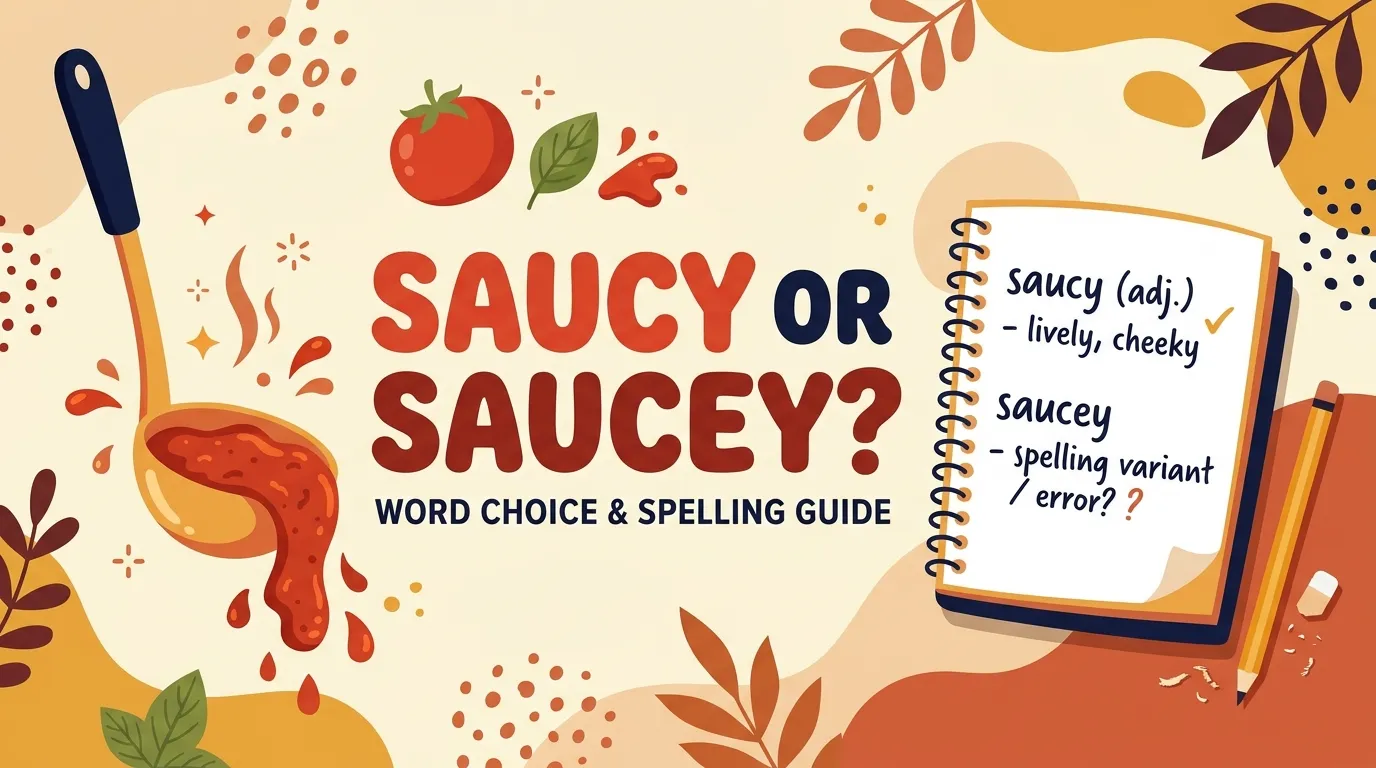
“Saucy” is the standard spelling, while “saucey” is usually a nonstandard spelling or an intentional name.
Imagine you are writing about a plate of pasta. You want to say that the pasta has lots of rich sauce. You type, “The pasta is very saucey.” It looks natural because the word comes from sauce. But there is a small spelling problem. The standard form is saucy.
The word saucy has more than one meaning. It can describe food that has a lot of sauce. It can also describe a person, joke, smile, or comment that is bold, cheeky, or slightly rude. In some contexts, it can also have a playful or mildly sexual meaning.
People search for saucey or saucy because both forms look and sound almost the same. The extra e in saucey seems logical because of the word sauce. However, standard English uses saucy. The form saucey can still appear as an alternative spelling, brand name, username, or creative spelling.
So, if you are writing an essay, email, article, or school assignment, saucy is the safe choice.
Pronunciation
Saucy
- US: /ˈsɔːsi/ or /ˈsɑːsi/, depending on the accent.
- UK: /ˈsɔːsi/
- Two syllables: sau-cy
Saucey
When saucey is used as an alternative spelling of saucy, it is normally pronounced the same way.
The spelling changes, but the sound does not normally change. Cambridge gives US and UK pronunciations for saucy, while Oxford gives /ˈsɔːsi/.
Learn more about: https://suitmean.com/villian-or-villain/

Difference Between Saucey and Saucy
1. Standard spelling
Saucy is the standard spelling in modern English.
Saucey is usually not the spelling you should use in normal writing. It can appear as an alternative form or as a creative name.
Examples:
- She made a saucy joke.
- The chicken is very saucy.
2. Dictionary use
Saucy is listed in major English dictionaries.
It has clear meanings and examples. Saucey is much less common as a standard dictionary form.
Examples:
- The dictionary explains the word saucy.
- I checked the spelling of saucy before writing my essay.
3. Food meaning
Saucy can describe food that has plenty of sauce.
It is common in cooking and food writing.
Examples:
- We ordered saucy chicken wings.
- This pasta is rich and saucy.
4. Personality meaning
Saucy can describe someone who is bold or cheeky.
It may describe a person who speaks in a playful but slightly rude way.
Examples:
- The child gave a saucy answer.
- She has a saucy sense of humor.
5. Meaning of saucey
When people write saucey to mean the adjective, they usually mean saucy.
The extra e often comes from the word sauce.
Examples:
- ❌ He gave a saucey reply.
- ✅ He gave a saucy reply.
6. Formal writing
Use saucy in formal and school writing.
Avoid saucey unless it is a name, brand, title, or deliberate spelling.
Examples:
- The report describes the character as saucy.
- The article uses the word saucy to describe the remark.
7. Informal writing
You may see saucey on social media, in usernames, product names, or creative writing.
This does not make it the normal spelling of the adjective.
Examples:
- The username uses Saucey as a creative name.
- A company may choose Saucey as its brand name.
8. Pronunciation
The two spellings can sound the same when saucey is used as an alternative spelling of saucy.
This makes the confusion stronger.
Examples:
- The word saucy sounds like “SAW-see.”
- A creative spelling such as saucey may keep the same sound.
9. Word formation
Saucy comes from sauce + -y.
English often changes the final spelling when a suffix is added. The final e in sauce does not stay in saucy.
Examples:
- sauce → saucy
- spice → spicy
10. Safe choice
If you are not using a brand or special name, choose saucy.
It works in American English, British English, and other major forms of English.
Examples:
- The food was saucy.
- His answer was saucy.
Nature and Behaviour of Saucey and Saucy
Nature of Saucy
Saucy is an adjective.
It describes a person, action, comment, style, or food. Its meaning depends on the sentence.
For food, it can mean having a lot of sauce.
For people, it can mean cheeky, bold, or slightly rude. It can also describe playful or mildly sexual behavior.
Nature of Saucey
Saucey is mainly seen as an alternative or nonstandard spelling of saucy.
It may also be used as a brand name, username, product name, or creative spelling. One dictionary source records saucey as an alternative form of saucy.
Why People Get Confused About Saucey and Saucy
The confusion is easy to understand.
The word sauce ends in -ce. So, many people think the adjective should be saucey.
But English spelling does not always work by simply adding -y to the full word.
The standard form is:
sauce → saucy
The same kind of spelling change can be seen in words such as:
- spice → spicy
- ice → icy
- juice → juicy
Another reason is sound. Saucy and the alternative spelling saucey can sound the same.
Comparison Table
| Feature | Saucey | Saucy |
|---|---|---|
| Standard spelling | No | Yes |
| Part of speech | Usually a name or misspelling | Adjective |
| Food meaning | Not standard | Has plenty of sauce |
| Person meaning | Not standard | Cheeky or bold |
| Formal writing | Avoid as an adjective | Correct |
| US English | Nonstandard | Correct |
| UK English | Nonstandard | Correct |
| Pronunciation | Usually the same | Standard pronunciation |
| Recipe use | Avoid | Common |
| Schoolwork | Avoid as an adjective | Use this spelling |
The Origin of Saucey and Saucy
The standard word saucy comes from sauce + -y. Its early meaning was linked to food that was like sauce or flavored with sauce. Later, its meaning changed and expanded. By the 1520s, it could describe people, words, or actions that were bold, cheeky, or impertinent.
The word saucy is recorded from around the early 1500s.
The figurative meaning makes sense. Sauce can add extra taste or strength to food. In a similar way, a saucy comment adds extra boldness to speech.
The spelling saucey has also appeared as an alternative form. Historical examples show that it has sometimes been used in printed English.
British vs American English
There is no normal British-versus-American spelling difference here.
Both varieties use:
saucy
British English
- She gave a saucy smile.
- The chicken was very saucy.
American English
- She gave a saucy smile.
- The chicken was very saucy.
The pronunciation can differ slightly between American and British accents. Cambridge gives /ˈsɑːsi/ for one US pronunciation and /ˈsɔːsi/ for UK English.
This is not like colour/color or centre/center.
There is no standard rule saying:
- British = saucey
- American = saucy
That is not correct.
Which One Should You Use?
For US English
Use saucy.
Example:
The restaurant serves saucy chicken.
For UK English
Use saucy.
Example:
The restaurant serves saucy chicken.
For global English
Use saucy when you mean the normal English adjective.
If you see Saucey as a company, product, username, or other name, keep its original spelling.
Common Mistakes
Mistake 1
❌ The pasta is saucey.
✅ The pasta is saucy.
Mistake 2
❌ He gave a saucey answer.
✅ He gave a saucy answer.
Mistake 3
❌ She has a saucey smile.
✅ She has a saucy smile.
Mistake 4
❌ That was a saucey joke.
✅ That was a saucy joke.
Mistake 5
❌ The wings are extra saucey.
✅ The wings are extra saucy.
Everyday Usage Examples
In Emails
The meal was tasty and very saucy.
On Social Media
These noodles are so saucy!
In News Writing
The actor made a saucy comment during the interview.
In Formal Writing
The writer uses saucy humor to make the character seem bold.
In Food Writing
The restaurant is known for its saucy chicken wings.
In Daily Speech
That was a saucy reply!
Usage Trends
The standard form saucy remains the normal spelling in English.
The alternative saucey appears from time to time. It can be found in informal writing, creative names, usernames, and some older printed examples.
Online writing can make spelling confusion stronger. People often create new spellings for usernames, brands, jokes, or social media posts.
So, seeing saucey online does not mean it has replaced saucy.
For essays, work emails, websites, school work, and other standard writing, saucy remains the safer choice.
Metaphors and Similes
The word saucy can create fun comparisons.
Metaphor
Her reply was a saucy spark in a quiet meeting.
This means her reply was bold and lively.
Simile
His answer was as saucy as hot pepper sauce.
This means his answer was very bold or cheeky.
Food Metaphor
The pasta was a saucy little adventure.
This gives the food a fun and lively feeling.
Connotative Meaning
The meaning of saucy can change with the situation.
Positive Meaning
It can mean playful, lively, or charming.
She gave a saucy smile.
Here, the word can sound playful.
Negative Meaning
It can mean rude or disrespectful.
The student gave a saucy answer.
Here, the word may suggest poor manners.
Neutral Meaning
It can simply describe food.
The noodles are very saucy.
Here, there is no rude meaning.
The context tells the reader which meaning is intended.
Idioms and Proverbs
There is no major common English proverb built around saucy.
However, the word can appear in playful expressions.
Saucy remark
He made a saucy remark during dinner.
This means a bold or slightly rude comment.
Saucy smile
She gave him a saucy smile.
This suggests a playful or cheeky smile.
Saucy joke
The comedian told a saucy joke.
This may mean the joke was slightly rude or sexual but playful.
Literature and Movies
Literature
The word saucy has a long history in English literature.
William Shakespeare uses the word in Othello, a tragedy written around 1603–1604. Roderigo speaks of doing “bold and saucy wrongs,” where saucy has the older sense of bold or insolent.
This shows that saucy has been used as a figurative word for centuries.
Movies
The word also appears in modern film language.
For example, Love Actually (2003), a British-American romantic comedy, includes the phrase “saucy minx” in dialogue. The word is used in a playful way to describe someone as bold and cheeky.
The word can also appear in movie reviews and descriptions when writers describe a character, joke, scene, or style as saucy.
Why This Difference Matters
Small spelling choices can change the quality of writing.
If you use saucy correctly, your readers can understand your meaning at once.
This matters for students because spelling errors can make school work look less clear.
It matters for workers because emails, reports, and documents should use standard English.
It also matters for society because clear language helps people share ideas. When a word has two similar spellings, knowing the standard form can reduce confusion.
The key lesson is simple:
Use saucy for the normal English adjective.
Do not change it to saucey just because it comes from sauce.
Usefulness in Daily Life
You may use saucy when talking about:
- food
- cooking
- jokes
- comments
- smiles
- people
- characters
- movies
- books
- social situations
For food:
I want a saucy burger.
For a person:
The child gave a saucy answer.
For humor:
That was a saucy joke.
For writing:
The character has a saucy personality.
Knowing the correct spelling helps you write these sentences with confidence.
Situational Preference
Use saucy in almost every normal situation. Apply it in school work, emails, articles, reports, social posts, and everyday writing. Use it for food when you mean “full of sauce.” Use it for a person or comment when you mean “cheeky,” “bold,” or “slightly rude.” Utilize Saucey only when it is a real name, brand, username, title, or intentional creative spelling. Do not use saucey simply because the word comes from sauce. If you are unsure, choose saucy. It is the standard form in both British and American English.
Common Questions
Is saucey a correct English word?
Saucy is the standard spelling. Saucey can appear as an alternative spelling or intentional name, but it is not the normal choice for standard writing.
Is saucy British or American?
It is used in both British and American English.
What does saucy mean?
It can mean full of sauce. It can also mean cheeky, bold, playful, or slightly rude.
Is saucy a bad word?
No. It is a normal English adjective. Its meaning depends on the context.
Why do people spell saucy as saucey?
The confusion often comes from the word sauce. People may think the final e should remain before -y.
Is saucey pronounced differently from saucy?
When saucey is used as an alternative spelling of saucy, it is normally pronounced the same way.
Should I use saucey in an essay?
No. Use saucy in an essay unless Saucey is a specific name or title that must keep that spelling.
Conclusion
The main difference between saucey and saucy is spelling and standard usage. Saucy is the normal English spelling. Saucey may appear as an alternative form, creative spelling, or name, but it is not the safest choice for normal writing. The word saucy has several meanings. It can describe food that has plenty of sauce. It can also describe a person, smile, joke, or comment that is bold, cheeky, or slightly rude. In some contexts, it can have a playful or mildly sexual meaning. The word has a long history. It comes from sauce + -y and has been used in English since around the early 1500s. Shakespeare also used saucy in Othello.
Remember one simple rule:
Sauce → saucy
So, write: The pasta is saucy.
And: He gave a saucy reply.
If you are writing for school, work, a website, or formal communication, saucy is the spelling to choose.

I’m Sultan Sikander, an English language specialist, SEO specialist, digital publisher, and researcher. I create clear, accurate, and well-researched content on English grammar, vocabulary, word meanings, and language comparisons, helping readers understand and use English with confidence.