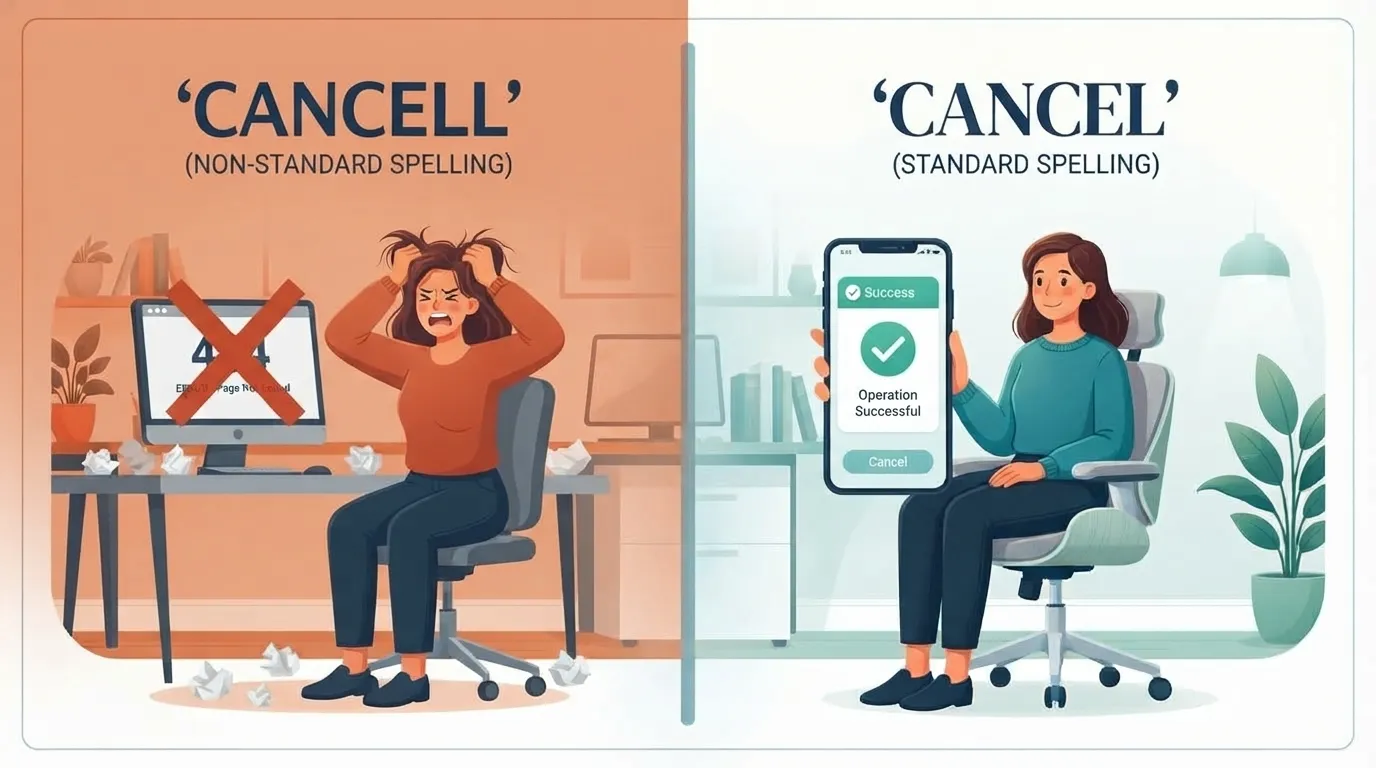
“Cancel” is the correct spelling in modern English. “Cancell” is not normally used as an English word.
Imagine you are planning a birthday party. You have already sent invitations, ordered a cake, and booked a hall. But then something unexpected happens. You need to call the hall and cancel the booking. Now, suppose you are writing a message and wonder, “Should I write cancell or cancel?” This is a common spelling question for English learners. Many people add an extra “l” because some English words use double consonants.
The confusion becomes greater when people see related words such as “cancelled” and “cancellation.” These words do contain double letters in some forms, which makes cancell or cancel a popular search query. In this article, we will explain the difference between cancell or cancel in simple English. You will learn the correct spelling, pronunciation, grammar rules, British and American usage, common mistakes, and everyday examples. By the end, you will know exactly when to use cancel and why cancell is usually incorrect.
Pronunciation
Cancel
- US pronunciation: /ˈkæn.səl/
- UK pronunciation: /ˈkæn.səl/
Cancell
“Cancell” is not a standard modern English spelling. Therefore, it does not have a normal dictionary pronunciation as an English word.
If someone writes “cancell” by mistake, they usually intend to pronounce it like “cancel.”
Read more about: https://suitmean.com/sitted-or-seated/
Difference Between Cancell or Cancel
1. Correct Spelling
Cancel is the correct spelling in modern English.
Cancell is generally considered a misspelling.
Examples:
- Please cancel my appointment.
- I need to cancel the order.
2. Dictionary Status
Cancel appears in standard English dictionaries.
Cancell does not normally appear as a standard modern English verb.
Examples:
- The dictionary lists the verb “cancel.”
- “Cancell” is usually marked as incorrect in spelling checks.
3. Meaning
Cancel means to stop something that was planned or arranged.
Cancell has no separate meaning in standard English.
Examples:
- We had to cancel the meeting.
- She decided to cancel her trip.
4. Part of Speech
Cancel is mainly used as a verb.
It can also appear in related forms such as “cancellation” and “canceled.”
Cancell is not normally used as a standard English part of speech.
Examples:
- They will cancel the event.
- The cancellation surprised everyone.
5. Spelling Rule
The word cancel ends with one “l” in its basic form.
The word cancell incorrectly adds an extra “l.”
Examples:
- Correct: Cancel the subscription.
- Incorrect: Cancell the subscription.
6. American English Usage
American English usually uses “cancel” as the base form.
It also commonly uses “canceled” with one “l.”
Examples:
- The airline canceled the flight.
- Please cancel my reservation.
7. British English Usage
British English also uses “cancel” as the base form.
However, British English usually doubles the final “l” in forms such as “cancelled.”
Examples:
- The school cancelled the class.
- We had to cancel our plans.
8. Grammar
“Cancel” can be used with different verb forms.
Examples include:
- Cancel
- Cancels
- Canceled or Cancelled
- Canceling or Cancelling
“Cancell” is not the correct base form.
Examples:
- I cancel my order.
- She cancels her appointment.
9. Formal Writing
In formal writing, cancel is the correct word.
“Cancell” should not be used in emails, reports, applications, or official documents.
Examples:
- Please cancel the scheduled meeting.
- The company decided to cancel the contract.
10. Common Search Confusion
People often search for cancell or cancel because they confuse the base word with its other forms.
The double “l” appears in British forms such as “cancelled” and “cancelling.”
Examples:
- Correct base form: cancel
- British past form: cancelled
Nature and Behaviour of Cancell or Cancel
Nature and Behaviour of Cancel
The word “cancel” is an action word. It describes stopping something before it happens or ending something that already exists.
It can be used for:
- Meetings
- Flights
- Orders
- Events
- Subscriptions
- Plans
Examples:
- I need to cancel my appointment.
- They canceled the concert because of rain.
Nature and Behaviour of Cancell
“Cancell” does not have a standard meaning in modern English.
It is usually a spelling error caused by adding an extra “l.”
Writers should avoid using it in normal English communication.
Why People Get Confused About Cancell or Cancel
The main reason for confusion is the difference between the base form and its related words.
The correct base form is “cancel.”
But when we add endings, spelling can change:
- Cancel → canceled (American English)
- Cancel → cancelled (British English)
- Cancel → canceling (American English)
- Cancel → cancelling (British English)
Because learners see double “l” in some forms, they may incorrectly write “cancell” as the base word.
The important rule is simple:
Always use “cancel” as the basic verb.
Comparison Table
| Feature | Cancel | Cancell |
| Correct English Word | Yes | No, usually incorrect |
| Meaning | Stop something planned | No standard meaning |
| Part of Speech | Verb | Not standard |
| Base Form | Correct | Incorrect |
| US English | Cancel | Not used |
| UK English | Cancel | Not used |
| Related Forms | Canceled, cancelling | No standard forms |
| Formal Writing | Correct | Incorrect |
| Dictionary Entry | Yes | Usually no |
| Everyday Use | Very common | Spelling mistake |
Similarities
There are very few similarities between these two spellings.
Both may appear in searches about stopping plans or events. However, only “cancel” is correct in standard English.
The Origin of Cancel
The word cancel has a long history.
It comes from the Latin word “cancellare,” which means to cross out or make something invalid. The word later entered Old French and Middle English.
In English, “cancel” developed the meaning of removing, stopping, or ending something.
Over time, it became a common verb used in everyday life.
Examples:
- Cancel a ticket.
- Cancel a meeting.
- Cancel an order.
The spelling “cancell” is not the traditional English form of the word.
British vs American English
The base form is the same in both British and American English.
FormAmerican EnglishBritish EnglishBase VerbCancelCancelPast TenseCanceledCancelled-ing FormCancelingCancellingNounCancellationCancellation
Examples
American English:
- The flight was canceled.
- She is canceling her membership.
British English:
- The flight was cancelled.
- She is cancelling her membership.
The main difference is usually the extra “l” in some British spellings.
Which One Should You Use?
Use cancel in all forms of standard English when you need the basic verb.
In American English:
- Cancel
- Canceled
- Canceling
For British English:
- Cancel
- Cancelled
- Cancelling
For global English, “cancel” is the safest and most widely understood base form.
Never use “cancell” in normal English writing.
Common Mistakes
Mistake 1: Adding an Extra L
Incorrect: I want to cancell my order.
Correct: I want to cancel my order.
Mistake 2: Using British Spelling as the Base Form
Incorrect: Please cancell the meeting.
Correct: Please cancel the meeting.
Mistake 3: Confusing Cancel with Cancellation
Incorrect: We need to cancellation the event.
Correct: We need to cancel the event.
Mistake 4: Incorrect American Spelling
Incorrect in standard American English: The flight was cancelled.
Correct American English: The flight was canceled.
However, “cancelled” is correct in British English.
Everyday Usage Examples
In Emails
- Please cancel my appointment scheduled for Monday.
- I am writing to request cancellation of my order.
On Social Media
- The concert has been canceled due to bad weather.
- I had to cancel my weekend plans.
In News
- The airline canceled several flights.
- The event was cancelled after heavy rain.
In Formal Writing
- Customers may cancel their subscription at any time.
- The organization decided to cancel the program.
Usage Trends
“Cancel” is one of the most common verbs in modern English.
It appears frequently in:
- Business emails
- Online shopping
- Travel websites
- Social media
- News reports
- Customer service messages
The spelling “cancell” is not widely accepted in standard English.
Most spelling tools, dictionaries, and grammar checkers will identify “cancell” as an error.
The confusion mainly happens because British English doubles the final “l” in some forms of the verb.
Metaphors and Similes
The word “cancel” can sometimes be used in figurative language.
Cancel Out
This means to balance or remove the effect of something.
Example:
- The two opposite forces canceled each other out.
Cancel a Debt
This means to remove or forgive a debt.
Example:
- The charity helped cancel the family’s debt.
Figurative Example
- Her kindness canceled out the sadness of the day.
The word “cancell” has no common metaphorical use.
Connotative Meaning
Negative Meaning
“Cancel” can sometimes suggest disappointment or loss.
Example:
- The canceled trip made the children sad.
Positive Meaning
Canceling something can also bring relief.
Example:
- I canceled my stressful appointment and felt better.
Neutral Meaning
In many situations, “cancel” is simply a practical action.
Example:
- Please cancel the booking before Friday.
The emotional meaning depends on the situation.
Idioms and Proverbs
There are no famous proverbs specifically about the word “cancell.”
However, “cancel” appears in common expressions.
Cancel Out
Meaning: To balance or remove an effect.
Example:
- The extra cost canceled out the savings.
Cancel Culture
Meaning: A modern social term for publicly rejecting or avoiding a person, company, or organization because of their actions or opinions.
Example:
- The actor faced cancel culture after making controversial comments.
Cancel a Debt
Meaning: To forgive or remove money that someone owes.
Example:
- The government agreed to cancel part of the debt.
Literature and Movies
Literature
The word “cancel” appears in many types of literature, including fiction, drama, journalism, and business writing.
It is especially common in modern novels and stories about daily life, travel, and relationships.
One famous literary work connected to the idea of stopping or ending plans is The Cancellation of the Future, a contemporary theme found in science fiction and social fiction writing.
The word itself is widely used across English literature.
Movies
The word “cancel” is common in modern movie dialogue and titles related to relationships, plans, and social issues.
Examples include films and documentaries discussing “cancel culture,” a major social topic in the 2020s.
Unlike some words with famous literary origins, “cancel” is mainly important because of its everyday use in modern communication.
Why This Difference Matters
Knowing the difference between “cancell” and “cancel” matters because correct spelling helps people understand your message.
For students, it improves spelling and grammar skills.
English learners, it builds confidence in writing.
Others like professionals, correct spelling creates a good impression in emails, reports, and official documents.
A small spelling mistake can make writing look careless. Using “cancel” correctly helps your communication remain clear and professional.
Usefulness in Daily Life
You use the word “cancel” in many everyday situations.
For example:
- Cancel a doctor’s appointment.
- Cancel a food order.
- Cancel a hotel booking.
- Cancel a subscription.
- Cancel a meeting.
- Cancel a flight.
Knowing the correct spelling helps you communicate quickly and clearly.
It is especially useful when dealing with companies, websites, schools, banks, and travel services.
Situational Preference
Use cancel whenever you want to stop a plan, event, booking, order, or activity. It is correct in both American and British English as the base form. In American English, use “canceled” and “canceling” for related forms. In British English, use “cancelled” and “cancelling.” Never use “cancell” in formal or informal writing. If you are unsure, remember that the word ends with one “l” in its basic form. This simple rule works in emails, school assignments, business writing, social media, and everyday conversations.
Questions To Asked,
1. Is cancell a correct English word?
No. “Cancell” is generally not a standard English word. The correct spelling is “cancel.”
2. What is the correct spelling: cancell or cancel?
The correct spelling is “cancel.”
3. Why do people write cancell?
People often confuse “cancel” with related forms such as “cancelled” and “cancelling.”
4. Is cancel American or British English?
“Cancel” is used in both American and British English.
5. Is cancelled correct?
Yes. “Cancelled” is the standard British English spelling.
6. Is canceled correct?
Yes. “Canceled” is the standard American English spelling.
7. How can I remember the correct spelling?
Remember this rule: The basic verb is always “cancel” with one “l.”
Conclusion
The difference between cancell or cancel is easy to understand. “Cancel” is the correct spelling and is used in standard English around the world. “Cancell” is usually a spelling mistake. The word cancel means to stop something that was planned, arranged, or scheduled. You can cancel a meeting, flight, order, appointment, or subscription. Both American and British English use “cancel” as the basic verb. The main spelling difference appears in related forms. American English uses “canceled” and “canceling,” while British English uses “cancelled” and “cancelling.” Remembering this rule can help you avoid common spelling errors. If you are ever unsure about the word cancell or cancel, choose “cancel.” Correct spelling makes your writing clear and professional. It also helps students, English learners, and professionals communicate with confidence. So, the final answer is simple: Cancel is correct. Cancell is incorrect in standard modern English.

I’m Sultan Sikander, an English language specialist, SEO specialist, digital publisher, and researcher. I create clear, accurate, and well-researched content on English grammar, vocabulary, word meanings, and language comparisons, helping readers understand and use English with confidence.







1 thought on “Cancell or Cancel: The Easy Guide to Correct English Spelling”