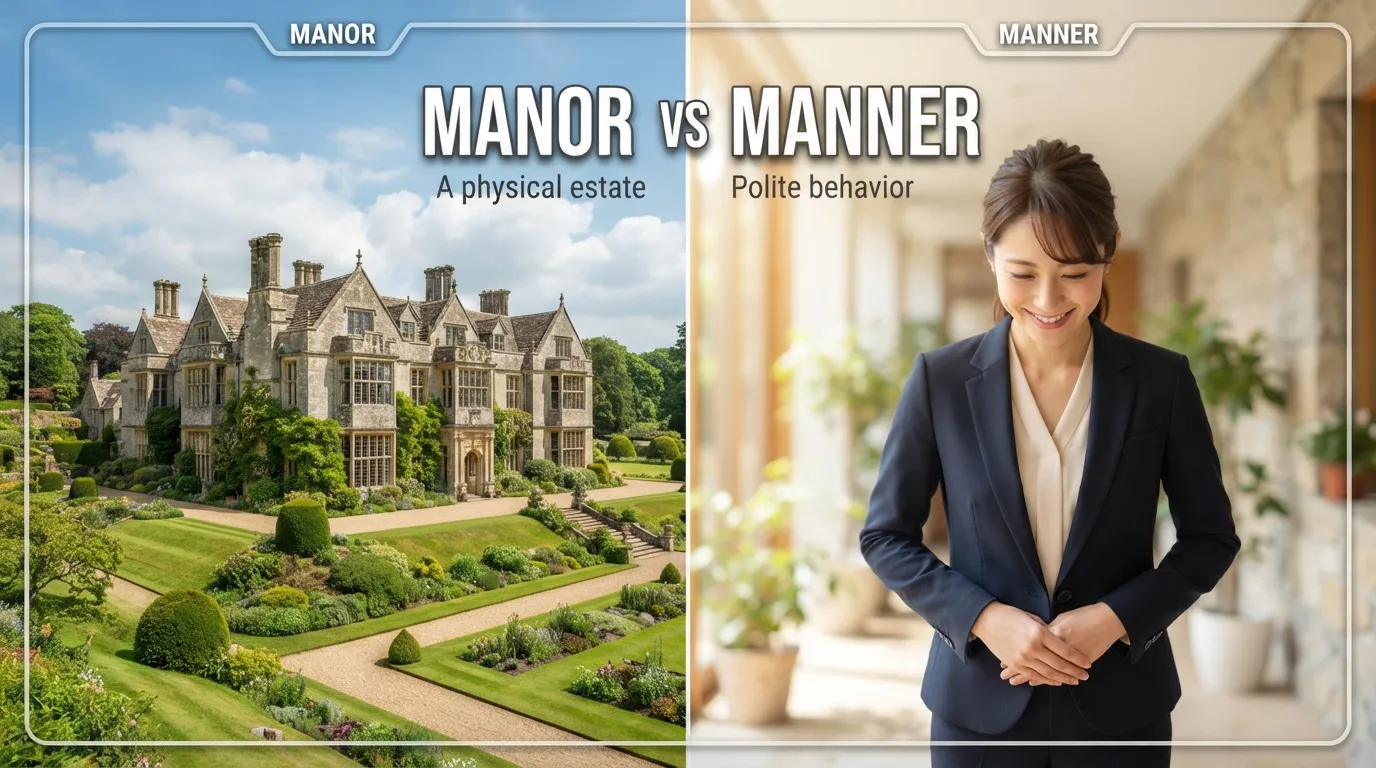
A manor is a large house or estate, while a manner means the way something is done or a person’s behavior.
Have you ever typed a word and stopped to ask, “Is it manor or manner?” You are not alone. These two words sound almost the same, but they have very different meanings. Imagine reading a story about a beautiful old manor in England. It may have large gardens, tall walls, and many rooms. Now imagine someone saying, “She spoke in a polite manner.” Here, the word describes how she spoke.
These two words are similar therefore confuse the learners. However, their meanings and uses are completely different. Knowing the difference between manor or manner helps you write better sentences and avoid common spelling mistakes. When you write an email, school work, or a social media post, use the right word. In this guide, we will explain manor or manner in simple English with examples, comparisons, and useful tips.
Pronunciation
Manor
- US pronunciation: /ˈmænər/
- UK pronunciation: /ˈmænə/
Manner
- US pronunciation: /ˈmænər/
- UK pronunciation: /ˈmænə/
In British and American English, both words sound the same. This can be confusing.
Read the related guidehttps://suitmean.com/sitted-or-seated/
A Simple Linking Hook
Both words sound similar. Now we can learn their meanings and uses clearly.
Difference Between Manor or Manner
1. Basic Meaning
The first major difference is their meaning.
Manor means a large country house, often with land around it. It was once the home of a wealthy family.
Examples:
- The old manor stood on a green hill.
- We visited a beautiful manor in the countryside.
Manner means the way a person does something or behaves.
Examples:
- He answered the question in a polite manner.
- Her calm manner made everyone feel comfortable.
2. Part of Speech
Both words are usually used as nouns.
Manor is a noun. It names a large house or building.
Examples:
- The manor has a large garden.
- The historic manor attracts many visitors.
Manner is a noun. It means how a person acts or does something.
Examples:
- His manner was friendly.
- She completed the task in a careful manner.
3. Meaning Related to Buildings
Manor is connected with buildings and property.
It often refers to a large house in the countryside.
Examples:
- The royal family lived in a grand manor.
- The manor was built hundreds of years ago.
Manner has nothing to do with buildings.
Examples:
- She has a gentle manner.
- His manner of speaking is clear.
4. Meaning Related to Behavior
Manner is commonly used to describe behavior.
It tells us how someone acts.
Examples:
- The teacher spoke in a kind manner.
- His rude manner upset his friends.
Manor cannot describe behavior.
Incorrect: She has a beautiful manor.
Correct: She has a beautiful manner.
5. Use in History
The word manor is often found in history books.
In medieval England, a manor was a large estate owned by a lord or wealthy landowner.
Examples:
- The lord managed his manor carefully.
- Many workers lived near the medieval manor.
Manner is not connected to medieval estates.
Examples:
- The knight behaved in a brave manner.
- The king spoke in a respectful manner.
6. Use in Everyday English
Manner is common in daily conversations and writing.
Examples:
- Please speak in a polite manner.
- She handled the problem in a professional manner.
Manor is less common in everyday speech.
Mostly used when talking about historic homes, estates etc.
Examples:
- The manor is now open to tourists.
- They bought an old manor house.
7. Word Associations
The word manor is associated with:
- House
- Estate
- Land
- Property
- History
Examples:
- The manor had beautiful gardens.
- The estate included a large manor.
The word manner is associated with:
- Behavior
- Style
- Way
- Attitude
- Actions
Examples:
- His manner was polite.
- She completed the work in a professional manner.
8. Common Expressions
Manor appears in expressions related to houses and estates.
Examples:
- Manor house
- Country manor
- Historic manor
Sentences:
- The manor house was surrounded by trees.
- They stayed at a country manor.
Manner appears in many common phrases.
Examples:
- In a polite manner
- In a similar manner
- In this manner
Sentences:
- Please behave in a respectful manner.
- The machine works in a similar manner.
9. Meaning in Formal Writing
Manner is often used in formal English.
It helps describe how something happens.
Examples:
- The report was prepared in a professional manner.
- The issue should be handled in a careful manner.
Manor is used in descriptive, historical, or property-related writing.
Examples:
- The manor dates back to the 16th century.
- The historic manor was restored last year.
10. Spelling Difference
The spelling is a little different. It is important.
Manor has one “n” after “ma.”
Manner has two “n”s.
Examples:
- Manor = A large house or estate.
- Manner = A way of behaving or doing something.
A simple memory trick is:
Manor = Mansion-like house
Manner = Method or behavior
Nature and Behaviour of Manor or Manner
Nature and Behaviour of Manor
A manor is a physical place. It can be seen, visited, owned, or described. It often has historical value.
Manors may include:
- Large houses
- Gardens
- Farms
- Land
- Old buildings
Example:
- The ancient manor attracts tourists every year.
The word manor often creates an image of history, wealth, and the countryside.
Nature and Behaviour of Manner
Manner is an abstract idea. It describes how people behave or how actions happen.
It cannot be touched or seen like a building. We can see a person’s manner in how they act and speak.
Examples:
- Her friendly manner made new students feel welcome.
- His careless manner caused problems.
Manner can be polite, rude, calm, serious, friendly, or professional.
Why People Get Confused About Manor or Manner
People often mix up these words. They sound the same. Their spelling looks almost the same.
Both words start with “man” and look almost the same. When people hear them, they may not know which word is being used.
For example:
- “The old manor was beautiful.”
- “She spoke in a polite manner.”
The pronunciation is nearly identical, but the meanings are completely different.
The best way to avoid confusion is to understand the context. Ask yourself:
- Am I talking about a building or place? Use manor.
- Am I talking about behavior or a way of doing something? Use manner.
Comparison Table
| Feature | Manor | Manner |
| Meaning | A large house or estate | A way of doing something or behaving |
| Type | Noun | Noun |
| Related To | Buildings and land | Behavior and actions |
| Common Use | Historical and property writing | Everyday and formal writing |
| Example | The manor was very old. | He spoke in a polite manner. |
| Pronunciation | /ˈmænər/ | /ˈmænər/ |
| Spelling | One “n” after “ma” | Double “n” |
| Similarity | Both sound almost the same | Both sound almost the same |
Similarities Between Manor and Manner
Although their meanings differ, they share some features:
- Both are nouns.
- Both begin with “man.”
- Both have similar pronunciation.
- Both can appear in formal writing.
- Both are commonly confused by English learners.
The Origin of Manor
The word manor comes from Old French and Latin roots. It is related to the idea of a dwelling place or estate.
In medieval times, a manor was an important place in English society. A lord or wealthy landowner often owned a manor. The land included farms, houses, and workers.
The manor system played an important role in medieval Europe. People lived and worked on large estates under the control of landowners.
Today, manor usually means a large old house or a nice country home.
Example:
- The old manor reminds visitors of medieval England.
The Origin of Manner
The word manner also has historical roots. It comes from Old French and Latin words connected with the meaning of “way” or “method.”
Over time, manner became a common English word used to describe behavior, style, and actions.
Today, it is used in many situations.
Examples:
- He spoke in a friendly manner.
- The work was completed in a professional manner.
The word has remained useful in both everyday and formal English.
British vs American English
There is almost no difference in spelling between British and American English for these two words.
Manor in British English
In British English, manor often refers to a historic country house or estate.
Example:
- The family lives in an old English manor.
Manor in American English
American English also uses manor to describe large homes, estates, or historic properties.
Example:
- The historic manor attracts visitors every summer.
Manner in Both Varieties
The word manner has the same spelling and meaning in both British and American English.
Examples:
- She spoke in a polite manner.
- He handled the situation in a professional manner.
The main difference is not regional. It is the meaning and context.
Which One Should You Use?
Use manor when talking about:
- A large house
- A country estate
- Historical property
- Land owned by a wealthy family
Use manner when talking about:
- Behavior
- Actions
- Style
- Method
- The way something happens
For US, UK, and global English, the rules are the same.
Quick Tip
If you can replace the word with “house” or “estate,” use manor.
If you can replace it with “way” or “behavior,” use manner.
Common Mistakes
Mistake 1: Using Manor for Behavior
Incorrect:
- He has a polite manor.
Correct:
- He has a polite manner.
Mistake 2: Using Manner for a House
Incorrect:
- The old manner was built in 1700.
Correct:
- The old manor was built in 1700.
Mistake 3: Confusing “Manor House” and “Manner”
Correct:
- They visited a beautiful manor house.
Incorrect:
- They visited a beautiful manner house.
Mistake 4: Spelling Manner with One “n”
Incorrect:
- She behaved in a polite maner.
Correct:
- She behaved in a polite manner.
Mistake 5: Spelling Manor with Double “n”
Incorrect:
- The historic manner is open to visitors.
Correct:
- The historic manor is open to visitors.
Everyday Usage Examples
In Emails
- Please handle the matter in a professional manner.
- The company owns a historic manor outside the city.
On Social Media
- What a beautiful old manor! I would love to visit this place.
- Her kind manner makes everyone smile.
In News Writing
- The historic manor will open its doors to the public next month.
- The official handled the questions in a calm manner.
In Formal Writing
- The issue must be addressed in a responsible manner.
- The manor played an important role in local history.
Usage Trends
The word manner is much more common in modern English. People use it in conversations, emails, books, and professional writing.
The word manor is less common because it refers to a specific type of building or estate. However, it still appears often in:
- Historical books
- Real estate descriptions
- Travel articles
- Literature
- Movies and television
Today, people may also use manor in names of hotels, restaurants, and wedding venues.
Metaphors and Similes
Metaphors with Manor
A manor can symbolize wealth, history, or power.
Example:
- The old manor was a silent witness to centuries of history.
Here, the manor is described as a witness, even though it cannot actually watch events.
Similes with Manor
Examples:
- The manor stood like a castle in the countryside.
- The grand manor was as beautiful as a painting.
Metaphors with Manner
Manner can describe a person’s behavior in a creative way.
Examples:
- Her manner was a warm blanket on a cold day.
- His calm manner was an anchor during the crisis.
These expressions show how behavior can affect people’s feelings.
Connotative Meaning
Positive Meaning of Manor
Manor often suggests:
- Beauty
- Wealth
- History
- Elegance
- Tradition
Example:
- The elegant manor stood among beautiful gardens.
Negative Meaning of Manor
In some contexts, manor may suggest:
- Wealth and class differences
- Old social systems
- Power and inequality
Example:
- The story showed the difference between manor owners and poor workers.
Neutral Meaning of Manner
Manner is usually neutral.
Example:
- He completed the task in a careful manner.
Positive Meaning of Manner
Manner can suggest kindness, politeness, and respect.
Example:
- Her friendly manner made everyone feel welcome.
Negative Meaning of Manner
Manner can also describe rude or bad behavior.
Example:
- His rude manner offended the guests.
Idioms and Proverbs
There are no major common English idioms specifically built around the word manor.
However, manner appears in several useful expressions.
In a Manner of Speaking
This means something is true in a particular way, but not exactly.
Example:
- In a manner of speaking, he was the leader of the group.
In This Manner
This means “in this way.”
Example:
- Please complete the form in this manner.
Good Manners
This phrase refers to polite and respectful behavior.
Example:
- Children should learn good manners at home.
Bad Manners
This refers to rude or disrespectful behavior.
Example:
- Interrupting people is considered bad manners.
Literature and Movies
Literature
Manors often appear in English literature, especially in historical fiction, Gothic fiction, and classic novels.
Jane Eyre by Charlotte Brontë (1847) features grand estates and houses that reflect social class and history.
Pride and Prejudice by Jane Austen (1813) shows large country houses. These houses show wealth and social status.
Manner is also common in literature because writers often describe how characters behave.
Examples:
- A character may have a gentle manner.
- Another character may speak in a rude manner.
Movies
Manors frequently appear in historical and mystery movies.
Gosford Park (2001, United Kingdom) is set in a large English country estate.
Downton Abbey (2019, United Kingdom) shows life in a grand English estate and explores social classes and family relationships.
These stories help viewers understand the historical meaning of manor.
Manner is important in movies. Actors use their faces, words, and actions to show how a character acts.
Why This Difference Matters
Knowing the difference between manor and manner is important for English learners and experts.
For learners, it prevents spelling and grammar mistakes. Using the wrong word can change the meaning of a sentence.
For writers, correct word choice makes writing clear and professional.
For society, language helps people communicate ideas correctly. A small spelling mistake can sometimes create confusion.
For example:
- “The manor was polite” does not make sense.
- “The manner was polite” is also incomplete unless we explain whose manner.
Understanding context helps people express themselves clearly.
Usefulness in Daily Life
This difference is useful in many everyday situations.
At School
Students can avoid mistakes in essays and assignments.
At Work
Professionals can use manner correctly in emails and reports.
Example:
- Please respond in a professional manner.
While Traveling
Tourists may read about historic manors and estates.
Example:
- The ancient manor is a popular tourist attraction.
While Reading
Understanding both words helps readers enjoy books and stories more easily.
While Speaking
Knowing the difference helps you choose the right word when discussing history, behavior, or places.
Situational Preference
The best word depends on the situation. Use manor when your sentence is about a large house, estate, or historic property. For example, a travel writer may describe a beautiful manor in the English countryside. Use manner when discussing how someone behaves or how an action is performed. It is common in emails, reports, conversations, and formal writing. If you are unsure, think about the meaning first. Are you describing a place? Choose manor. Are you describing a way of doing something or someone’s behavior? Choose manner. This simple question can help you avoid most mistakes.
Quick Questions and Answers
1. What is the main difference between manor and manner?
Manor means a large house or estate. Manner means the way something is done or a person’s behavior.
2. Do manor and manner sound the same?
Yes, they usually have almost the same pronunciation in both British and American English.
3. Is manor a noun?
Yes. Manor is a noun used for a large house, estate, or historic property.
4. Is manner a noun?
Yes. Manner is a noun that describes behavior, style, or the way something happens.
5. Which word should I use for polite behavior?
Use manner.
Example: She spoke in a polite manner.
6. Which word should I use for an old country house?
Use manor.
Example: They visited an old manor in England.
7. How can I remember the difference?
Remember: Manor is related to a mansion or house. Manner is related to behavior or a way of doing something.
Conclusion
Manor and manner sound almost the same. Their meanings are different. Manor means a large house, estate, or old country home. Manner means the way a person acts or the way something is done. Use manor when you talk about a house or estate. Use manner when you talk about actions, behavior, or a way of doing something. Knowing this simple difference can help you use the right word. It can also make your writing clear and easy to understand.
Final Memory Tip
Manor = House or Estate
Manner = Way or Behavior

I’m Sultan Sikander, an English language specialist, SEO specialist, digital publisher, and researcher. I create clear, accurate, and well-researched content on English grammar, vocabulary, word meanings, and language comparisons, helping readers understand and use English with confidence.







2 thoughts on “Manor or Manner: How to Use Each Word Correctly”