“Villain” is the correct spelling. “Villian” is a common spelling mistake.
Imagine you are watching a movie with your family. The hero is trying to save the city. A bad character keeps stopping him. Your little brother says, “That villian is so mean!” You understand what he means, but the spelling is not correct. The right word is villain.
A villain is a bad person or a bad character in a story, movie, book, or play. A villain may hurt others, break the law, or cause trouble. Cambridge Dictionary also uses villain for a bad person or a harmful character in a story.
Many people search for villian or villain because the word is easy to spell the wrong way. The letters i and a can be confusing. People may remember the sound but not the correct order of the letters.
If you are unsure about villian or villain, remember one simple rule: villain is correct.
Pronunciation
Villain
US: /ˈvɪl.ən/ UK: /ˈvɪl.ən/
Cambridge gives the same main pronunciation for both US and UK English.
Villian
Villian is not the standard spelling of the word. It is usually a spelling mistake for villain. So, when you want to say the standard word, use the pronunciation of villain.
The pronunciation is easier than the spelling. The word has two syllables.
Learn more about: https://suitmean.com/apprised-or-appraised/
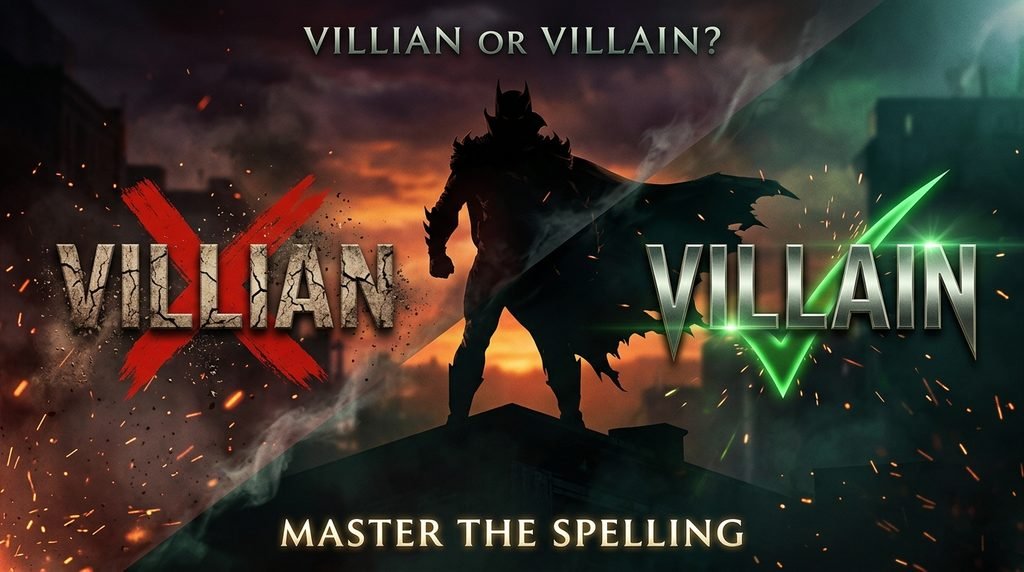
Difference Between Villian and Villain
1. Correct spelling
Villain is the correct spelling.
Villian is incorrect when you mean a bad person or story character.
Example 1: The villain escaped from the castle.
Example 2: The hero defeated the villain.
2. Meaning
Villain means a bad person or a bad character.
Villian has no standard English meaning as the spelling of this word.
Example 1: The villain stole the money.
Example 2: The movie has a very clever villain.
3. Letter order
The main problem is the order of the letters.
The correct word is:
v-i-l-l-a-i-n
A common mistake is:
v-i-l-l-i-a-n
The a and i are placed in the wrong order in villian.
Example 1: Correct: villain
Example 2: Incorrect: villian
4. Use in stories
Villain is often used for the bad character in a story.
It can be found in books, movies, plays, and comics.
Example 1: The villain wanted to control the kingdom.
Example 2: The hero faced the villain at the end.
5. Use for real people
Villain can also describe a real person who behaves in a very bad way.
This use is often strong and negative.
Example 1: The criminal was described as a villain.
Example 2: People saw him as the villain of the story.
6. Use in movies
Movies often have a hero and a villain.
The villain creates problems for the hero.
Example 1: The villain planned to destroy the city.
Example 2: The hero finally stopped the villain.
7. Use in books
Writers use villain to describe an important bad character.
The villain may create the main problem in the story.
Example 1: The novel has a powerful villain.
Example 2: The villain tricks the main character.
8. Use in everyday speech
Villain can be used outside stories too.
People may use it for someone they see as harmful or bad.
Example 1: The company was called the villain in the debate.
Example 2: He became the villain of the office story.
9. Grammar
Villain is a noun.
It names a person or character.
Example 1: The villain is angry.
Example 2: Several villains appear in the story.
10. Spelling in standard English
There is only one standard spelling for this word:
villain
The spelling villian should be corrected.
Example 1: ❌ The villian lost the fight. ✅ The villain lost the fight.
Example 2: ❌ She played the villian. ✅ She played the villain.
Nature and Behaviour of Villian and Villain
Nature of Villain
A villain is a noun. It can describe a bad person or a bad character in a story. Cambridge defines a villain as a person who harms others or breaks the law. It can also mean a harmful character in a book, play, or movie.
A villain may be:
- cruel
- dishonest
- dangerous
- selfish
- greedy
- harmful
But not every villain has all these traits.
Nature of Villian
Villian is not the standard spelling.
It is usually a spelling error caused by changing the order of a and i.
Use villain instead.
Why People Get Confused About Villian and Villain
The confusion comes from the spelling.
When people say the word, they hear its sounds. They do not see the letters.
The middle part can be hard to remember.
People may write:
villian
instead of:
villain
A useful memory trick is:
vill + ain = villain
Think of -ain at the end.
You can also remember this sentence:
The villain has an “a” before the final “i.”
This can help you avoid the common spelling mistake.
Comparison Table
| Feature | Villian | Villain |
|---|---|---|
| Spelling | Incorrect | Correct |
| Meaning | No standard meaning here | A bad person |
| Part of speech | Not standard for this meaning | Noun |
| Use in stories | Incorrect | Correct |
| Use in movies | Incorrect | Correct |
| Plural form | Not standard | Villains |
| US English | Incorrect | Correct |
| UK English | Incorrect | Correct |
| Formal writing | Avoid it | Use it |
| Example | The villian ran. | The villain ran. |
Similarity
The two forms look almost the same.
They also have the same intended sound when villian is simply a misspelling of villain.
The important difference is spelling.
The Origin of Villain
The word villain has a long history.
It came into English from Anglo-French and Old French vilain. That word originally meant a peasant, farmer, or common person. It came from Medieval Latin villanus, meaning a farm worker, which was linked to Latin villa, meaning a country house or farm.
Over time, the meaning changed.
By the middle of the 16th century, villain had developed the meaning of a bad person or scoundrel. Later, the word became common for a bad character in a novel, play, or other story. This story-character meaning is recorded from 1822.
So the modern meaning did not appear at once. The word changed over many years.
British vs American English
There is no spelling difference between British and American English.
| Type | British English | American English |
|---|---|---|
| Correct spelling | Villain | Villain |
| Pronunciation | /ˈvɪl.ən/ | /ˈvɪl.ən/ |
| Plural | Villains | Villains |
| Meaning | A bad person | A bad person |
| Wrong form | Villian | Villian |
Cambridge Dictionary gives the same standard pronunciation for both regions
British English
The villain escaped from prison.
American English
The villain escaped from prison.
The spelling stays the same.
The pronunciation is also listed as /ˈvɪl.ən/ in both US and UK English by Cambridge.
What about “villian”?
Do not use villian as a British spelling.
It is not a British-American spelling difference like:
colour / color
The correct spelling is villain in both forms of English.
Which One Should You Use?
For US English
Use:
villain
Example:
The villain escaped.
For UK English
Use:
villain
Example:
The villain escaped.
For global English
Use:
villain
It is the standard spelling and is understood around the world.
Avoid villian in school work, articles, emails, stories, and other standard writing.
Common Mistakes
Mistake 1
❌ The villian is evil.
✅ The villain is evil.
Mistake 2
❌ He played the villian in the movie.
✅ He played the villain in the movie.
Mistake 3
❌ The hero defeated the villian.
✅ The hero defeated the villain.
Mistake 4
❌ The story has three villians.
✅ The story has three villains.
Mistake 5
❌ She wrote about the main villian.
✅ She wrote about the main villain.
Mistake 6
❌ The villian escaped at night.
✅ The villain escaped at night.
Everyday Usage Examples
In Emails
I enjoyed the story about the hero and the villain.
This is fine in a casual or work email when discussing a book or movie.
On Social Media
That villain was the best part of the movie!
This is a natural casual use.
In News
A news report may use villain when discussing a person who is viewed as harmful or when describing a character in a story.
Example: The film’s villain became a major topic among fans.
In Formal Writing
The novel presents the villain as a major source of conflict.
This is suitable for school or literary writing.
Usage Trends
Villain is a common English word.
It is used in:
- movies
- books
- comics
- games
- news
- reviews
- everyday speech
- school writing
The word is also used outside fiction. Cambridge lists a broader informal use for something or someone seen as harmful or dangerous.
The spelling mistake villian can appear online because people often type quickly or remember the letters incorrectly.
For standard English, however, villain remains the form to use.
Metaphors and Similes
The word villain can also be used in creative comparisons.
Metaphor
The storm was the villain of the day.
Here, the storm is compared to a villain because it caused problems.
Simile
The old machine moved like a villain in a dark movie.
This creates a strong picture in the reader’s mind.
Another Metaphor
Fear became the villain in his mind.
Here, fear is treated like a character that causes trouble.
These uses are figurative. They do not mean that the storm, machine, or fear is a real person.
Connotative Meaning
Villain usually has a strong negative meaning.
Negative Meaning
It can suggest evil, harm, cruelty, or dishonesty.
Example: The villain hurt innocent people.
Neutral Story Meaning
In fiction, villain can simply identify the main bad character.
Example: The novel has a clever villain.
The word still describes a bad character, but it does not always tell us every detail about that character.
Figurative Meaning
The word can describe something that causes harm.
Example: The company called pollution the villain behind the problem.
This is a figurative use.
Idioms and Proverbs
There are no major common proverbs that use villain.
However, English has the expression:
Villain of the piece
This means the person or thing seen as the main cause of a problem. Cambridge lists villain of the piece as an idiom.
Example: In the story, the greedy manager is the villain of the piece.
The villain in the story
This phrase is also common.
Example: Everyone thought he was the villain in the story.
Literature and Movies
Villains are important in literature and movies.
Literature
William Shakespeare’s Richard III, a historical tragedy first performed around the late 16th century, gives readers one of English literature’s famous villain-like figures. The word villain itself has long been used for harmful or bad characters in plays and novels.
Another famous example is Mr. Hyde in Robert Louis Stevenson’s Strange Case of Dr Jekyll and Mr Hyde, a Gothic novella published in 1886. Hyde is a dark and harmful character in the story.
Movies
Many movies have a clear hero and villain.
Star Wars: Episode IV – A New Hope (1977, United States) features Darth Vader as a major villain.
The Lion King (1994, United States) features Scar as the main villain.
These examples show how the word villain is used in popular stories.
Why This Difference Matters
Correct spelling helps readers understand your writing.
The mistake villian is easy to make. The letters look almost right. But standard English uses villain.
This matters for:
- students
- teachers
- writers
- bloggers
- job seekers
- English learners
- content creators
Correct spelling also helps when you search for information online.
If you search for villain, you are more likely to find the word in dictionaries, books, movie reviews, and other standard sources.
A small spelling mistake can change how professional your writing looks.
Usefulness in Daily Life
You can use villain when talking about:
- movies
- books
- comics
- TV shows
- video games
- plays
- stories
- criminals
- people who cause harm
Examples:
Who is the villain in this movie?
The book has a scary villain.
The villain tricks the hero.
The story’s villain has a hidden plan.
The word is useful in both casual and formal writing.
Situational Preference
Use villain in every situation where you mean a bad person or bad character. Use it in school work, stories, movie reviews, social media, emails, and everyday speech. Do not change the spelling for British or American English. Both use villain. The form villian should be avoided because it is a common spelling mistake. If you are writing for a formal audience, make sure the spelling is correct. If you are talking about a movie, book, game, or play, villain is the normal word for the bad character. The simple rule is easy: villain is correct; villian is incorrect.
Questions
Is “villian” a correct spelling?
No. Villain is the correct standard spelling.
What does “villain” mean?
A villain is a bad person or a bad character in a book, movie, play, or story.
How do you spell the word correctly?
Spell it:
V-I-L-L-A-I-N
How do you pronounce “villain”?
The main US and UK pronunciation is /ˈvɪl.ən/.
Is “villian” the British spelling?
No. British English also uses villain.
Why do people spell villain as villian?
People often mix up the a and i in the middle of the word. The correct order is -ain.
What is an easy way to remember the spelling?
Remember:
vill + ain = villain
The ending is -ain, not -ian.
Conclusion
The difference between villian or villain is simple. Villain is the correct spelling. Villian is a common spelling mistake.
A villain is a bad person or a bad character. We often see villains in movies, books, plays, comics, and games. The word can also describe a person who causes harm or trouble. Cambridge gives these meanings in its dictionary.
The spelling can be confusing because the letters a and i are easy to switch. Many people write villian by mistake. But the correct form is:
v-i-l-l-a-i-n
The spelling is the same in British and American English. The pronunciation is also listed as /ˈvɪl.ən/ in both varieties.
The word has a long history. It came from Old French and Medieval Latin words linked to farm workers and country life. Over time, its meaning changed to describe a bad or harmful person and later a bad character in stories.
So, when you mean a bad person or story character, always choose villain.

I’m Sultan Sikander, an English language specialist, SEO specialist, digital publisher, and researcher. I create clear, accurate, and well-researched content on English grammar, vocabulary, word meanings, and language comparisons, helping readers understand and use English with confidence.






2 thoughts on “Villian or Villain: Which Spelling Is Correct?”