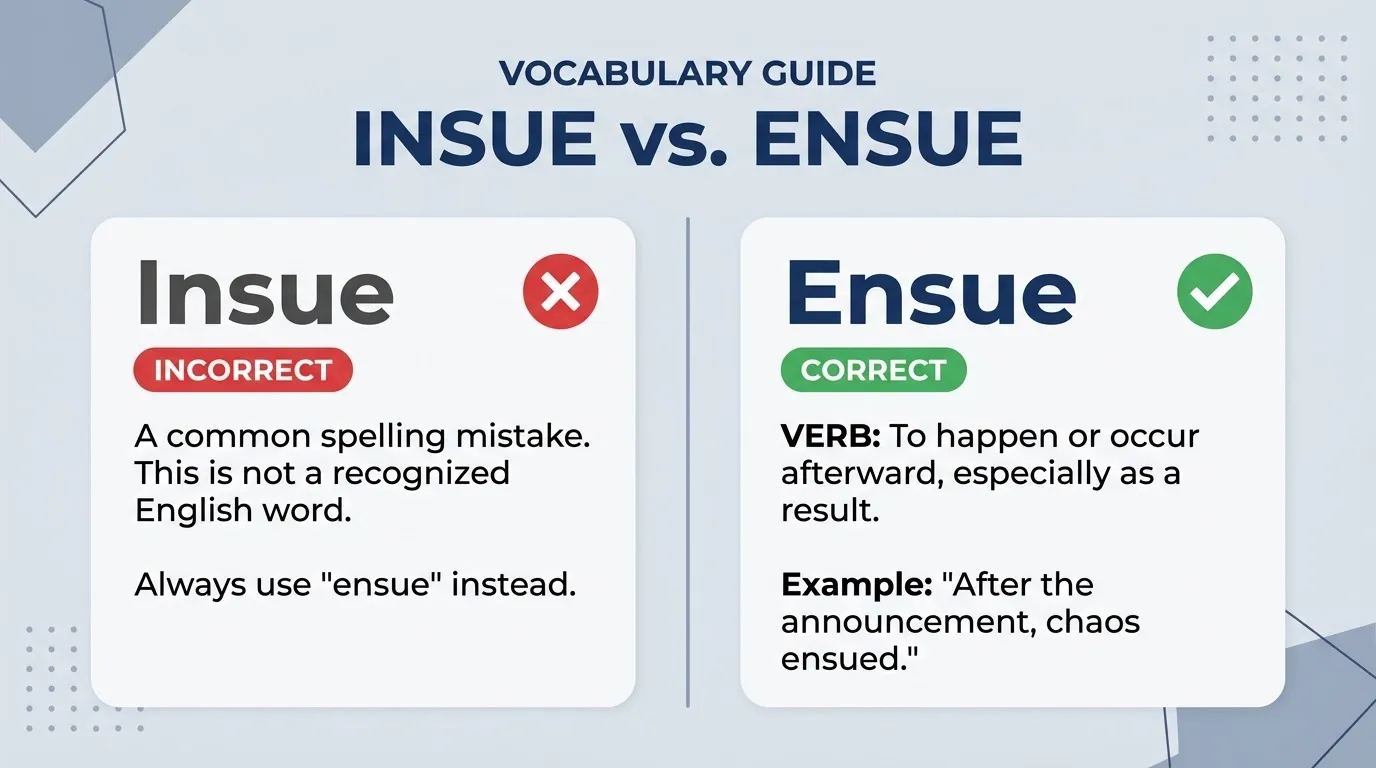
Ensue is the correct spelling; insue is not the standard modern spelling when you mean “to happen afterward.”
Imagine you are at school. A student drops a stack of books. The books fall across the floor. Other students rush to help. A short moment of confusion ensues. This means the confusion happens after the books fall. Many people stop when they see insue or ensue. Both forms can look possible because they sound similar when spoken. The correct word is ensue. It is a verb. It means “to happen after something else” or “to happen as a result.” Cambridge defines ensue as something that happens after another event, especially as a result of it.
People often search for insue or ensue because they hear the word before they see it in writing. The first vowel can also be easy to forget. This can cause mistakes in school work, emails, stories, and online posts.
If you are unsure about insue or ensue, remember one simple rule: use ensue when you mean that something happens afterward.
Pronunciation
Ensue
- US: /ɪnˈsuː/
- UK: /ɪnˈsjuː/
The UK form has a small y sound before the long “oo” sound. The US form does not normally have that sound.
Insue
Insue is not the standard modern spelling of this verb. It is best treated as a spelling error when you mean ensue. It does not have a standard modern US or UK pronunciation for this meaning.
You May Also Like: https://suitmean.com/performing-or-preforming/
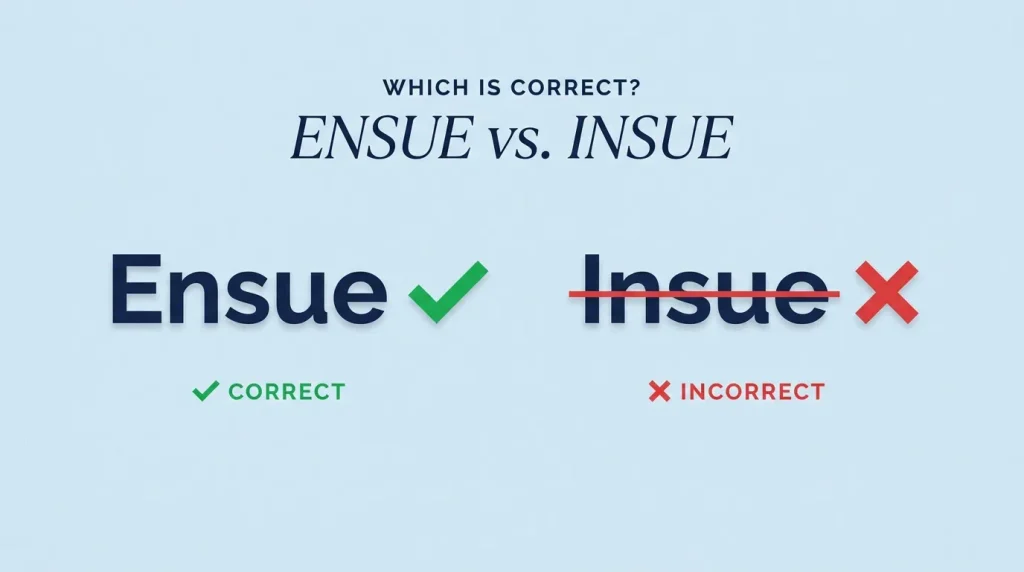
A Simple Link
Now let us look at the main differences between these two spellings.
Difference Between Insue or Ensue
1. Correct Spelling
Ensue is the correct spelling in modern standard English.
Insue is not the standard spelling when the meaning is “to happen afterward.” Modern dictionaries define ensue, not insue, as the normal verb for this meaning.
Examples:
- A long discussion ensued after the meeting.
- Confusion ensued when the lights went out.
2. Meaning
Ensue means to happen after something else.
It can also mean to happen as a result of something.
Examples:
- A fight ensued after the argument.
- Silence ensued after the teacher spoke.
3. Standard English Use
Ensue is used in standard English.
Insue should not be used in normal school, work, or formal writing.
Examples:
- Correct: A debate ensued.
- Incorrect: A debate insued.
4. Grammar
Ensue is a verb.
Its common forms are:
- ensue
- ensues
- ensued
- ensuing
Examples:
- Trouble may ensue.
- Trouble ensued.
- The ensuing debate lasted an hour.
5. Time
Ensue often shows that one event comes after another.
The first event happens. The second event ensues.
Examples:
- The alarm rang, and panic ensued.
- The teacher asked a question, and a long discussion ensued.
6. Cause and Result
Ensue often connects an event with its result.
The second event can be caused by the first event.
Examples:
- A power cut caused confusion to ensue.
- A small mistake led to problems that ensued.
7. Formal Tone
Ensue can sound more formal than simple words such as happen or follow.
It is common in news, reports, books, and formal writing.
Examples:
- A heated debate ensued.
- Several changes ensued after the new rule.
8. Word Family
Ensue has related forms.
The past form is ensued. The -ing form is ensuing.
Examples:
- An argument ensued.
- The ensuing argument lasted ten minutes.
9. Dictionary Status
Ensue is a standard dictionary word.
Insue is not the standard modern form for this meaning. Historical sources show that insue existed as an obsolete form of ensue.
Examples:
- Modern English: Trouble ensued.
- Do not write: Trouble insued.
10. Best Choice for Writers
Use ensue in essays, emails, reports, stories, and posts.
Avoid insue when you mean “happen afterward.”
Examples:
- A heated exchange ensued.
- Several problems ensued after the change.
Nature and Behaviour of Insue or Ensue
Nature of Ensue
Ensue is a verb. It describes something that happens after another event.
It often follows an event, action, decision, or situation.
Examples:
- A celebration ensued.
- A long silence ensued.
The word can show a simple sequence:
Event → Result → Event that ensues
Nature of Insue
In modern standard English, insue is not the normal form of the verb. If someone writes insue, they usually mean ensue.
Historical sources record insue as an obsolete form of ensue.
Why People Get Confused About Insue or Ensue
The main problem is spelling.
People often hear ensue in speech. The first vowel is weak. This can make the word sound less clear.
The ending also looks simple. A writer may think the word starts with in- because many English words do.
Examples include:
- inside
- include
- increase
- invite
This can lead to the wrong spelling insue.
Another reason is that insue has existed in older English as an obsolete form. That history can make the spelling look more believable.
For modern English writing, use ensue.
Comparison Table
| Feature | Insue | Ensue |
| Standard modern spelling | No | Yes |
| Meaning “happen afterward” | No | Yes |
| Part of speech | Historical/obsolete form | Verb |
| Common today | No | Yes |
| Past form | Obsolete insued | ensued |
| -ing form | Obsolete insuing | ensuing |
| US English | Avoid | Use |
| UK English | Avoid | Use |
| Formal writing | Avoid | Suitable |
| Meaning | Historical form | Follow or happen afterward |
| Similarity | Looks and sounds similar | Looks and sounds similar |
| Main difference | Wrong modern spelling | Correct modern spelling |
The Origin of Insue or Ensue
The history of ensue goes back many centuries.
Etymonline traces ensue to Middle English and Old French forms. It is linked to Latin insequi, meaning “to follow” or “to follow after.” The modern idea of something happening after another event developed from this sense of following.
The word appeared in English around the late Middle Ages. Early meanings included “follow” and “pursue.” Later, it gained the sense “to follow as a result” or “to happen afterward.”
Insue has also appeared in older English. Etymonline lists it as an obsolete form of ensue.
So the two forms have a historical connection. Modern standard English uses ensue.
British vs American English
There is no spelling difference between British and American English for this word.
Both use:
ensue
The main difference is pronunciation.
- US: /ɪnˈsuː/
- UK: /ɪnˈsjuː/
American English Examples
- A debate ensued after the vote.
- Confusion ensued after the announcement.
British English Examples
- A debate ensued after the meeting.
- A long silence ensued.
The spelling stays the same in both varieties.
Which One Should You Use?
For US English
Use ensue.
Example:
A heated argument ensued.
For UK English
Use ensue.
Change block type or style
Move Heading block from position 113 up to position 112
Move Heading block from position 113 down to position 114
Change alignment
Change text alignment
Example:
A heated argument ensued.
For Global English
Use ensue.
It is understood across standard English varieties.
If you are writing for school, work, websites, or international readers, ensue is the safe standard choice.
Common Mistakes
Mistake 1: Using Insue
❌ A fight insued.
✅ A fight ensued.
Mistake 2: Using Insue in Formal Writing
❌ Confusion insued after the announcement.
✅ Confusion ensued after the announcement.
Mistake 3: Confusing Ensue With Ensure
Ensue means to happen afterward.
Ensure means to make sure.
Examples:
- Problems ensued after the mistake.
- Please ensure that the door is locked.
Mistake 4: Misspelling the Past Form
❌ A debate insued.
✅ A debate ensued.
Mistake 5: Forgetting “En”
Remember:
EN + SUE = ENSUE
Everyday Usage Examples
In Emails
A short delay ensued after the system stopped working.
In Social Media
The music stopped, and total silence ensued.
In News Writing
Protests ensued after the new rule was announced.
In Formal Writing
Several changes ensued after the company adopted the new policy.
In School Writing
A discussion ensued after the teacher asked the question.
In Stories
The door opened, and a strange silence ensued.
Usage Trends
Ensue remains a standard English verb. It is especially useful when a writer wants to show that one event follows another.
It is common in formal writing, news reports, books, and descriptions.
Insue is not the normal modern spelling. When it appears in modern writing, it is usually intended as ensue.
The older form insue has historical evidence, but it is not the spelling to choose in modern standard English.
Metaphors and Similes
Ensue is usually used in a literal way. It can also appear in figurative writing.
Metaphor
A storm of questions ensued.
The questions are compared to a storm. This shows that many questions came quickly.
Another Example
A wave of anger ensued.
The anger is compared to a wave.
Simile
A simile can describe an event that ensues.
After the news, people moved like a rushing river, and confusion ensued.
Here, the people are compared to a rushing river.
Connotative Meaning
Ensue is mostly neutral.
The word itself does not mean something good or bad. The event that follows gives it the feeling.
Positive Meaning
A joyful celebration ensued.
The result is happy.
Negative Meaning
Chaos ensued after the accident.
The result is negative.
Neutral Meaning
A discussion ensued after the question.
The result is neither clearly good nor bad.
Idioms and Proverbs
There is no famous common English proverb that depends on ensue.
There is, however, a common pattern:
Chaos ensued.
This means that a situation became confused or disorderly.
Another common pattern is:
A debate ensued.
It means a debate happened after something else.
You may also see:
What ensued was…
Example:
What ensued was a long and useful discussion.
Literature and Movies
Literature
The word ensue has a long history in English literature.
William Shakespeare used ensue in A Midsummer Night’s Dream, a comedy from the late 16th century. In Act 3, Oberon says that a mistake with the love potion will cause a change in true love to ensue.
Shakespeare also used the word in other works. A Shakespeare glossary records uses in As You Like It, The Winter’s Tale, and other plays.
The word is also found in modern fiction. For example, a description of Haruki Murakami’s 1Q84 uses ensued when discussing events that followed.
Movies
The word and its forms are also common in movie descriptions and reviews.
For example, descriptions of Shakespeare film productions often use ensue or ensued to describe events that follow.
The 1998 British-American film Twelfth Night, directed by Trevor Nunn, is a comedy-drama based on Shakespeare’s play. A review describes the romantic misunderstandings as “hijinks” that ensue.
The 1999 film Titus, a British-Italian-American adaptation of Shakespeare’s Titus Andronicus, is also described with the word ensue when discussing the violence that follows in the story.
This shows how useful the word is in storytelling. It helps writers show that one event follows another.
Why This Difference Matters
Correct spelling helps readers understand your writing.
Using ensue shows that you know the standard form. Using insue can distract readers.
This matters for:
- Students
- Teachers
- Writers
- Job seekers
- Bloggers
- Office workers
- English learners
A small spelling error can change how polished your writing looks.
Learning ensue also helps you understand books, news reports, and formal writing. The word is common when writers want to show a clear sequence of events.
Usefulness in Daily Life
You can use ensue when you describe something that happens after another event.
For example:
A short argument ensued.
A long meeting ensued.
Silence ensued.
Confusion ensued.
A celebration ensued.
A debate ensued.
You do not need to use ensue in every situation. Simple words like happen, follow, and come after are often easier.
For example:
A fight happened after the game.
This is simple.
A fight ensued after the game.
This sounds more formal.
Situational Preference
Use ensue when you want to show that something happened after another event. It works well in formal writing, news reports, essays, stories, and professional emails. Use happen or follow when you want very simple language. Use ensue for both American and British English. Do not choose insue for modern standard English. It is an old form, not the normal modern spelling. If your sentence is for young learners, “happen afterward” may be easier to understand. If your sentence is formal, ensue can make the meaning short and clear.
FAQs
Is it insue or ensue?
Ensue is the correct modern spelling when you mean “to happen afterward.” Insue is not the standard modern spelling.
What does ensue mean?
Ensue means to happen after something else. It can also mean to happen as a result of something.
Is ensue a verb?
Yes. Ensue is a verb.
Example:
Problems may ensue.
What is the past tense of ensue?
The past tense is ensued.
Example:
A heated discussion ensued.
What is the -ing form of ensue?
The -ing form is ensuing.
Example:
The ensuing debate lasted an hour.
Is insue ever correct?
Insue is found in historical English as an obsolete form of ensue. It is not the normal modern spelling.
Is ensue used in both American and British English?
Yes. Both use the spelling ensue. The main pronunciation difference is that British English commonly has a small /j/ sound before /uː/, while American English normally does not.
Conclusion
Ensue is the correct modern spelling. Insue should not be used when you mean “to happen afterward.” The word ensue is a verb. It describes an event that follows another event or happens as a result of it.
You can use ensue in both American and British English. The spelling stays the same. The main pronunciation difference is found in the vowel sound after the s. The word has a long history. It comes from older forms linked to the idea of following or coming after. Insue also appeared in older English, but it is now obsolete as a standard form.
The easiest way to remember the modern spelling is simple:
EN + SUE = ENSUE
Write ensue in your essays, emails, reports, stories, and posts. If you want simple English, you can also use happen afterward or follow. When you want a short, formal word, ensue is the correct choice.

I’m Sultan Sikander, an English language specialist, SEO specialist, digital publisher, and researcher. I create clear, accurate, and well-researched content on English grammar, vocabulary, word meanings, and language comparisons, helping readers understand and use English with confidence.











1 thought on “Insue or Ensue: Which Spelling Is Correct?”