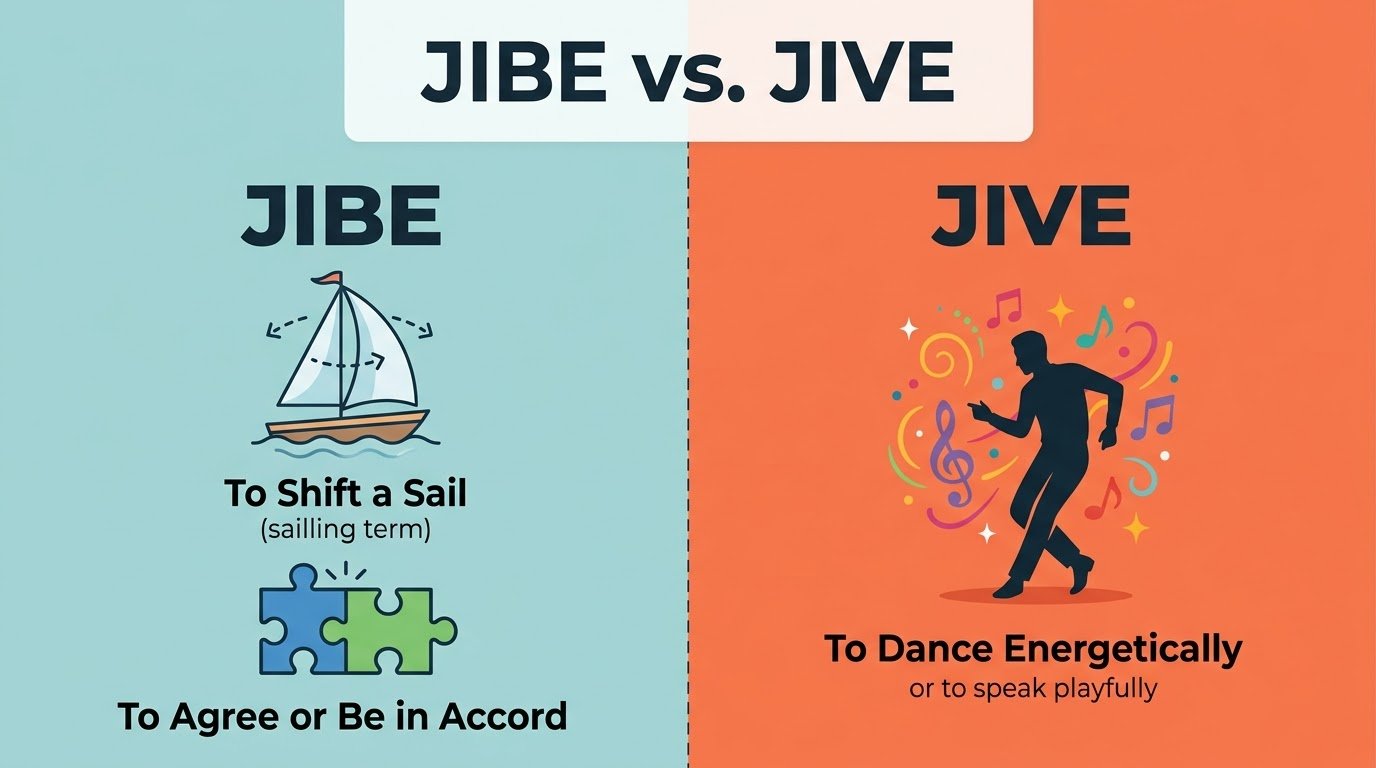
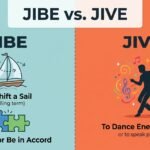
Jibe means to agree, match, or fit. Jive is linked to jazz, dancing, slang, or false and silly talk.
Imagine you are checking two reports at work. The first report says 500 boxes were shipped. The second report says 500 boxes were shipped too. You can say, “The two reports jibe.” They match. Now imagine your friend starts dancing to a fast jazz song. You may say that your friend can jive. The two words sound close, but they have different uses.
Jibe can mean “to agree” or “to be in harmony with.” It also has a sailing meaning. A ship can jibe when its sail moves from one side to the other. Jive can mean a type of music or dance. It can mean silly, false, or misleading talk. Some Americans use jive to mean “agree.” This use is common. Many language guides prefer jibe for that meaning.
People often look up jibe or jive. The words sound almost the same.
. The key is simple: use jibe for agreement and jive for jazz, dance, or slang.
Pronunciation
Jibe
US: /dʒaɪb/ UK: /dʒaɪb/
Jive
US: /dʒaɪv/ UK: /dʒaɪv/
The biggest difference is the very last sound. The last sound is the main difference. Jibe ends with a b sound. Jive ends with a v sound.
You also like this: https://suitmean.com/insue-or-ensue/
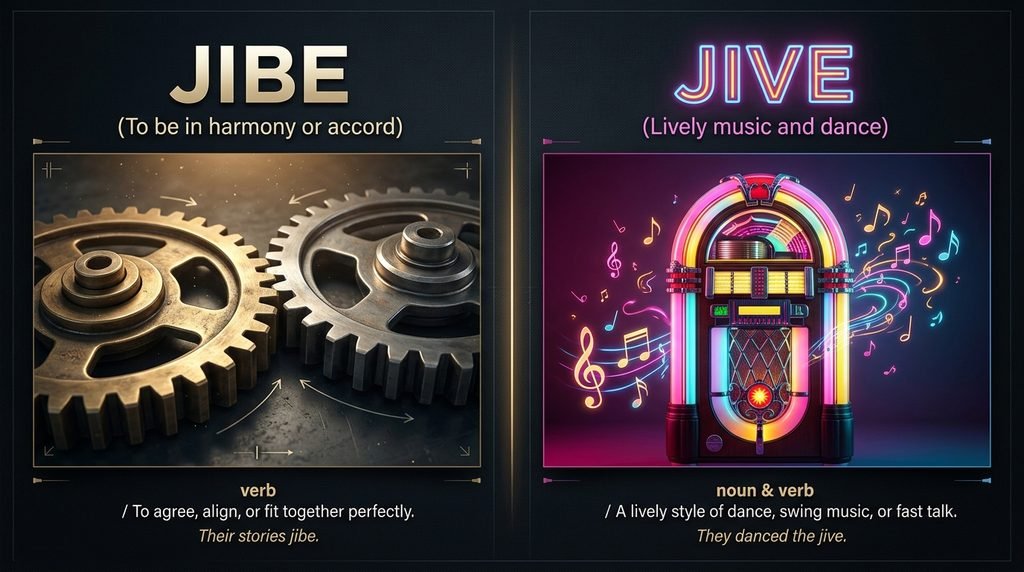
A Simple Way to Remember the Difference
Think of jibe as match.
Think of jive as music, dance, or slang.
Now let us look at the difference in more detail.
Difference Between Jibe and Jive
1. Basic Meaning
Jibe means to agree, match, or fit with something.
Jive can mean jazz music, a dance, or slang talk.
Examples:
- Her story does not jibe with the facts.
- The two reports jibe with each other.
- They learned to jive at the dance class.
- The band played lively jive music.
2. Use for Agreement
Jibe is used when 2 things match to each other.
This is one of the most common uses of jibe.
Examples:
- His words do not jibe with his actions.
- The numbers jibe with our records.
Jive is sometimes used for this meaning in American English. Jibe is prefer by many forrmal guides.
3. Use for Music
Jive can describe a kind of lively jazz or swing music.
Jibe does not mean a type of music.
Examples:
- We listened to old jive music.
- The band played jive at the party.
Do not use jibe for the music meaning.
4. Use for Dance
Jive can also mean a dance.
It is known as a lively dance style.
Examples:
- Sarah learned the jive for the school show.
- They watched a couple jive on stage.
Jibe does not mean to dance.
5. Use for False or Silly Talk
Jive can refer to talk that is false, silly, or misleading.
Examples:
- I do not believe his jive.
- Stop giving me that jive.
Here, jibe would not have the same meaning.
6. Grammar
Jibe is a verb that means to agree, match, or fit together perfectly.
Jibe can also be a noun with two completely different meanings.
Examples:
- The facts jibe with the report.
- Their stories do not jibe.
Jive can work as a noun, verb, or adjective.
Examples:
- The band played jive.
- They jive to the music.
- That sounds like jive talk.
7. Formal Writing
Jibe is the correct word to choose in formal writing when you mean “agree” or “match.”
Examples:
- The results jibe with the earlier study.
- The evidence does not jibe with his claim.
Jive is the word you use for music, dance, or slang.
Examples:
- The dancers performed the jive.
- The article describes old jive slang.
8. Sailing
Jibe has a special sailing meaning.
During downwind sailing, a jibe occurs when the boat turns and the wind swings the sail to the opposite side.
People in Britain often spell this sailing word as “gybe.”
Examples:
- The sailor prepared to jibe.
- The boat jibed during the turn.
Jive has no sailing meaning.
9. Sound
The words sound very close.
They start with the same j sound and have the same long i sound.
The final sounds are different.
Jibe ends in b.
Jive ends in v.
Examples:
- Jibe: “The facts jibe.”
- Jive: “They jive to the music.”
10. Common Confusion
Many people mistakenly spell the sailing word as “jive” instead of “jibe.”
This happens because the words sound similar.
Examples:
- Correct: “His story does not jibe with the facts.”
- Common mistake: “His story does not jive with the facts.”
- Correct: “The numbers jibe with the report.”
- Common mistake: “The numbers jive with the report.”
Nature and Behaviour of Jibe and Jive
Nature of Jibe
Jibe is a useful word for agreement and matching.
It often appears with with.
Common pattern:
jibe with + noun
Examples:
- Her answer does not jibe with the evidence.
- His story jibes with the report.
It can also be used in sailing.
Nature of Jive
Jive has a wider cultural history.
It can refer to music and dance. It can also describe slang or misleading talk.
Examples:
- They danced the jive.
- He was speaking jive.
The word can sound informal when it means slang or false talk.
Why People Get Confused About Jibe and Jive
The main reason is sound.
Both words begin with j.
Both have the long i sound.
Only the last sound changes.
There is another reason. Some people use jive in the sense of “agree” or “fit.” This use has appeared in American English for many years. Many dictionaries and style guides still warn that jive is often being used in place of jibe for this meaning.
This creates confusion.
A simple rule helps:
Agree or match = jibe.
Music, dance, or slang = jive.
Comparison Table
| Feature | Jibe | Jive |
| Main meaning | Agree or match | Music, dance, or slang |
| Main use | Agreement | Music and informal speech |
| Verb | Yes | Yes |
| Noun | Yes | Yes |
| Adjective | Limited | Yes |
| Music meaning | No | Yes |
| Dance meaning | No | Yes |
| False talk | No | Yes |
| Sailing | Yes | No |
| Common pattern | Jibe with | Jive to / jive talk |
| Formal “agree” | Preferred | Often avoided |
| US pronunciation | /dʒaɪb/ | /dʒaɪv/ |
| UK pronunciation | /dʒaɪb/ | /dʒaɪv/ |
| UK sailing spelling | Jibe or gybe | Jive is not used |
| Example | The facts jibe. | They danced the jive. |
Similarities
- Both are English words.
- Both start with j.
- Both have the long i sound.
- Both can be verbs.
- Both can be nouns.
- Both can appear in informal speech.
- Both are often confused because they sound alike.
The Origin of Jibe and Jive
Origin of Jibe
The word jibe has more than one history because it has more than one meaning.
The “agree” meaning appeared in American English in the early 1800s. Its exact origin is not fully clear. Some sources connect it with the idea of things fitting or agreeing.
The sailing word has a different history. It is related to the older sailing word gybe. The word refers to moving a sail from one side of a boat to the other.
Origin of Jive
Jive appeared in American English slang in the 1920s.
It became linked with jazz culture, lively music, dance, and slang. It could also mean empty or misleading talk.
The dance meaning became strongly linked with swing and jazz culture.
The later use of jive to mean “agree” seems to have developed under the influence of jibe.
British vs American English
Jibe in American English
In American English, jibe commonly means “agree” or “match.”
Example:
- The facts jibe with the report.
Jibe in British English
British English also uses jibe for “agree” or “match.”
Example:
- His story does not jibe with the evidence.
For sailing, British English commonly uses gybe.
Example:
- The yacht gybed in the strong wind.
Jive in American English
Jive is used for music, dance, and slang.
Example:
- They danced the jive.
- He was talking jive.
Some American speakers also use jive to mean “agree.” This is widely understood, but it is often treated as nonstandard or less preferred in careful writing.
Jive in British English
British English also uses jive for the dance and related music.
Example:
- The dancers performed a lively jive.
For formal writing, use jibe when you mean “agree” or “match.”
Which One Should You Use?
Use jibe when you mean agree, match, or fit.
Use jive when you mean a dance, a type of music, or slang talk.
For US English:
- “The facts jibe with the report.”
- “They danced the jive.”
In UK English:
- “The facts jibe with the report.”
- “The sailors gybed the boat.”
For global English, jibe is the safer choice when you mean “agree.” It is clear and works well in formal writing.
- Common Mistakes
- Mistake 1: Using jibe for a dance
- ❌ They danced the jibe.
- ✅ They danced the jive.
- Mistake 2: Using jive for a formal “match” meaning
- ❌ The facts jive with the report.
- ✅ The facts jibe with the report.
- Mistake 3: Writing “jibe music”
- ❌ We listened to jibe music.
- ✅ We listened to jive music.
- Mistake 4: Confusing a jibe with jive talk
- ❌ He made a jive at my clothes.
- ✅ He made a jibe at my clothes.
Everyday Usage Examples
In Emails
- “The sales numbers do not jibe with our report.”
- “The new figures jibe with the data we received.”
On Social Media
- “That story does not jibe with what I saw.”
- “She can really jive!”
In News Writing
- “The new evidence does not jibe with the earlier account.”
- “The dancers performed a classic jive.”
In Formal Writing
- “The results jibe with the findings of the earlier study.”
- “The study discusses the history of jazz and jive culture.”
In Daily Speech
- “Your story does not jibe with mine.”
- “They were dancing the jive.”
Usage Trends
Jibe remains useful in writing when people want to say that two facts, stories, or ideas agree.
Jive remains strongly linked with music, dance, and informal language.
The use of jive for “agree” has existed for decades. It is common enough to be understood by many readers. Still, many style guides and language experts prefer jibe for formal writing.
This means you may see both forms in real-world writing.
For school work, reports, business writing, and careful English, jibe is the safer choice for “agree.”
Metaphors and Similes
These words can also appear in figurative language.
Jibe as a Figurative Idea
When two ideas jibe, they fit together.
Example:
- “Her actions and words jibe like two pieces of the same puzzle.”
This means her actions and words agree.
Another example:
- “The two stories jibe like matching pages in a book.”
Jive as a Figurative Idea
Jive can suggest lively movement or false talk.
Example:
- “The dancers moved with the energy of a jive song.”
Another example:
- “His excuse sounded like jive.”
This means his excuse sounded false or silly.
Connotative Meaning
Jibe
The word jibe is usually neutral.
It simply says that things agree or match.
Example:
- “The two reports jibe.”
There is no strong positive or negative feeling.
Jive
Jive can have different feelings.
It can have a positive or lively feeling when it refers to music or dance.
Example:
- “The band played a fun jive tune.”
It can have a negative feeling when it means false or silly talk.
Example:
- “I am tired of his jive.”
It can also be neutral when talking about the dance or music style.
Idioms and Proverbs
There is no major traditional proverb built around jibe.
Word Jive, however, appears in several familiar expressions.
Jive Talk
Jive talk means slang or talk that may sound silly, exaggerated, or misleading.
Example:
- “I do not want jive talk. Give me the facts.”
Jive Turkey
Jive turkey is an old slang expression for a foolish, dishonest, or annoying person.
Example:
- “The old movie used the phrase jive turkey.”
This expression is strongly linked with older American slang and may sound dated today.
Hand Jive
Hand jive is a rhythmic hand movement linked with music and dance.
Example:
- “The students learned the hand jive for the show.”
Literature and Movies
Literature
The word jibe appears in modern literary and critical writing when writers mean “fit” or “agree.” For example, a discussion of Lionel Trilling’s work in The Wilson Quarterly uses jibe in the phrase “doesn’t jibe with,” meaning “does not agree with.”
The word jive is strongly connected with American jazz and African American slang. Its history in music and speech became important during the 20th century. The word was used for lively jazz and dance and for slang or misleading talk.
Movies
The 1943 American film Jive Junction uses jive in its title. The film centers on music and a high-school jive band.
The 1943 American musical film Stormy Weather also features Cab Calloway and the Nicholas Brothers in the famous “Jumpin’ Jive” number.
These examples show why jive is strongly connected with music and dance.
Why This Difference Matters
Knowing the difference helps you write clearly.
If you write jibe, readers can understand that two things agree or match.
If you write jive, readers may think about music, dance, slang, or false talk.
The wrong word can change the meaning of a sentence.
This matters in school work. It matters in emails. It matters in reports and articles.
For example:
- “The facts jibe with the evidence.”
This clearly means the facts agree with the evidence.
But:
- “The facts jive with the evidence.”
Some readers will understand it. Other readers may see it as a word-choice error.
Using the right word makes your writing easier to understand.
Usefulness in Daily Life
See jibe in news reports, business writing, school essays, and discussions about facts.
You may see jive in music writing, dance articles, movies, old slang, and informal speech.
Use jibe when comparing:
- Stories
- Facts
- Numbers
- Reports
- Statements
- Ideas
- Evidence
You can use jive when talking about:
- Music
- Dance
- Jazz culture
- Slang
- Silly talk
- Misleading talk
A simple word choice can make your message much clearer.
Situational Preference
Use jibe when you are talking about facts, reports, stories, opinions, or ideas that agree. It is a good choice for school, work, news, and formal writing. Use jive when you are talking about a dance, jazz-related music, slang, or misleading talk. If you mean “agree” and you are not sure which word to choose, use jibe. It is the clearer choice in careful English. In British sailing, use gybe for the sailing move. This small rule can help you avoid many word-choice mistakes.
Common Questions
Is jibe or jive correct for “agree”?
Jibe is the traditional and safer choice.
Example:
- “Her story does not jibe with the facts.”
Can jive mean agree?
Yes. Some American speakers use jive to mean “agree” or “fit.” This use is well known, but many language guides consider jibe the better choice for formal writing.
Does jive mean dance?
Yes. Jive can be a lively dance.
Example:
- “They danced the jive.”
Does jibe mean insult?
It can, in another use, be a variant spelling of gibe, meaning a taunt or sharp remark. This is a separate meaning from the common verb jibe meaning “agree.”
Is jibe used in British English?
Yes. British English uses jibe for “agree” or “match.” For the sailing meaning, gybe is also common in British English.
What is the easiest way to remember jibe and jive?
Remember:
Jibe = agree or match.
Jive = music, dance, or slang.
Which word should I use in formal writing?
Use jibe when you mean “agree” or “match.” Use jive when you mean the dance, music, or slang sense.
Conclusion
Jibe and jive sound almost the same, but they do not have the same main meaning. Jibe usually means to agree, match, or fit. It is often followed by with, as in “The facts jibe with the report.” It also has a sailing meaning. In British sailing, gybe is a common spelling for that meaning. Jive is linked with music, dance, and slang. It can describe a lively dance or music style. It can also mean false, silly, or misleading talk. Some people use jive to mean “agree,” especially in American English. This use is common, but jibe is still the safer choice in formal writing. The easiest rule is simple: jibe means agree or match; jive means music, dance, or slang. If you remember this rule, you can choose the right word in emails, essays, reports, social media posts, and everyday speech.
Meta Description
Learn the difference between jibe or jive, with simple meanings, pronunciation, examples, usage rules, origins, mistakes, and easy tips for better English.

I’m Sultan Sikander, an English language specialist, SEO specialist, digital publisher, and researcher. I create clear, accurate, and well-researched content on English grammar, vocabulary, word meanings, and language comparisons, helping readers understand and use English with confidence.






1 thought on “Jibe or Jive: What Is the Difference?”