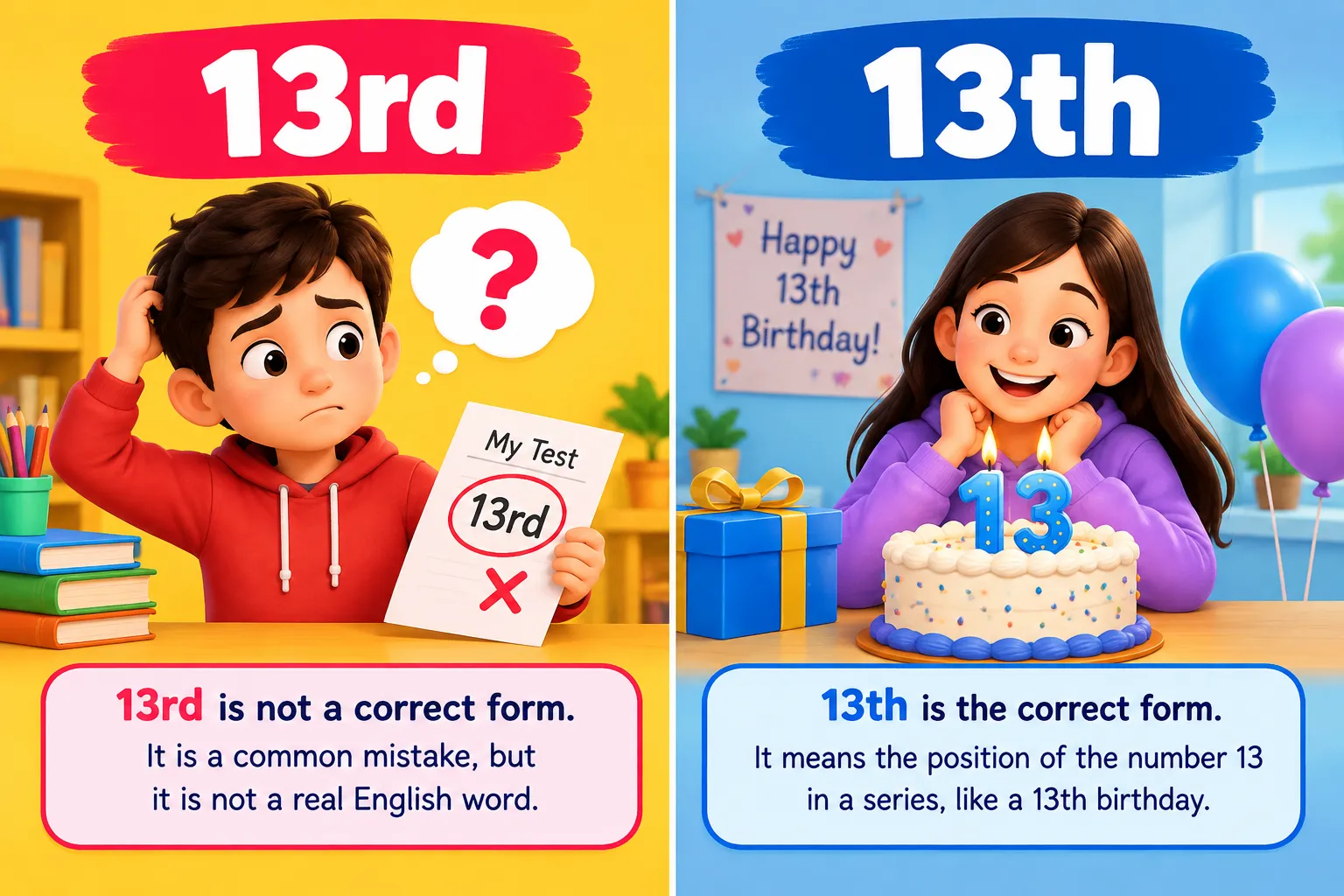
13th is correct, while 13rd is incorrect.
Imagine a student writing a date on a school assignment. The teacher asks for the ordinal form of the number 13. The student writes “13rd.” It looks like a small mistake, but the correct form is “13th.” This simple error can confuse many English learners. The words 13rd or 13th often appear in online searches because people are unsure which ending to use with the number thirteen. English ordinal numbers follow special spelling rules. Numbers such as 1st, 2nd, and 3rd have different endings, while most other numbers use “th.” Understanding 13rd or 13th helps students, writers, and professionals use dates and rankings correctly. Whether you are writing an invitation, a birthday message, or a formal document, choosing the right ordinal number makes your writing clear and correct. In this article, we will explain the difference between 13rd and 13th in very simple words.
Pronunciation
13rd
“13rd” is not a correct standard English ordinal form. Therefore, it does not have a standard pronunciation as an ordinal number.
13th
- US English: thirteenth
- UK English: thirteenth
The pronunciation is the same in both American and British English.
Read more about: https://suitmean.com/wp-admin/post.php?post=263&action=edit
Difference Between 13rd or 13th
1. Correct Spelling
The first and most important difference is spelling.
- 13rd is incorrect.
- 13th is correct.
Examples:
- Today is the 13th of June.
- She finished 13th in the race.
2. Grammar Rule
The number 13 follows the ordinal number rule for numbers ending in 3 but not exactly 3.
Although 3 normally becomes 3rd, thirteen becomes 13th.
Examples:
- Three = 3rd.
- Thirteen = 13th.
3. Use in Dates
We use 13th when writing dates.
We do not use 13rd in correct English writing.
Examples:
- My exam is on the 13th of March.
- The meeting will take place on the 13th.
4. Use in Rankings
13th is also used to show position in a competition or list.
Examples:
- He came 13th in the marathon.
- The book ranked 13th on the sales list.
5. Meaning
Both forms attempt to describe the ordinal form of thirteen, but only 13th has the correct meaning and grammatical use.
Examples:
- The 13th chapter is interesting.
- She lives on the 13th floor.
6. Formal Writing
13th should always be used in formal writing.
13rd can make your writing look careless or incorrect.
Examples:
- The event will be held on the 13th of August.
- Please submit your report by the 13th.
7. Academic Writing
Students should use 13th in school assignments, exams, and research papers.
Examples:
- The 13th century was an important period in history.
- Chapter 13th contains useful information.
Note: In many sentences, “Chapter 13” is more natural than “Chapter 13th.”
8. Digital Communication
People often make spelling mistakes while typing quickly online. The incorrect form may appear in messages, but it should be avoided.
Examples:
- Correct: See you on the 13th.
- Incorrect: See you on the 13rd.
9. International English
13th is accepted worldwide in standard English.
It is used in American English, British English, Australian English, and many other English-speaking regions.
Examples:
- The 13th floor is closed.
- Our appointment is on the 13th.
10. Easy Rule to Remember
The easiest rule is simple: numbers ending in 13 always use “th.”
Examples:
- 13th
- 113th
- 213th
This rule helps prevent mistakes.
Nature and Behaviour of 13rd or 13th
Nature of 13rd
13rd is an incorrect spelling. It comes from a common misunderstanding of ordinal number rules. Since 3 becomes 3rd, some people incorrectly apply the same rule to 13.
Nature of 13th
13th is the correct ordinal number. It shows the position of something after the twelfth item.
For example:
- 12th = twelfth
- 13th = thirteenth
- 14th = fourteenth
The word 13th is used naturally in dates, rankings, lists, and descriptions.
Why People Get Confused About 13rd or 13th
People often get confused because the number 13 ends with the digit 3.
They remember this rule:
- 1st
- 2nd
- 3rd
Then they assume:
- 13rd
But this is wrong because ordinal numbers ending in 11, 12, and 13 always use “th.”
For example:
- 11th, not 11st
- 12th, not 12nd
- 13th, not 13rd
This is one of the most common English spelling rules that learners need to remember.
Comparison Table
| Feature | 13rd | 13th |
| Correct or incorrect | Incorrect | Correct |
| Ordinal number | No | Yes |
| Used in dates | No | Yes |
| Used in rankings | No | Yes |
| Standard English | No | Yes |
| US English | Incorrect | Correct |
| UK English | Incorrect | Correct |
| Example | 13rd May | 13th May |
Similarities
Both forms are related to the number thirteen and are usually intended to express its ordinal meaning.
However, only 13th is grammatically correct.
The Origin of the Keyword
The word thirteenth comes from the number thirteen and the ordinal ending “-th.”
English ordinal numbers developed from Old English and other Germanic language influences. The endings used for ordinal numbers changed over time, but many common forms remained.
The numbers one, two, and three have special ordinal forms:
- One → first
- Two → second
- Three → third
Most other numbers use “-th.”
Thirteen follows the general “-th” rule, which gives us thirteenth.
The shortened form 13th is commonly used in modern English writing.
British vs American English
There is no spelling difference between American and British English for 13th.
Both varieties use:
- 13th
- thirteenth
American English Example
The concert is on the 13th of July.
British English Example
The concert is on the 13th of July.
Both sentences are correct.
The main difference between British and American English is often date formatting, not the ordinal spelling.
For example:
- British English: 13 July
- American English: July 13
However, when using an ordinal form, both can use 13th.
Which One Should You Use?
Always use 13th.
For US English
Use 13th in dates, rankings, and formal writing.
Example: July 13th.
For UK English
Use 13th in the same situations.
Example: 13th July.
For Global English
13th is the safest and most widely accepted form.
Avoid 13rd in all standard English writing.
Common Mistakes
Here are some common errors and their corrections.
IncorrectCorrect13rd13th23rd?Correct: 23rd33rd?Correct: 33rd113rd113th213rd213th
Important Rule
Numbers ending in 11, 12, or 13 always use “th.”
Examples:
- 11th
- 12th
- 13th
- 111th
- 112th
- 113th
Everyday Usage Examples
In Emails
Correct:
Please attend the meeting on the 13th.
On Social Media
Correct:
My birthday is on the 13th!
In News
Correct:
The company announced its 13th anniversary celebration.
In Formal Writing
Correct:
The agreement was signed on the 13th of September.
In School Writing
Correct:
The 13th chapter explains the main idea.
Usage Trends
The correct form, 13th, is used widely around the world. It appears in books, newspapers, websites, school documents, calendars, and business communication.
The incorrect form, 13rd, usually appears because of typing mistakes or confusion with 3rd.
Searches for “13rd or 13th” show that many English learners want to confirm the correct spelling. This makes the topic useful for students and anyone learning English as a second language.
As English continues to be used globally, simple grammar rules like this remain important for clear communication.
Metaphors and Similes
The number 13th itself is not commonly used in special idioms or metaphors. However, it can appear in figurative expressions related to order, progress, or position.
Example 1
“She reached the 13th step of her journey.”
This may describe progress in life, not just physical steps.
Example 2
“He felt like the 13th player on the team.”
This could mean someone feels unimportant or left out.
These are creative uses, not fixed English expressions.
Connotative Meaning
Positive Meaning
The 13th can have a positive meaning when it represents success or achievement.
Example:
She celebrated her 13th year of business with pride.
Negative Meaning
Some people connect the number 13 with bad luck because of cultural beliefs.
Example:
He was nervous about traveling on the 13th.
Neutral Meaning
In most normal writing, 13th simply shows order or position.
Example:
The 13th chapter is the longest chapter in the book.
Idioms and Proverbs
There is no common English idiom specifically using “13th” or “13rd.”
However, the number thirteen is sometimes connected with the phrase “unlucky thirteen.”
Example:
Some people believe that thirteen is an unlucky number.
This is a cultural belief, not a grammar rule.
Literature and Movies
The ordinal number 13th appears often in literature and movie titles.
Literature
“The Thirteenth Tale” is a mystery novel by Diane Setterfield, published in 2006.
The title uses “Thirteenth,” which is the full word form of 13th.
Movies
“The 13th Warrior” is a historical action movie released in 1999 in the United States.
“The 13th Floor” is a science fiction movie released in 1999.
These examples show how the correct ordinal form appears in titles and popular culture.
Why This Difference Matters
Knowing the difference between 13rd and 13th is important for English learners, students, teachers, and professionals.
A small spelling mistake can change the quality of your writing. Correct ordinal numbers make dates, rankings, and instructions easier to understand.
For learners, understanding this rule builds confidence in English grammar.
For experts and professionals, correct writing creates a better impression in emails, reports, and official documents.
In society, clear communication helps people avoid misunderstandings. Dates are especially important in schools, workplaces, hospitals, events, and legal documents.
Using 13th instead of 13rd may seem like a small detail, but small details often make writing accurate and professional.
Usefulness in Daily Life
You may need to use 13th in many everyday situations.
Birthdays
My birthday is on the 13th of April.
Appointments
Your appointment is scheduled for the 13th.
School Events
The annual sports day will be held on the 13th.
Business Meetings
The next meeting is on the 13th of September.
Competitions
He finished 13th in the competition.
Knowing the correct form helps you write messages and documents without mistakes.
Situational Preference
The choice is simple in every situation: use 13th. Whether you are writing an informal text message, a school assignment, a business email, or a newspaper article, 13th is always the correct ordinal form. In American English, you may write July 13th, while British English often writes 13th July. Both are correct. The form 13rd should never be used in standard English. If you are unsure about ordinal numbers, remember that numbers ending in 11, 12, and 13 always take the ending “-th.” This rule works for 11th, 12th, 13th, 111th, and 113th.
Common questions,
Is 13rd correct?
No. 13rd is incorrect. The correct form is 13th.
Why is 13th correct instead of 13rd?
Numbers ending in 13 always use the ordinal ending “-th,” regardless of the final digit.
How do you write the 13th date?
You can write:
- 13th May (British style)
- May 13th (American style)
How do you pronounce 13th?
It is pronounced “thirteenth” in both American and British English.
Is 13th used in formal writing?
Yes. 13th is correct for formal letters, reports, emails, and official documents.
What is the difference between 3rd and 13th?
3rd is the ordinal form of three. 13th is the ordinal form of thirteen.
Is 113rd correct?
No. 113th is correct because the number ends in 13.
Conclusion
The difference between 13rd and 13th is simple but important. 13th is the correct English ordinal form, while 13rd is incorrect. Many people make this mistake because they remember that the number 3 becomes 3rd. However, thirteen follows a different rule. Numbers ending in 11, 12, and 13 always use “th.” That is why we write 11th, 12th, and 13th. The correct form is used in dates, rankings, school assignments, business emails, news reports, and everyday communication. It works the same way in both British and American English, although date formats may differ. Remember this easy rule: if a number ends in 13, use “th,” not “rd.” For example, 13th, 113th, and 213th are all correct. Using the right form improves your grammar and makes your writing clear. So, whenever you wonder about 13rd or 13th, choose 13th with confidence.
13th is always the correct choice in standard English.

I’m Sultan Sikander, an English language specialist, SEO specialist, digital publisher, and researcher. I create clear, accurate, and well-researched content on English grammar, vocabulary, word meanings, and language comparisons, helping readers understand and use English with confidence.