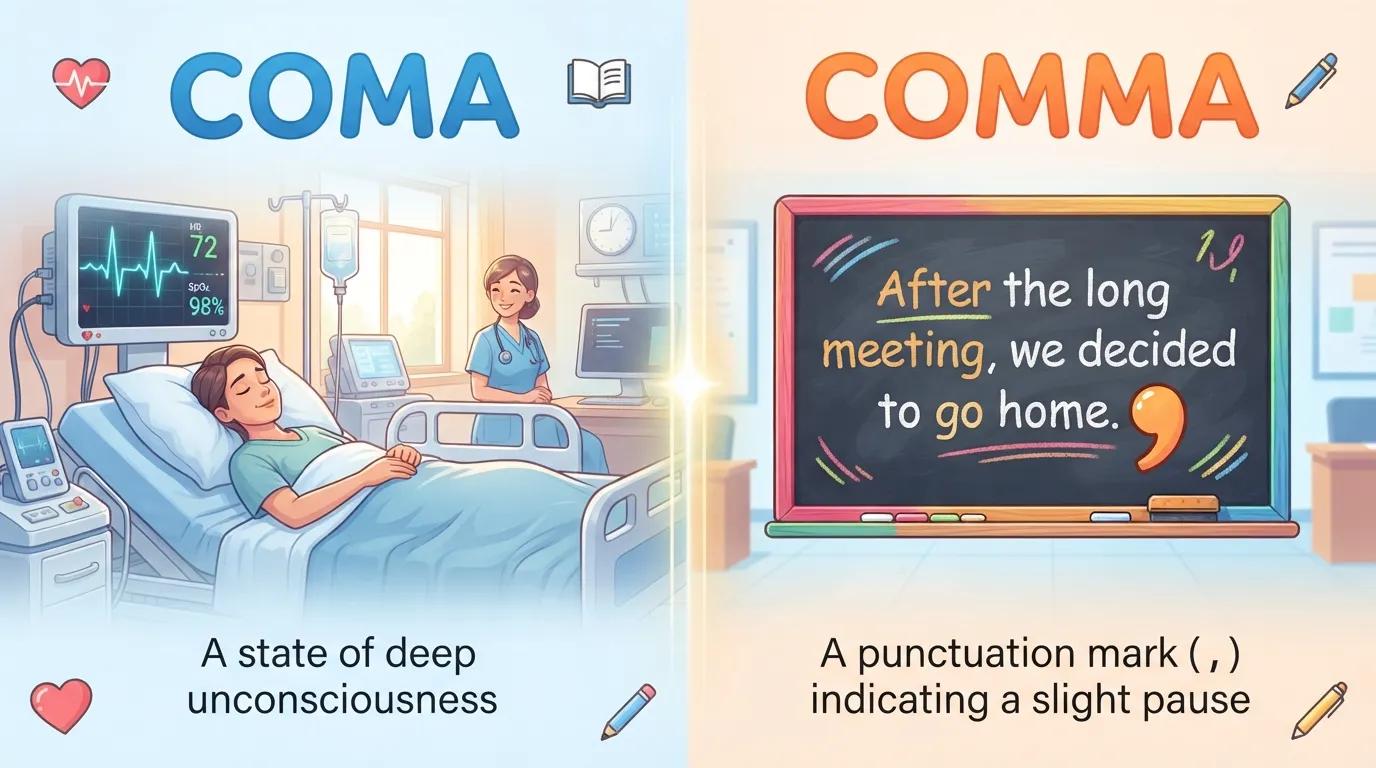
A coma is a serious medical condition in which a person is unconscious, while a comma is a punctuation mark used to separate words or parts of a sentence.
Imagine a teacher writing a sentence on the board: “After eating, Ali went home.” The teacher explains that the small mark after “eating” is a comma. Later that day, Ali hears about a patient in the hospital who is in a coma. Although these two words sound almost the same, their meanings are completely different. A comma helps us write clear sentences. A coma describes a medical state in which a person cannot wake up or respond normally. Many English learners search for “coma or comma” because these words have similar spellings and sounds. This can lead to mistakes in writing, speaking, and medical conversations. Learning the difference between coma and comma is important. One belongs to grammar, while the other belongs to medicine. Knowing when to use each word helps us communicate clearly and avoid embarrassing mistakes.
Pronunciation of Coma and Comma
WordUS PronunciationUK PronunciationComa/ˈkoʊmə//ˈkəʊmə/Comma/ˈkɑːmə//ˈkɒmə/
Both words have two syllables.
- Coma: CO-ma
- Comma: COM-ma
The first vowel sound is different in American and British English.
Read more about: https://suitmean.com/cancell-or-cancel/
Difference Between Coma and Comma
1. Meaning
The biggest difference between coma and comma is their meaning.
Coma means a deep state of unconsciousness. A person in a coma cannot wake up or respond normally.
Examples:
- The patient has been in a coma for three days.
- Doctors are watching the man who is in a coma.
Comma is a punctuation mark used in writing.
Examples:
- I bought apples, oranges, and bananas.
- After school, Sara went home.
2. Field of Use
The words belong to completely different fields.
Coma is mainly used in medicine and health.
Examples:
- The doctor explained the patient’s coma.
- The accident left him in a coma.
Comma is used in grammar, writing, and punctuation.
Examples:
- Add a comma after the introductory phrase.
- The comma makes the sentence easier to read.
3. Part of Speech
Both words can be nouns, but their functions are different.
Coma is a noun that names a medical condition.
Example:
- The coma lasted for several weeks.
Comma is a noun that names a punctuation mark.
Example:
- Put a comma between the two clauses.
4. Physical Condition vs Writing Mark
A coma describes a condition of the human body and brain.
Examples:
- The patient entered a coma after the accident.
- The doctors are trying to understand the cause of the coma.
A comma is a written symbol.
Examples:
- Use a comma before “but” in some compound sentences.
- The comma separates items in a list.
5. Symbol and Appearance
A coma is not a writing symbol.
A comma looks like this:
,
It is a small curved mark placed near the bottom of a line of writing.
Examples:
- Hello, John!
- We need milk, bread, and eggs.
A coma has no punctuation symbol.
Examples:
- The patient is still in a coma.
- His coma was caused by a serious injury.
6. Effect on Communication
A comma can change the meaning or clarity of a sentence.
Examples:
- Let’s eat, Grandma.
- Let’s eat Grandma.
The first sentence is a friendly invitation. The second sentence sounds dangerous because the comma is missing.
A coma affects a person’s ability to communicate.
Examples:
- The patient cannot speak while in a coma.
- Family members hope she will wake from her coma.
7. Common Context
The word coma often appears in hospital and medical reports.
Examples:
- The patient remains in a coma.
- He recovered after spending two weeks in a coma.
The word comma often appears in English lessons and writing instructions.
Examples:
- Check your comma placement.
- The editor removed an unnecessary comma.
8. Related Words
Words related to coma include:
- unconsciousness
- brain injury
- patient
- recovery
- hospital
Examples:
- The patient lost consciousness and entered a coma.
- Doctors are studying his brain injury.
Words related to comma include:
- punctuation
- sentence
- grammar
- clause
- list
Examples:
- The sentence needs a comma.
- Use commas to separate items in a list.
9. Importance of Correct Use
Using the wrong word can create confusion.
Incorrect:
- The patient was in a comma.
Correct:
- The patient was in a coma.
Incorrect:
- Please add a coma after the name.
Correct:
- Please add a comma after the name.
One wrong letter can change the entire meaning.
10. Memory Trick
A simple memory trick can help you remember the difference.
Coma = Medical Condition
Think of a hospital patient.
Comma = Writing Mark
Think of a sentence and punctuation.
Examples:
- The injured man was in a coma.
- The sentence needs a comma.
Remember: A coma affects a person. A comma affects a sentence.
Nature and Behaviour of Coma and Comma
Nature and Behaviour of Coma
A coma is a serious medical condition. It causes a person to remain unconscious for a long time. The person may not respond to voices, touch, or other forms of stimulation.
A coma can happen because of:
- Brain injuries
- Stroke
- Severe illness
- Lack of oxygen
- Certain medical conditions
A person in a coma needs medical care and close observation.
Nature and Behaviour of Comma
A comma is a punctuation mark. It helps organize words and ideas in a sentence.
A comma can:
- Separate items in a list.
- Show a short pause.
- Separate parts of a sentence.
- Make writing easier to understand.
Commas are small, but they play an important role in clear writing.
Why People Get Confused About Coma and Comma
People often confuse these words because they look and sound very similar.
Both words begin with “com.” They also have two syllables. However, their meanings are completely unrelated.
The confusion usually happens because of:
- Similar spelling.
- Similar pronunciation.
- Fast typing.
- Lack of grammar knowledge.
- Hearing the words without seeing them written.
For example, a learner may hear someone say “comma” and write “coma.” This mistake is common in English learning.
The best way to avoid confusion is to remember their meanings. One belongs to medicine, and the other belongs to punctuation.
Comparison Table
| Feature | Coma | Comma |
| Meaning | A state of deep unconsciousness | A punctuation mark |
| Field | Medicine | Grammar and writing |
| Part of speech | Noun | Noun |
| Used for | Describing a medical condition | Organizing sentences |
| Symbol | No symbol | , |
| Example | He is in a coma. | Add a comma here. |
| Related words | Patient, hospital, unconsciousness | Sentence, grammar, punctuation |
| Effect | Affects a person’s awareness | Affects written meaning |
| Common place | Hospitals and medical reports | Books, emails, and documents |
| Main purpose | Describes a health condition | Improves sentence clarity |
Similarities Between Coma and Comma
Although they are different, they have a few similarities:
- Both are nouns.
- Both have similar spellings.
- Both have two syllables.
- Both are commonly confused by English learners.
- Both are important words in their own fields.
The Origin of Coma and Comma
Origin of Coma
The word coma comes from the Greek word koma, meaning “deep sleep.” It entered medical language through Latin and later became common in English.
The original idea was connected to a deep or prolonged state of sleep. Today, coma refers to a serious condition of unconsciousness.
Origin of Comma
The word comma comes from the Greek word komma, meaning “something cut off” or “a short part.” It later entered Latin and English.
The meaning is connected to separating parts of writing. Over time, the comma became an important punctuation mark.
Although both words come from ancient Greek roots, they developed different meanings and uses.
British vs American English
There is little difference between British and American English in the meaning of coma and comma.
Coma
Both British and American English use coma with the same spelling.
Examples:
- The patient is in a coma.
- He recovered from a coma.
Comma
Both varieties also use comma with the same spelling.
Examples:
- Add a comma after the introduction.
- The sentence has too many commas.
Pronunciation Difference
American English usually says:
- Coma: /ˈkoʊmə/
- Comma: /ˈkɑːmə/
British English usually says:
- Coma: /ˈkəʊmə/
- Comma: /ˈkɒmə/
The spelling remains the same in both forms of English.
Which One Should You Use?
Use coma when talking about a medical condition.
Example:
- The patient has been in a coma since the accident.
Use comma when talking about punctuation or writing.
Example:
- Put a comma after the greeting in the letter.
For learners around the world, the best advice is simple: learn the meaning and context of each word.
If you are writing a medical report, use coma. If you are writing an essay, email, or sentence, you may need a comma.
Common Mistakes
Mistake 1: Using Comma for a Medical Condition
Incorrect:
- The man is in a comma.
Correct:
- The man is in a coma.
Mistake 2: Using Coma for Punctuation
Incorrect:
- Please put a coma between the words.
Correct:
- Please put a comma between the words.
Mistake 3: Confusing the Words in Speech
Incorrect:
- The teacher asked me to add a coma.
Correct:
- The teacher asked me to add a comma.
Mistake 4: Forgetting the Meaning
Incorrect thinking:
- Coma and comma mean the same thing.
Correct thinking:
- Coma relates to medicine.
- Comma relates to grammar.
Everyday Usage Examples
In Emails
Comma:
Dear Sarah,
Thank you for your message.
A comma is often used after greetings.
Social Media
Comma:
Let’s go, friends!
The comma helps separate the greeting from the main message.
News Reports
Coma:
The news reported that the injured driver remained in a coma after the accident.
In Formal Writing
Comma:
The researcher collected data from three cities, Lahore, Karachi, and Islamabad.
In Medical Conversations
Coma:
The doctor said that the patient is slowly recovering from the coma.
Usage Trends
Both words are common in English, but they are used in different situations.
The word comma appears much more often in everyday writing. Students, teachers, writers, journalists, and office workers use commas regularly.
The word coma is less common in daily conversation. It mainly appears in medical discussions, hospital reports, news stories, and health-related content.
Because comma is used so frequently in writing, learners are more likely to encounter it in English lessons.
However, coma remains an important word because understanding medical terms can help people communicate during emergencies.
Metaphors and Similes
Metaphors with Coma
The word coma is sometimes used figuratively to describe deep sleep or inactivity.
Examples:
- After the long journey, I fell into a coma-like sleep.
- The old project was in a coma for several years.
These are informal and figurative uses.
Metaphors with Comma
Comma is sometimes used figuratively to describe a pause.
Examples:
- Life needs a comma, not a full stop.
- Take a comma before making a big decision.
Here, the comma represents a short pause in life.
Connotative Meaning
Coma
The word coma usually has a serious or negative emotional meaning.
It may suggest:
- Fear
- Sadness
- Medical danger
- Uncertainty
Example:
- The family was worried because their loved one was in a coma.
Comma
The word comma usually has a neutral meaning.
It is connected with:
- Writing
- Grammar
- Learning
- Clarity
Example:
- The student learned how to use commas correctly.
A comma does not usually carry strong positive or negative emotions.
Idioms and Proverbs
There are no widely recognized traditional idioms specifically using coma and comma together. However, both words can appear in creative expressions.
Comma Expressions
This idea is sometimes compared to a comma in writing.
“Take a pause.”
Example:
- Before making a decision, take a comma-like pause and think carefully.
Medical Expressions Related to Coma
“Wake from a coma”
Example:
- The patient finally woke from a coma after several weeks.
“Fall into a coma”
Example:
- The injured man fell into a coma after the accident.
These are common expressions in medical and news writing.
Literature and Movies
Literature
Punctuation has played an important role in literature. Writers use commas to control rhythm, meaning, and pauses.
Many famous English writers, including Jane Austen and Charles Dickens, used punctuation carefully to shape their sentences.
Commas are especially important in novels, essays, poetry, and academic writing.
Movies
Medical comas are often shown in films and television dramas.
Examples include:
- Awakenings (1990), an American drama film directed by Penny Marshall, explores patients with severe neurological conditions.
- The Diving Bell and the Butterfly (2007), a French film, explores life after a serious brain condition.
- While You Were Sleeping (1995), an American romantic comedy, includes confusion surrounding a patient in a coma.
These films show how medical conditions can affect families and relationships.
Why This Difference Matters
Knowing the difference between coma and comma matters because words shape meaning.
For English learners, using the wrong word can make writing unclear or confusing. A grammar mistake may change a simple sentence into something completely different.
For doctors, nurses, and medical workers, correct language is especially important. Misunderstanding medical words can cause serious communication problems.
For society, clear communication helps people understand news, health information, school lessons, and important documents.
A small spelling difference can have a big effect. That is why learning similar words is an important part of improving English.
Usefulness in Daily Life
Understanding coma and comma is useful in many daily situations.
At School
Students need commas when writing essays, stories, and answers.
At Work
Employees use commas in emails, reports, and official documents.
In Hospitals
People may hear or read the word coma during medical emergencies.
While Reading News
News articles often use both words in different contexts.
During English Learning
Knowing the difference improves spelling, vocabulary, and communication skills.
These simple words are useful because they appear in different parts of everyday life.
Situational Preference
The choice between coma and comma depends entirely on the situation. If you are talking about a person who is unconscious, use coma. If you are discussing writing, punctuation, or sentence structure, use comma. In a hospital, a doctor may explain that a patient is in a coma. In a classroom, a teacher may ask students to add a comma to a sentence. For emails, essays, and social media posts, comma is the correct word when you need a punctuation mark. For medical news or health discussions, coma is the correct choice. Never choose based only on sound. Always think about the meaning and context.
Common Questions
1. What is the main difference between coma and comma?
A coma is a medical condition involving unconsciousness. A comma is a punctuation mark used in writing.
2. Do coma and comma sound the same?
No. They sound similar, but the vowel sounds are different.
3. Is coma a punctuation mark?
No. Coma is a medical term.
4. What does a comma look like?
A comma looks like this: ,
5. Can both coma and comma be nouns?
Yes. Both words are nouns, but they have different meanings.
6. Which word is used in grammar?
Comma is used in grammar and punctuation.
7. Which word is used in medicine?
Coma is used in medicine and healthcare.
Conclusion
The difference between coma and comma is simple but important. A coma is a serious medical condition in which a person remains unconscious and cannot respond normally. A comma is a small punctuation mark used to separate words, phrases, and parts of sentences. Although these words look and sound similar, they belong to completely different fields. Coma belongs to medicine, while comma belongs to grammar and writing. English learners often confuse these words because of their similar spelling. The best way to remember them is to connect each word with its meaning. Think of a hospital patient when you see the word coma. Think of a sentence when you see the word comma. Using the correct word helps make communication clear. Whether you are writing an email, studying English, reading the news, or discussing health, knowing this difference can prevent mistakes.
Remember this simple rule: Coma affects a person. Comma affects a sentence.

I’m Sultan Sikander, an English language specialist, SEO specialist, digital publisher, and researcher. I create clear, accurate, and well-researched content on English grammar, vocabulary, word meanings, and language comparisons, helping readers understand and use English with confidence.












1 thought on “Coma or Comma: The Simple Difference Everyone Should Know”