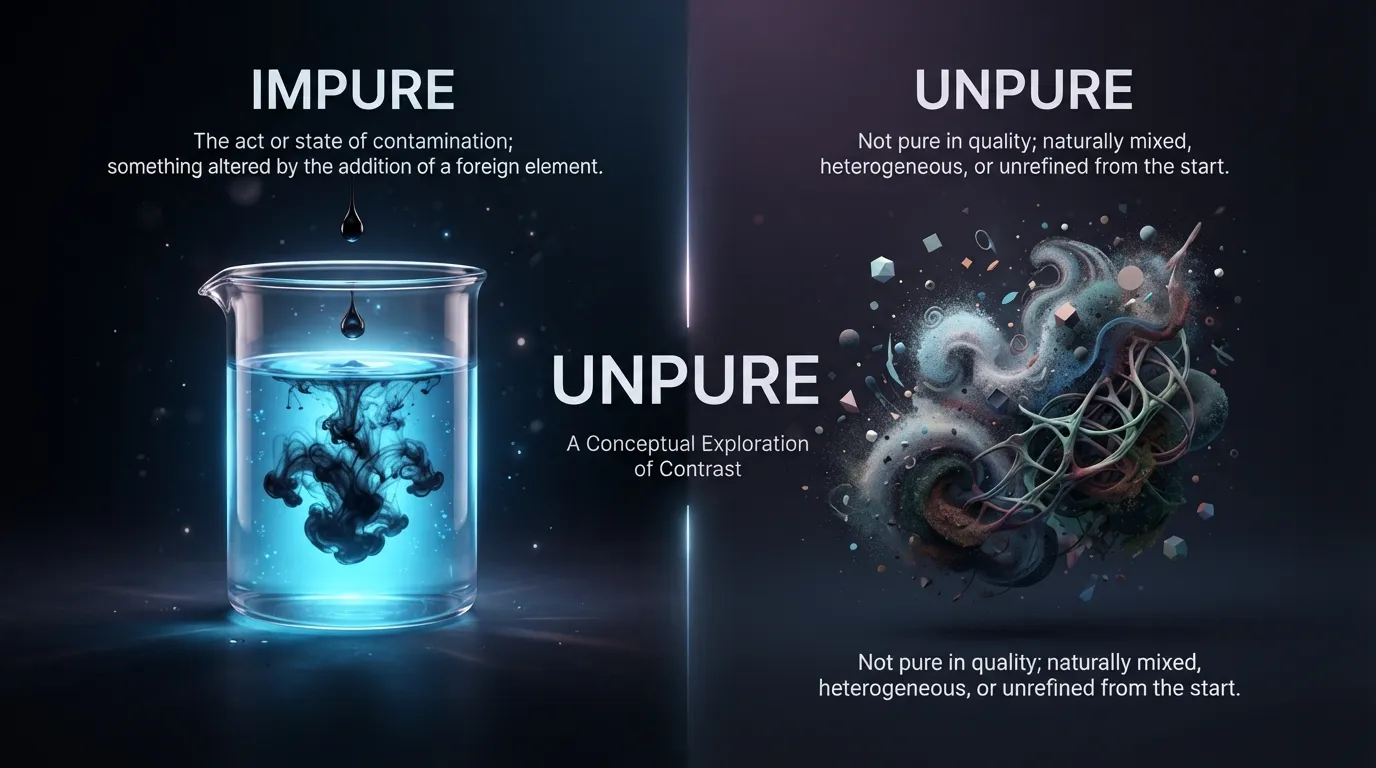
“Impure” is the correct and common English word. “Unpure” is rare and usually not recommended.
Imagine a student writing about water in a science class. He writes, “This water is unpure.” His teacher gently corrects him: “Use impure instead.” This small mistake is common because both words seem to have the same meaning. The word impure means not pure, clean, or free from unwanted things. The word unpure also appears in some dictionaries and old writings, but it is much less common in modern English. This is why many learners search for unpure or impure when they are unsure which word to use. Understanding unpure or impure helps you choose the right word in schoolwork, emails, reports, and daily conversations. In most cases, impure is the safer and more natural choice.
This article explains the difference between unpure and impure, their meanings, history, pronunciation, usage, and common mistakes in simple English.
Pronunciation
Impure
- US: /ɪmˈpjʊr/
- UK: /ɪmˈpjʊə/
Unpure
- US: /ˌʌnˈpjʊr/
- UK: /ˌʌnˈpjʊə/
Note: “Impure” is far more common in modern English.
Read more about: https://suitmean.com/stolen-or-stollen/
A Simple Transition
Now, let us look at the clear differences between these two words.
Difference Between Unpure and Impure
1. Meaning
Impure means something is not pure or clean.
Unpure also means not pure, but it is uncommon.
Examples:
- The water was impure.
- The scientist tested the impure chemical.
2. Common Usage
Impure is widely used in modern English.
Unpure is rarely used.
Examples:
- Doctors warn people about impure drinking water.
- The report found impure materials in the product.
3. Correctness in Modern English
Impure is the standard and accepted word.
Unpure is not usually considered wrong, but it sounds unusual.
Examples:
- Use “impure” in an English exam.
- Avoid “unpure” in formal writing unless you have a special reason.
4. Prefix Difference
“Impure” uses the prefix im-, which means “not.”
“Unpure” uses the prefix un-, which also means “not.”
Examples:
- Impure means not pure.
- Unpure means not pure.
5. Formal Writing
Impure is suitable for formal writing.
Unpure is uncommon in professional writing.
Examples:
- The laboratory discovered impure substances.
- The company removed impure ingredients from its products.
6. Scientific Use
Scientists commonly use impure to describe substances.
They rarely use unpure.
Examples:
- The sample contains impure metals.
- Impure water may contain harmful germs.
7. Natural Sound
“Impure” sounds natural to native English speakers.
“Unpure” may sound awkward or old-fashioned.
Examples:
- This oil is impure.
- This oil is unpure. (Uncommon)
8. Dictionary Recognition
Both words may appear in dictionaries, but their usage is very different.
Impure is the normal choice.
Unpure is much less frequent.
Examples:
- Most learners should remember “impure.”
- Writers should check context before using “unpure.”
9. Positive and Negative Meaning
Both words usually describe something that lacks purity.
Examples:
- Impure water is unsafe to drink.
- An impure material may affect product quality.
10. Best Choice for Learners
For students and English learners, impure is the best word to learn and use.
Examples:
- Write: “The water is impure.”
- Avoid writing: “The water is unpure.”
Nature and Behaviour of Unpure and Impure
Nature of Impure
Impure is a common adjective. It describes something that is mixed with unwanted substances or is not completely pure.
It can describe:
- Water
- Air
- Metals
- Chemicals
- Food
- Thoughts or intentions
Examples:
- Impure water can make people sick.
- The gold was impure.
Nature of Unpure
Unpure is also an adjective in some forms of English. It means not pure.
However, it is uncommon in everyday modern English. It may appear in older texts, religious writing, or creative language.
Example:
- The writer described the character as unpure.
For normal communication, “impure” is better.
Why People Get Confused About Unpure and Impure
People get confused because both words use prefixes that mean “not.”
English has many words beginning with un-, such as:
- Unhappy
- Unkind
- Unfair
- Unclear
This makes learners think “unpure” should be correct.
However, English does not always follow simple rules. Some words use im- instead of un-.
Examples:
- Pure → Impure
- Possible → Impossible
- Patient → Impatient
- Mature → Immature
That is why “impure” is the standard form.
Comparison Table
| Feature | Unpure | Impure |
| Meaning | Not pure | Not pure |
| Grammar | Adjective | Adjective |
| Modern Usage | Rare | Very common |
| Formal Writing | Less preferred | Preferred |
| Scientific Writing | Rare | Common |
| Everyday English | Uncommon | Natural |
| Dictionary Status | Found in some dictionaries | Standard word |
| Best Choice | Usually avoid | Use regularly |
Similarities
Both words:
- Are adjectives.
- Describe something that is not pure.
- Can relate to physical or moral qualities.
- Use a negative prefix.
The Origin of Unpure and Impure
The word pure comes from Latin purus, meaning clean or clear.
The prefix im- comes from Latin and means “not.” It is often used before words beginning with certain consonant sounds.
Over time, English developed the word impure as the natural opposite of pure.
The word unpure follows the general English pattern of adding “un-” to a word. It has appeared in older English texts, but it never became as common as “impure.”
Today, “impure” is the established word in standard English.
British vs American English
There is almost no difference between British and American English in the spelling or meaning of impure.
Both varieties use:
- Impure water
- Impure thoughts
- Impure substances
Examples:
American English: The sample was impure.
British English: The sample was impure.
The word “unpure” is uncommon in both varieties.
Which One Should You Use?
Use impure in almost every situation.
For American English
Use impure in school, work, science, and daily speech.
For British English
Use impure in formal and informal writing.
For Global English
Use impure because it is widely understood around the world.
Simple rule: When you mean “not pure,” choose impure.
Common Mistakes
Mistake 1: Using Unpure in Formal Writing
Incorrect: The water is unpure.
Correct: The water is impure.
Mistake 2: Thinking Un- Always Works
Incorrect: Unpossible
Correct: Impossible
Mistake 3: Using Both Words Interchangeably
While both may carry a similar meaning, impure is much more natural.
Mistake 4: Assuming Unpure Is Always Wrong
Unpure can appear in some dictionaries and older texts. It is not completely meaningless. However, it is rarely the best choice in modern English.
Everyday Usage Examples
In Emails
- Please ensure that the water supply is free from impure substances.
On Social Media
- Clean water is important because impure water can cause illness.
News
- Authorities warned residents about impure drinking water.
Formal Writing
- The study examined the effects of impure air on human health.
In Daily Conversation
- Do not drink impure water.
Usage Trends
Modern English strongly prefers impure over unpure.
Impure appears frequently in:
- Science
- Medicine
- Education
- Religion
- Literature
- Everyday conversations
Unpure is much less common. It may appear in historical texts, poetry, or unusual writing styles.
For learners, choosing impure will sound more natural and correct in most situations.
Metaphors and Similes
The word impure can also have a figurative meaning.
Metaphor
- His impure intentions caused trouble.
This means his intentions were dishonest or morally wrong.
Simile
- Her thoughts were as impure as dirty water.
This compares impure thoughts to something physically dirty.
Other Examples
- The river became a symbol of an impure society.
- His impure motives were hidden behind kind words.
Connotative Meaning
Positive Meaning
Neither impure nor unpure usually has a positive meaning.
Negative Meaning
Both words can suggest:
- Dirtiness
- Contamination
- Dishonesty
- Moral weakness
Example:
- The impure water was unsafe.
Neutral Meaning
In science, impure can be neutral and factual.
Example:
- The impure metal contained other elements.
Idioms and Proverbs
There are no very common English idioms using the exact word “impure.” However, the idea of purity appears in many expressions.
“Clean hands”
This means innocence or honesty.
Example:
- The manager left the company with clean hands.
“Pure as snow”
This means completely innocent or morally clean.
Example:
- The child was described as pure as snow.
“A wolf in sheep’s clothing”
This describes someone who appears good but has bad intentions.
Example:
- He looked kind, but he was a wolf in sheep’s clothing.
Literature and Movies
The idea of purity and impurity appears often in literature and movies.
Literature
- The Scarlet Letter (1850) by Nathaniel Hawthorne explores themes of morality, sin, and social judgment.
- The Picture of Dorian Gray (1890) by Oscar Wilde explores moral corruption and innocence.
These works show how purity can refer to both physical and moral qualities.
Movies
- The Green Mile (1999, United States) explores innocence, morality, and human nature.
- The Lord of the Rings: The Fellowship of the Ring (2001, New Zealand/United States) includes themes of good, evil, and moral purity.
The word impure is often connected with deeper ideas about human behavior and society.
Why This Difference Matters
Knowing the difference between unpure and impure helps learners write better English.
Students may lose marks if they use uncommon words in formal writing. Professionals need clear language in reports, emails, and documents.
This difference also matters because language changes over time. Some words may exist in dictionaries but still sound unusual in modern communication.
Understanding common usage helps society communicate more clearly. When people choose familiar and standard words, messages are easier to understand.
For English learners, learning “impure” as the main opposite of “pure” prevents confusion and improves vocabulary.
Usefulness in Daily Life
The word impure is useful in many situations.
You may use it when talking about:
- Drinking water
- Food quality
- Air pollution
- Chemical products
- Gold and metals
- Moral behavior
- Religious ideas
- Personal intentions
Examples:
- The water became impure after the flood.
- The gold was impure and needed cleaning.
- Pollution makes the air impure.
- His impure motives were discovered.
Situational Preference
In almost every situation, choose impure instead of unpure. Use impure in school assignments, business emails, scientific reports, news writing, and everyday conversations. The word is clear, common, and accepted in both British and American English. Unpure may be used in rare literary, historical, or creative contexts, but it can sound strange to modern readers. If you are unsure which word to use, remember this simple rule: pure becomes impure when you want to express the opposite meaning.
Questions
Is unpure a correct English word?
Yes, unpure can be found in some dictionaries and older texts. However, it is rare in modern English.
Is impure the correct word?
Yes. Impure is the standard and most commonly used word meaning not pure.
What is the difference between unpure and impure?
Both mean not pure, but impure is much more common and natural in modern English.
Can I use unpure in formal writing?
It is better to avoid unpure in formal writing. Use impure instead.
Why does English use impure instead of unpure?
English uses different prefixes for different words. Impure comes from Latin-based word formation.
Is impure used in British English?
Yes. Impure is commonly used in both British and American English.
What is the opposite of pure?
The standard opposite of pure is impure.
Conclusion
The difference between unpure and impure is simple. Both words can mean something that is not pure, but impure is the correct and common choice in modern English. Impure is widely used in science, education, formal writing, and daily conversations. It can describe water, air, food, metals, chemicals, thoughts, and intentions. Unpure is much less common and may sound unusual to native English speakers. For students, writers, and English learners, the best rule is easy: use impure when you mean “not pure.” You do not need to worry about using unpure in normal communication. Understanding this small difference can improve your grammar, vocabulary, and writing skills. English has many words that do not follow simple prefix rules, so learning common usage is important. When in doubt, choose the word that native speakers use most often.
Remember: Pure → Impure is the standard word pair.

I’m Sultan Sikander, an English language specialist, SEO specialist, digital publisher, and researcher. I create clear, accurate, and well-researched content on English grammar, vocabulary, word meanings, and language comparisons, helping readers understand and use English with confidence.










2 thoughts on “Unpure or Impure: What Is the Correct Word?”