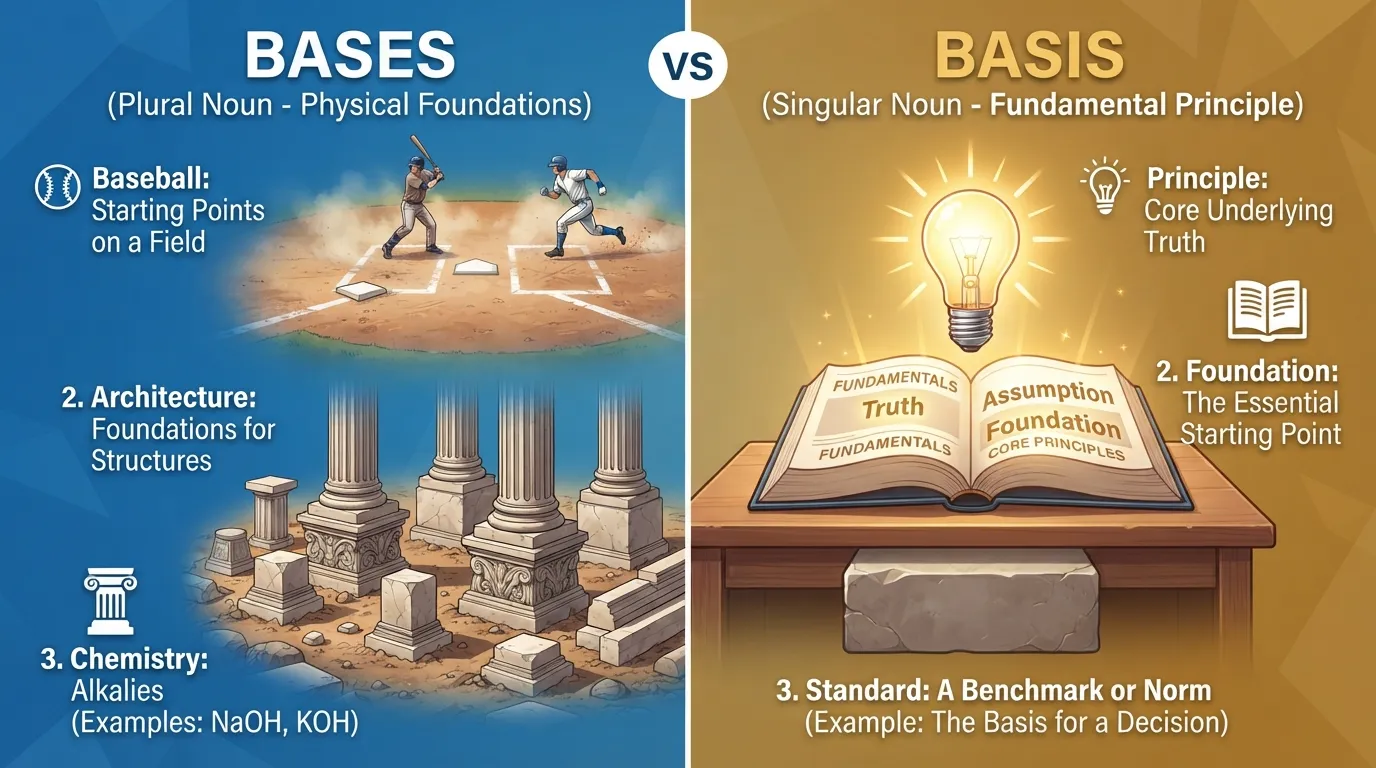
“Basis” means one foundation or reason, while “bases” means more than one foundation, place, or base.
Imagine your teacher asks why you chose a certain topic for your project. You might say, “I chose this topic on the basis of my interest.” Here, basis means the reason or foundation for your choice. Now imagine a company has offices in three cities. You can say, “The company has several bases around the country.”
The words bases or basis often confuse English learners because they look almost the same. They are both connected to the word “base,” but they are used differently. Basis is usually a singular noun. Bases is the plural form of base. People search for bases or basis because they want to know which word fits their sentence. This confusion is common in emails, school assignments, reports, and daily conversations. Understanding the difference between bases and basis helps you write clearly and avoid grammar mistakes.
See more about: https://suitmean.com/coma-or-comma/
Pronunciation
WordUS PronunciationUK PronunciationBasis/ˈbeɪ.sɪs//ˈbeɪ.sɪs/Bases/ˈbeɪ.siːz//ˈbeɪ.siːz/
Basis sounds like “bay-sis.”
Bases sounds like “bay-seez.”
Transition
Now that you know the basic meaning, let us explore the difference between bases and basis in detail.
Difference Between Bases and Basis
1. Singular and Plural
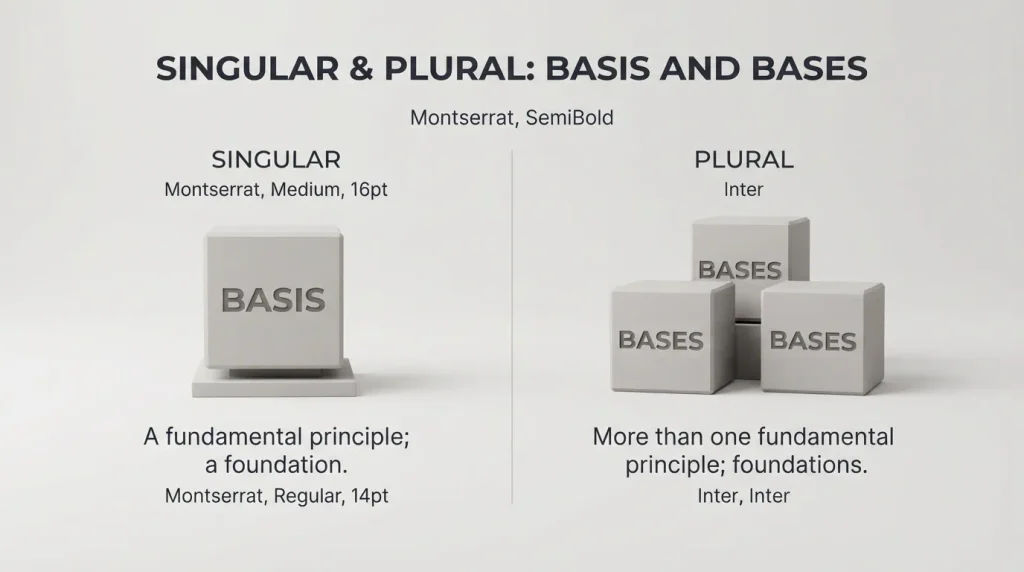
Basis is singular. It refers to one foundation, reason, or principle.
Bases is plural. It refers to more than one base or foundation.
Examples:
- Trust is the basis of friendship.
- The company has offices at several bases.
2. Meaning of Basis
Basis means the main reason or foundation for something.
It can also mean the starting point for an idea or decision.
Examples:
- The decision was made on the basis of facts.
- Hard work is the basis of success.
3. Meaning of Bases
Bases is the plural form of base. A base can mean a place, foundation, bottom part, or starting point.
Examples:
- The military has several bases.
- The table has four bases for support.
4. Number of Things
Basis refers to one thing.
Bases refers to two or more things.
Examples:
- This rule is the basis of the plan.
- These rules form the bases of the plan.
5. Use in Reasoning
Basis is often used when explaining reasons.
Examples:
- We selected her on the basis of experience.
- The judge made a decision on a legal basis.
Bases is not normally used to mean one reason.
6. Use in Science and Mathematics
Basis can mean a starting principle or set of ideas.
Bases can refer to chemical substances or mathematical foundations.
Examples:
- The theory has a strong scientific basis.
- Acids and bases are important in chemistry.
7. Use in Business
Basis is common in business decisions.
Examples:
- Employees are paid on a monthly basis.
- The contract was created on a legal basis.
Bases may refer to business locations.
Examples:
- The airline operates from several bases.
- The company has international bases.
8. Grammar Pattern
Basis is usually used with singular verbs.
Examples:
- The basis of the plan is clear.
- The basis for his decision was strong.
Bases can be used with plural meanings.
Examples:
- The bases of the buildings are strong.
- Military bases protect important areas.
9. Common Expressions
Common phrases with basis include:
- On the basis of
- On a daily basis
- On a regular basis
- The basis for something
Examples:
- We hired him on the basis of his skills.
- She exercises on a daily basis.
10. Root Word Connection
Basis comes from the Greek word basis, meaning foundation or step.
Bases comes from the word base.
Examples:
- Basis = one foundation.
- Bases = more than one base.
Nature and Behaviour of Bases and Basis
Nature of Basis
Basis is a singular noun. It describes a reason, foundation, or principle.
It is often used in formal English. You can find it in reports, academic writing, business documents, and legal writing.
Examples:
- The basis of the argument is clear.
- We made the decision on the basis of evidence.
Nature of Bases
Bases is the plural form of base.
It can refer to multiple physical places, foundations, or chemical substances.
Examples:
- The army has several bases.
- Scientists study acids and bases.
Why People Get Confused About Bases and Basis
The main reason is their similar spelling.
Many learners see the letters “basis” and “bases” and think they are interchangeable. However, they have different meanings and pronunciations.
Another reason is that bases is the plural form of base, while basis is a completely different word.
Remember this simple rule:
- Basis = one reason or foundation.
- Bases = more than one base.
Comparison Table
| Feature | Basis | Bases |
| Meaning | Foundation or reason | Plural of base |
| Number | Singular | Plural |
| Pronunciation | BAY-sis | BAY-seez |
| Root | Greek basis | English base |
| Common use | Reasons and principles | Places, foundations, chemicals |
| Example | Basis of a decision | Military bases |
| Grammar | Singular noun | Plural noun |
Similarities
- Both are nouns.
- Both relate to the word base.
- Both can describe foundations or starting points.
- Both are common in formal and academic English.
The Origin of Basis and Bases
Origin of Basis
The word basis comes from Ancient Greek basis, meaning a step, foundation, or something on which another thing stands.
Later, it entered Latin and then English. Today, basis often means the main reason or foundation for an idea.
Origin of Bases
Bases comes from the English word “base.” The word base has roots in Old French and Latin.
Base can mean the bottom part of something, a starting point, or a place where people work or live.
The plural form of base is bases.
British vs American English
There is no major spelling difference between British and American English for these words.
Both varieties use:
- Basis for one foundation or reason.
- Bases for more than one base.
Examples:
| American English | British English |
| On a daily basis | On a daily basis |
| Military bases | Military bases |
| Basis of the decision | Basis of the decision |
The pronunciation and spelling remain the same in both forms of English.
Which One Should You Use?
Use basis when you mean one reason, foundation, or principle.
Use bases when you mean more than one base.
For US English
Use the same rules. Basis is singular, and bases is plural.
For UK English
The same grammar rules apply.
For Global English
Focus on the meaning, not just the spelling.
Ask yourself:
“Am I talking about one reason or more than one base?”
If the answer is one reason, use basis.
Common Mistakes
Mistake 1: Using Bases for One Reason
Incorrect:
- Trust is the bases of friendship.
Correct:
- Trust is the basis of friendship.
Mistake 2: Using Basis for Multiple Locations
Incorrect:
- The army has several basis.
Correct:
- The army has several bases.
Mistake 3: Wrong Pronunciation
Incorrect pronunciation:
- Basis pronounced like “bay-seez.”
Correct pronunciation:
- Basis sounds like “bay-sis.”
Mistake 4: Confusing Basis With Base
Incorrect:
- The basis of the building is damaged.
This may be correct only if you mean the foundation of an idea or plan. For a physical structure, “base” may be better.
Correct:
- The base of the building is damaged.
Everyday Usage Examples
In Emails
- We made this decision on the basis of your feedback.
- Our company operates from several bases.
On Social Media
- Trust is the basis of every strong relationship.
- These are the bases of our success.
In News
- The government made the decision on the basis of new evidence.
- Military bases were built in remote areas.
In Formal Writing
- The research provides a strong basis for further study.
- The chemical reaction involves acids and bases.
Usage Trends
Basis is more common in formal writing, business, education, and law.
It often appears in phrases such as:
- On the basis of
- On a regular basis
- On a daily basis
- The basis for
Bases is common in science, geography, military writing, and mathematics.
It is also used in everyday conversations when talking about several locations or foundations.
Metaphors and Similes
Basis as a Metaphor
Basis can describe the foundation of an idea or relationship.
Examples:
- Honesty is the basis of a strong friendship.
- Education is the basis of a better future.
Bases as a Metaphor
Bases can describe several starting points or support systems.
Examples:
- Family and education are the bases of a happy life.
- Knowledge and practice are the bases of success.
Connotative Meaning
Basis
Basis usually has a neutral or positive meaning.
Positive example:
- Trust is the basis of a healthy relationship.
Neutral example:
- The report was prepared on the basis of facts.
Bases
Bases usually has a neutral meaning.
Positive example:
- Strong bases support a stable building.
Neutral example:
- The company has bases in different countries.
The meaning depends on the sentence and situation.
Idioms and Proverbs
There are no famous idioms using only the exact words “basis” or “bases.” However, several common expressions use basis.
On the Basis Of
Meaning: Because of something or using something as a reason.
Example:
- The teacher gave him extra time on the basis of his illness.
On a Daily Basis
Meaning: Every day.
Example:
- She checks her emails on a daily basis.
On a Regular Basis
Meaning: Often or regularly.
Example:
- We meet on a regular basis.
Literature and Movies
Literature
The word basis appears often in academic books, philosophy, and classic literature.
For example, philosophical writings by Aristotle and Plato discuss the basis of knowledge, truth, and society.
Modern novels and essays also use basis when discussing ideas and human relationships.
Movies
The word bases may appear in science-fiction and military movies.
Examples include:
- Apollo 13 (1995, United States), which includes space missions and scientific ideas.
- The Martian (2015, United States), which discusses science, problem-solving, and survival.
These works show how both words can appear in different subjects.
Why This Difference Matters
Knowing the difference between basis and bases helps you communicate clearly.
A wrong word can change the meaning of your sentence. For example, “the basis of success” means the foundation of success. But “the bases of success” means several foundations of success.
This difference matters for:
- Students writing assignments.
- Professionals writing reports.
- Writers creating articles.
- Scientists describing chemical substances.
- People communicating in daily life.
Correct word choice makes your writing easier to understand.
Usefulness in Daily Life
You can use these words in many situations.
At School
- Education is the basis of knowledge.
- The bases of the project include research and teamwork.
At Work
- Decisions should be made on the basis of facts.
- Our company has offices at several bases.
In Science
- Acids and bases are important in chemistry.
In Daily Conversation
- Trust is the basis of friendship.
- These are the bases of our plan.
Situational Preference
Choose “basis” when you are talking about one reason, foundation, or principle. It is common in formal writing and daily expressions such as “on the basis of facts” and “on a regular basis.” Choose “bases” when you mean more than one base. This can refer to physical locations, support points, or chemical substances. For example, a company may have several bases, while a decision may have one clear basis. Always check the meaning before choosing the word. If you mean one foundation, use basis. If you mean multiple bases, use bases.
FAQs
1. What is the main difference between basis and bases?
Basis means one foundation or reason. Bases means more than one base.
2. Is basis singular or plural?
Basis is singular.
3. What is the plural of basis?
The plural of basis is bases.
4. How do you pronounce basis?
Basis is pronounced “BAY-sis.”
5. How do you pronounce bases?
Bases is pronounced “BAY-seez.”
6. Can basis mean reason?
Yes. Basis can mean the reason or foundation for something.
Example: “The decision was made on the basis of facts.”
7. Is bases used in chemistry?
Yes. Bases are substances that can react with acids.
Conclusion
The difference between bases and basis is simple once you understand their meanings. Basis is a singular noun. It means one foundation, reason, or principle. Bases is the plural form of base. It means more than one base, location, foundation, or chemical substance. The words look similar, but they are not interchangeable. Use basis when talking about the foundation of an idea, decision, relationship, or action. Use bases when talking about several physical locations, support points, or chemical substances.
Remember this easy rule:
Basis = one reason or foundation. Bases = more than one base.
Both words are important in everyday English. You may see basis in emails, reports, schoolwork, and formal writing. You may see bases in science, geography, business, and military topics. Learning this small difference can improve your spelling, grammar, and communication skills. With regular practice, choosing between bases and basis will become easy.

I’m Sultan Sikander, an English language specialist, SEO specialist, digital publisher, and researcher. I create clear, accurate, and well-researched content on English grammar, vocabulary, word meanings, and language comparisons, helping readers understand and use English with confidence.