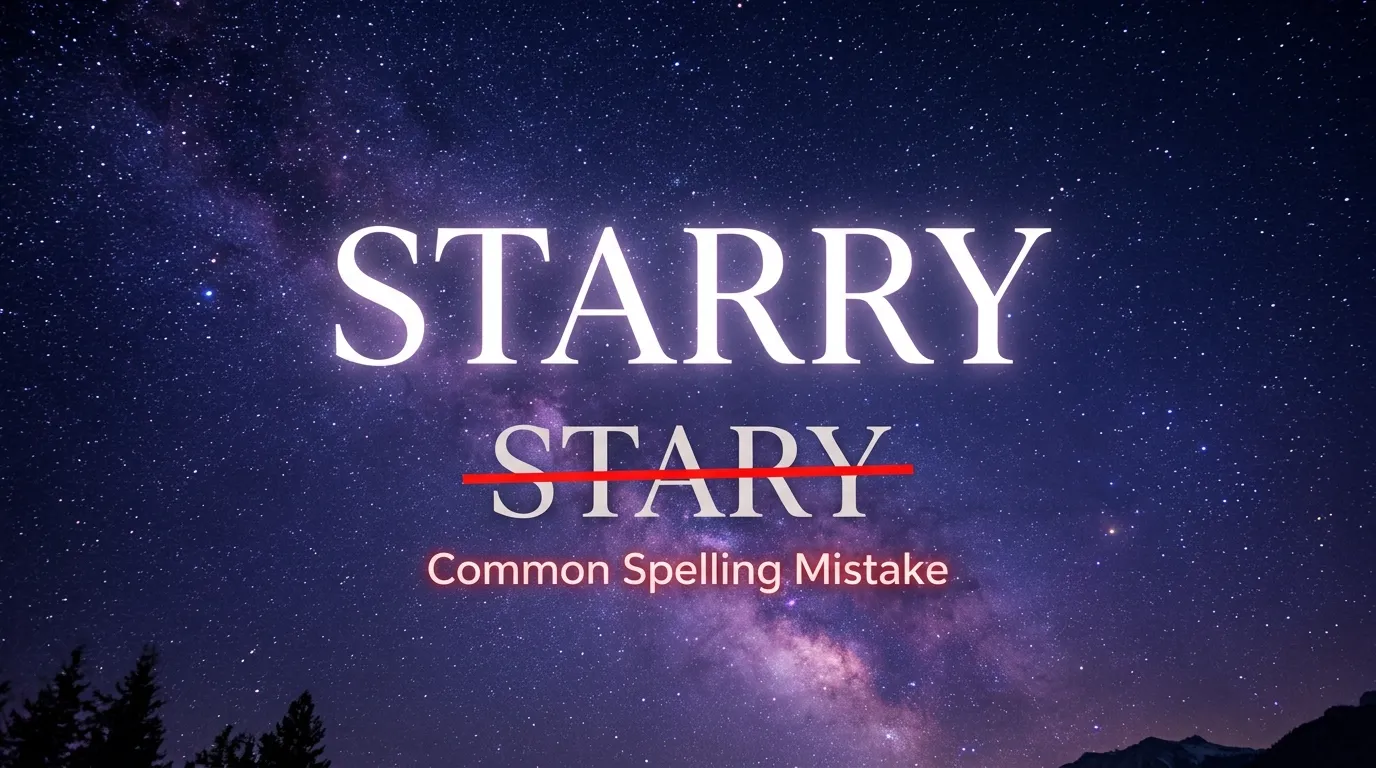
Starry is the usual correct word when you mean full of stars, covered with stars, or like stars.
Imagine a child looking at the night sky. The sky is dark. Many bright stars shine above. The child says, “What a beautiful starry sky!” The word starry describes the sky because it has many stars. Many English learners search for stary or starry because the two spellings look almost the same. The extra r can be easy to miss. In normal modern English, starry is the standard word for things connected with stars. It can describe a sky, night, eyes, light, or a beautiful view. Stary has a different and much less common history. Dictionaries record it as an alternative spelling of starey, meaning something related to staring. It can also appear in old or special uses. It is not the normal spelling for a sky filled with stars.
Knowing the difference between stary or starry helps you avoid spelling errors. It also helps you understand famous phrases such as “starry night” and “starry-eyed.”
Pronunciation
Starry
- US: /ˈstɑːr.i/
- UK: /ˈstɑː.ri/
Stary
- US: /ˈstɛr.i/
- UK: /ˈstɛə.ri/
The two words can sound different because stary comes from stare, while starry comes from star.
Check out: https://suitmean.com/unpure-or-impure/
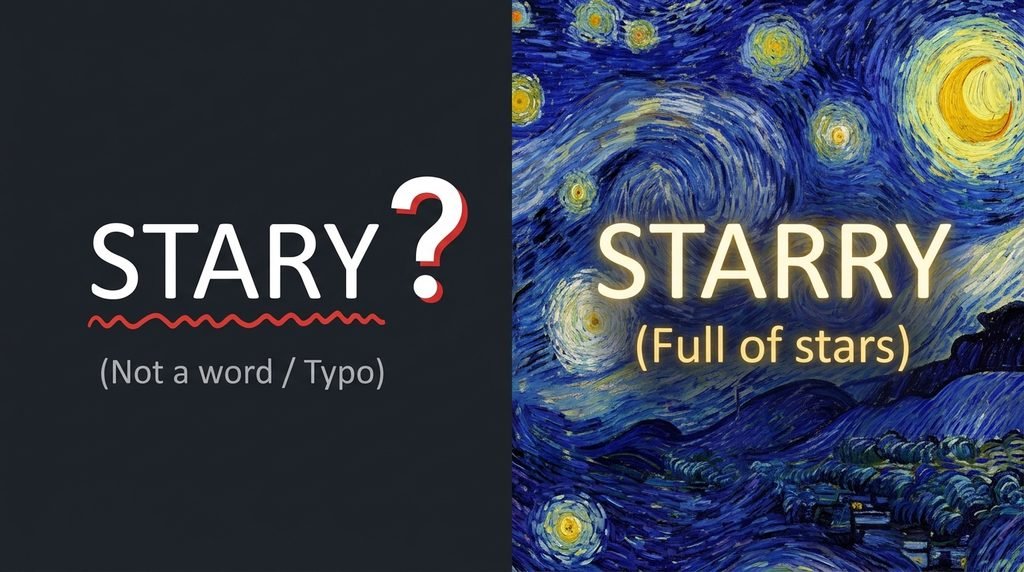
Difference Between Stary or Starry
1. Basic meaning
Starry means full of stars or related to stars.
Stary can be an alternative spelling of starey, which means showing or connected with staring.
Examples:
- We walked under a starry sky.
- The desert looked beautiful on the starry night.
- He gave me a stary look.
- Her eyes looked stary after hours of watching the screen.
2. Standard English use
Starry is a normal English adjective.
Stary is rare. It is not the usual spelling when you want to talk about stars.
Examples:
- We watched the starry sky.
- She loves starry nights.
3. Connection with stars
Starry has a direct connection with the word star.
Examples:
- The starry sky was clear.
- We enjoyed the starry view.
Stary does not normally mean “full of stars.”
Examples:
- ❌ We saw a stary sky.
- ✔ We saw a starry sky.
4. Connection with staring
Stary may be used as an alternative spelling of starey. The word comes from stare.
Examples:
- He had a stary look.
- The child had a stary expression.
Starry does not mean “looking for a long time.”
Examples:
- ✔ She gave me a starry look.
- ✔ She gave me a stary look.
The meaning depends on the word being used.
5. Spelling
Starry has two r’s.
Stary has one r.
Examples:
- ✔ starry night
- ❌ stary night
- ✔ starry sky
- ❌ stary sky
6. Common phrases
Starry appears in many familiar phrases.
Examples:
- starry sky
- starry night
Stary is much less common.
Examples:
- stary eyes can appear in the sense of starey eyes.
- stary look can describe a fixed or staring look.
7. Frequency
Starry is widely understood.
Stary is rare in normal English writing.
Examples:
- “The night was starry.” ✔
- “The sky was stary.” ✘
8. Formal writing
Use starry when writing about stars.
Examples:
- The poem describes a starry night.
- The report mentions a clear starry sky.
Avoid using stary to mean “full of stars.”
Examples:
- ❌ The painting shows a stary sky.
- ✔ The painting shows a starry sky.
9. Poetry and creative writing
Starry is common in poems, stories, songs, and creative writing.
Examples:
- A starry sky covered the quiet town.
- She dreamed beneath the starry heavens.
Stary is not the normal choice for this meaning.
10. Easy spelling rule
Remember this simple idea:
Star + ry = starry
The word keeps the double r.
Examples:
- star → starry
- sun → sunny
- fog → foggy
For the meaning connected with stars, remember the double r in starry.
Nature and Behaviour of Stary or Starry
Nature of starry
Starry is an adjective. It describes something connected with stars.
It can describe:
- a sky
- a night
- light
- eyes
- dreams
- patterns
- pictures
Examples:
- We slept under a starry sky.
- Her dress had a starry pattern.
It can also have a figurative meaning. Starry-eyed can describe someone who is very hopeful or idealistic.
Nature of stary
Stary is rare in English. Wiktionary records it as an alternative spelling of starey. It comes from stare + -y.
It may describe a person or expression that looks fixed or staring.
Examples:
- He had a stary expression.
- Her stary eyes showed surprise.
For ordinary writing about stars, use starry.
Why People Get Confused About Stary or Starry
The confusion comes from the spelling.
The words look almost the same.
The only major spelling difference is one extra r:
- stary
- starry
People may type stary when they mean starry.
The famous phrase “starry night” can also cause confusion because people often hear the word before they see it written.
A simple memory trick is:
Many stars = two r’s = starry.
Comparison Table
| Feature | Stary | Starry |
| Spelling | stary | starry |
| Common in English | Rare | Common |
| Main connection | Stare | Star |
| Meaning | Alternative form of starey | Full of or related to stars |
| Part of speech | Adjective | Adjective |
| Normal word for a night sky | No | Yes |
| Used in creative writing | Rare | Common |
| Used in formal writing | Rare | Yes |
| Example | a stary look | a starry sky |
| Double r | No | Yes |
Similarities
These words can work as adjectives.
Both can describe something about appearance.
Both are connected to visual description.
Their spellings are very close.
Their meanings are different.
The Origin of Stary or Starry
The history of starry goes back to the noun star. The word star comes from Old English steorra and is related to older Germanic words. It traces back to the Proto-Indo-European root associated with “star.”
Starry appeared in English in the late 14th century. It meant “filled with or lit by stars.” Later, it also developed the meaning “shining like a star.”
Stary has a different history in English. It is recorded as an alternative spelling of starey, formed from stare + -y. A historical English dictionary also records an older technical use connected with cloth whose separate threads could be seen clearly.
British vs American English
There is no normal British-American spelling change between starry and starry.
Both British and American English use:
starry
Examples:
- British English: We walked under a starry sky.
- American English: We walked under a starry sky.
The pronunciation has a small regional difference. Cambridge gives UK /ˈstɑː.ri/ and US /ˈstɑːr.i/.
Stary is not a British or American replacement for starry.
Which One Should You Use?
For US English
Use starry when you mean full of stars.
Example:
- It was a beautiful starry night.
For UK English
Use starry for the same meaning.
Example:
- We looked at the starry sky.
For global English
Use starry when describing stars.
It is clear and widely understood.
Use stary only when you have a special reason, such as a proper name or the rare adjective meaning related to staring.
Common Mistakes
Mistake 1: Using stary for a sky
❌ The stary sky was beautiful.
✔ The starry sky was beautiful.
Mistake 2: Writing stary night
❌ We enjoyed a stary night.
✔ We enjoyed a starry night.
Mistake 3: Forgetting the second r
❌ The stars made the night stary.
✔ The stars made the night starry.
Mistake 4: Thinking starry and stary always mean the same thing
They do not.
Starry is linked to stars.
Stary can be linked to staring in its rare English use.
Mistake 5: Using stary in school work
For normal school writing about stars, use starry.
Everyday Usage Examples
In emails
- We enjoyed a starry evening during our trip.
- The campsite had a clear starry sky.
On social media
- “A quiet night under the starry sky.”
- “Nothing beats a beautiful starry night.”
In news writing
- “The clear weather created a starry sky over the city.”
In formal writing
- “The poem uses a starry sky as an image of hope.”
Conversation
- “Look at that starry sky!”
- “It is such a beautiful starry night.”
Usage Trends
Starry is the normal word used in modern English when people describe stars.
It appears in everyday speech, books, poems, art, film titles, social media, and travel writing.
The word also has a strong cultural presence through famous works such as Vincent van Gogh’s The Starry Night.
Stary is much less common. It can appear as a rare English adjective, a proper name, or in other languages. It should not be used as a casual replacement for starry.
Metaphors and Similes
Starry can create strong pictures in writing.
Metaphor
- Her eyes were starry lights in the dark.
This compares her eyes with stars.
Simile
- His smile was like a starry sky.
This compares his smile with a beautiful sky.
Another example
- The city looked like a starry blanket at night.
The lights of the city are compared with stars.
Connotative Meaning
Positive meaning
Starry often has a positive feeling.
It can suggest:
- beauty
- peace
- hope
- dreams
- wonder
Example:
- We sat under the starry sky and talked for hours.
Negative meaning
The word can sometimes have a less practical meaning in starry-eyed.
A starry-eyed person may be very hopeful and may not think enough about real problems. Merriam-Webster lists a related sense of starry connected with idealistic thinking.
Example:
- His starry-eyed plan ignored the cost.
Neutral meaning
Starry can simply describe a sky.
Example:
- The night was clear and starry.
Idioms and Proverbs
There is no major common English proverb built around stary.
Starry-eyed is a well-known expression.
It means very hopeful, dreamy, or idealistic.
Example:
- She was starry-eyed about her new career.
Another common expression is reach for the stars.
It means to aim for a very high goal.
Example:
- Never be afraid to reach for the stars.
The word starry is also used in phrases such as:
- starry sky
- starry night
- starry eyes
- starry-eyed
Literature and Movies
Literature
Stars have appeared in English literature for centuries. The adjective starry is especially common in poetry and descriptive writing.
William Shakespeare used star imagery in works such as Romeo and Juliet, first performed around 1595. The phrase star-crossed lovers became one of the best-known star-related expressions in English.
The word starry is also common in romantic poetry because it creates a picture of the night sky.
Art
Vincent van Gogh’s famous painting The Starry Night was painted in 1889. The Van Gogh Museum identifies it as a work from 1889 and notes that the painting is held by The Museum of Modern Art in New York.
Movies
The word starry also appears in movie and media titles.
For example, La La Land (2016, United States) uses star and dream imagery throughout its story.
The phrase starry-eyed also appears often in films, songs, and television because it can describe a dreamy or hopeful person.
Why This Difference Matters
Correct spelling makes writing clear.
A small spelling change can change the meaning of a word. Starry tells the reader that something is connected with stars. Stary may point to the rare word related to staring.
Students need the correct form for school work.
Writers need it for clear descriptions.
English learners need it to build strong spelling habits.
Good spelling also helps readers understand messages quickly. It makes emails, posts, stories, and formal work easier to read.
The difference is small, but learning it can prevent repeated mistakes.
Usefulness in Daily Life
You may need starry when you:
- describe the night sky
- write a story
- write a poem
- post a travel photo
- describe a painting
- talk about camping
- write a school assignment
- describe a beautiful evening
Examples:
- We slept under a starry sky.
- The beach looked beautiful on the starry night.
- She painted a starry scene.
- The children watched the starry sky.
Situational Preference
Use starry in almost every normal situation when you mean something related to stars. Use it in school work, emails, stories, poems, social media posts, and formal writing. It is the clear choice for phrases such as starry sky and starry night. Stary has a rare English use related to starey, so it may appear when a writer wants to describe a staring look or expression. It can also appear as a name or in another language. Check the meaning before using it. For global English, starry is the safer and clearer word when talking about stars.
FAQs
1. Is stary or starry correct?
Starry is the normal word when you mean full of stars or related to stars.
2. Is stary a real English word?
Yes, but it is rare. English dictionaries record stary as an alternative spelling of starey. It can relate to staring.
3. Why does starry have two r’s?
Starry comes from star with the adjective ending -y. The standard spelling has two r’s.
4. Which is correct: stary sky or starry sky?
Starry sky is correct when you mean a sky filled with stars.
5. Is starry used in both British and American English?
Yes. Both use starry. The pronunciation has a small regional difference.
6. What does starry-eyed mean?
Starry-eyed means very hopeful, dreamy, or idealistic.
Example:
- The young artist was starry-eyed about her future.
7. How can I remember the spelling of starry?
Remember:
Stars = double r = starry.
Conclusion
The difference between stary or starry is simple once you look at the meaning. Starry is the normal English word for something full of stars, covered with stars, or connected with stars. It is used in phrases such as starry sky and starry night.
Stary is much less common. It can be an alternative spelling of starey, which is related to staring, may also appear as a name or in another language. It is not the usual word for a sky filled with stars. Both British and American English use starry for the normal meaning. The main difference is pronunciation, not spelling. The easiest way to remember the correct spelling is simple: starry has two r’s. Think of the many stars in the sky and remember the extra r.
So, when you write about stars, choose starry.
Correct: The night was starry.
Usually incorrect for this meaning: The night was stary.

I’m Sultan Sikander, an English language specialist, SEO specialist, digital publisher, and researcher. I create clear, accurate, and well-researched content on English grammar, vocabulary, word meanings, and language comparisons, helping readers understand and use English with confidence.