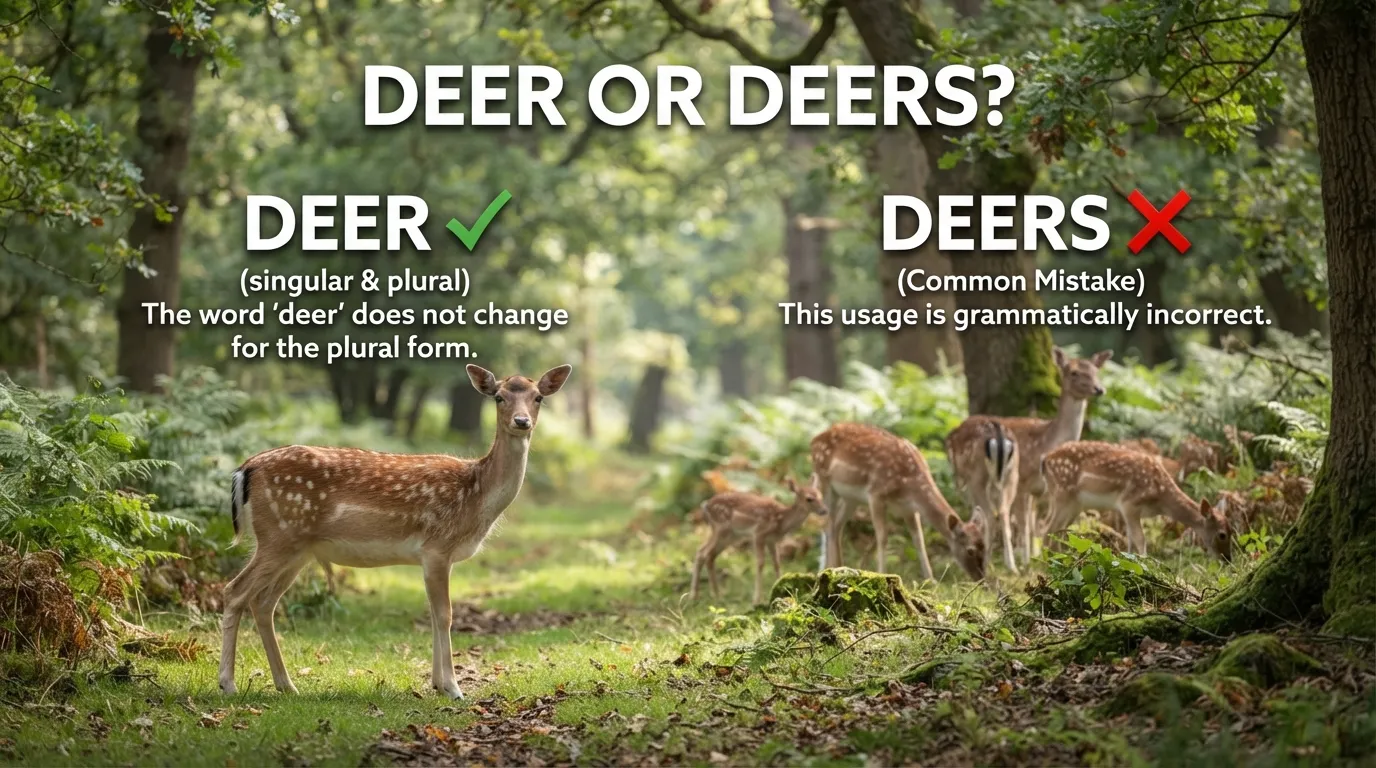
The correct plural of deer is usually “deer,” not “deers.”
Imagine a family visiting a wildlife park. They see one deer eating grass near the trees. Later, they spot five more deer running across the field. A child asks, “Are these deers?” The guide smiles and explains that the plural of deer is deer. This small English question confuses many learners. Both words seem possible because most English nouns add -s to make them plural. For example, one cat becomes cats, and one bird becomes birds. But deer follows a special rule. The word deer means a hoofed animal with antlers in many species. It can refer to one animal or more than one animal. The word deers is sometimes used in special scientific or regional contexts, but it is not the normal plural form in standard English.
People search for “deers or deer” because they want to write correctly in school, work, emails, and daily conversations. Understanding this difference helps you avoid a common grammar mistake.
Pronunciation
Deer
- US English: /dɪr/
- UK English: /dɪə/
Deers
- US English: /dɪrz/
- UK English: /dɪəz/
The word deer sounds like “dear” in both American and British English.
Learn more about: https://suitmean.com/piqued-or-peaked/
A Quick Link to the Main Difference
Now that we know the basic meaning, let’s look at ten simple differences between deer and deers.
Difference Between Deers or Deer
1. Singular and Plural Form
Deer can be both singular and plural.
Deers is not the usual plural form in standard English.
Examples:
- One deer is standing near the road.
- Ten deer are running through the forest.
2. Standard English Usage
Deer is the accepted standard plural form.
Deers is generally considered incorrect when talking about several animals.
Examples:
- Correct: We saw three deer.
- Incorrect in normal English: We saw three deers.
3. Meaning
Deer refers to a single animal or a group of animals.
Deers may appear in rare technical or specialized writing.
Examples:
- A deer crossed the street.
- The forest has many deer.
4. Grammar Rule
Deer belongs to a group of nouns with the same singular and plural form.
Deers follows the regular plural pattern of adding “-s,” but this pattern does not normally apply to deer.
Examples:
- One deer.
- Many deer.
5. Everyday Conversations
People always use deer in normal conversations when talking about more than one animal.
Deers sounds unusual to most native English speakers.
Examples:
- We watched deer in the park.
- The farmer protects deer from hunters.
6. Formal Writing
Deer is correct in reports, essays, and formal documents.
Deers should usually be avoided unless a specific technical meaning requires it.
Examples:
- The study examined deer populations.
- The report discussed deer habitats.
7. School English
Students should use deer as both singular and plural.
Teachers usually mark deers as a grammar mistake.
Examples:
- The student wrote about five deer.
- The children learned about deer in science class.
8. Countable Noun Usage
Deer is a countable noun, but its form does not change between singular and plural.
Examples:
- One deer was sleeping.
- Six deer were sleeping.
9. Verb Agreement
When deer means one animal, use a singular verb.
When deer means several animals, use a plural verb.
Examples:
- The deer is eating grass.
- The deer are eating grass.
10. Natural English Sound
Deer sounds natural in all common situations.
Deers often sounds awkward or incorrect.
Examples:
- Natural: Many deer live in this forest.
- Unnatural: Many deers live in this forest.
Nature and Behaviour of Deers or Deer
Nature and Behaviour of Deer
Deer are gentle animals found in forests, grasslands, and mountains. They eat plants, grass, leaves, and fruits.
Many deer live in groups called herds. Some species live alone or in small family groups.
Deer are known for their speed and alertness. They can quickly run away when they sense danger.
Male deer often grow antlers. Antlers are hard branches that grow on their heads.
Examples:
- Deer often move quietly through forests.
- A male deer may use its antlers during fights.
Nature and Behaviour of Deers
In standard English, deers is not normally used to describe the animals. The correct word is deer.
However, in rare scientific discussions, writers may use deers to separate different species or categories. This usage is uncommon and should not be used in everyday writing.
Why People Get Confused About Deers or Deer
People get confused because English has many nouns that form plurals by adding “-s.”
For example:
- Dog → Dogs
- Book → Books
- Tree → Trees
Because of this rule, learners naturally think:
- Deer → Deers
But English has many irregular nouns.
Examples:
- Sheep → Sheep
- Fish → Fish
- Moose → Moose
- Deer → Deer
These words keep the same form in singular and plural.
Comparison Table
| Feature | Deer | Deers |
| Singular form | Correct | Incorrect |
| Standard plural form | Correct | Usually incorrect |
| Meaning | One or more deer | Rare specialized usage |
| Common English | Very common | Very uncommon |
| School writing | Recommended | Avoid |
| Formal writing | Correct | Usually avoid |
| Everyday conversation | Natural | Unnatural |
| Verb with one animal | Deer is | Not normally used |
| Verb with many animals | Deer are | Not normally used |
| Example | Five deer ran away. | Five deers ran away. |
Similarities
- Both words relate to the animal called deer.
- Both can appear in discussions about wildlife.
- Both may be found in dictionaries or specialized language references.
- Both refer to the same general animal concept.
The Origin of Deer
The word deer has a long history in the English language.
It comes from Old English, where the word was used to describe wild animals. Over time, its meaning became more specific and came to refer mainly to animals in the deer family.
Deer belongs to the animal family Cervidae. This family includes species such as:
- Red deer
- White-tailed deer
- Reindeer
- Moose
The plural form remained deer instead of changing to deers. This is common in English words that have ancient roots.
British vs American English
British and American English both use deer as the standard plural form.
There is no major difference between the two varieties in this rule.
American English
- We saw several deer in the park.
- The deer is crossing the road.
British English
- We saw several deer in the park.
- The deer is crossing the road.
Important Note
Both British and American English generally avoid deers in normal usage.
Which One Should You Use?
Use deer in almost every situation.
For American English
Use deer for one animal and many animals.
Example:
- One deer is nearby.
- Many deer are nearby.
For British English
Follow the same rule.
Example:
- A deer was eating leaves.
- Several deer were eating leaves.
For Global English
Deer is the safest and most widely accepted choice.
If you are writing an essay, email, article, or social media post, use deer instead of deers.
Common Mistakes
Mistake 1: Adding -s
Wrong: There are many deers in the forest.
Correct: There are many deer in the forest.
Mistake 2: Using Singular Verb for Many Deer
Wrong: The deer is running across the field.
Correct: The deer are running across the field. (when talking about several deer)
Mistake 3: Thinking All Plurals Need -s
Wrong thinking: Every animal becomes plural with -s.
Correct understanding: Some animal names have the same singular and plural form.
Mistake 4: Using Deers in School Writing
Wrong: Five deers were found near the lake.
Correct: Five deer were found near the lake.
Everyday Usage Examples
In Emails
“Dear team, we saw several deer during our field visit.”
On Social Media
“Look at these beautiful deer!”
In News Reports
“Several deer were rescued from a busy highway.”
In Formal Writing
“Deer populations are increasing in some protected areas.”
In Daily Conversation
“Did you see the deer near the garden?”
Usage Trends
The word deer is widely used around the world. It appears in books, news articles, wildlife reports, school lessons, and everyday speech.
Deers is much less common. Most native English speakers do not use it as the normal plural form.
Searches for “deers or deer” often come from students, English learners, writers, and people checking grammar before publishing content.
Modern English continues to use deer as both singular and plural.
Metaphors and Similes
The word deer is often used in figurative language.
Simile Examples
- She moved like a deer through the quiet forest.
- His eyes were wide like a frightened deer.
Metaphor Examples
- The young runner was a deer on the track.
- She was a deer in the headlights during the difficult interview.
The phrase “deer in the headlights” describes someone who feels shocked, scared, or unable to react.
Connotative Meaning
Positive Meaning
Deer often suggest beauty, gentleness, peace, and nature.
Example:
- The graceful deer moved through the green forest.
Negative Meaning
Deer can sometimes suggest fear or confusion in figurative language.
Example:
- He stood like a deer in the headlights.
Neutral Meaning
In scientific and educational writing, deer simply refers to an animal.
Example:
- Deer are herbivores that eat plants.
Idioms and Proverbs
There are not many traditional idioms using the word deer, but some common expressions exist.
Deer in the Headlights
This phrase means someone is frozen with fear or surprise.
Example:
- When the teacher asked him a difficult question, he looked like a deer in the headlights.
Like a Deer in the Headlights
This is used to describe a person who cannot react quickly.
Example:
- She stood like a deer in the headlights when she heard the news.
Literature and Movies
Literature
Deer appear often in nature writing, poetry, fantasy, and children’s literature.
One famous example is The Yearling, a novel by Marjorie Kinnan Rawlings, published in 1938. The story follows a young boy and his relationship with a deer.
Deer are also common symbols in poetry and folklore. Writers often use them to represent innocence, freedom, beauty, and the natural world.
Movies
Deer have appeared in many films.
One famous example is Bambi, released in 1942 by Walt Disney Productions in the United States. The movie follows a young deer growing up in the forest.
Deer also appear in documentaries and nature films from many countries.
Why This Difference Matters
Knowing the difference between deer and deers helps learners write better English.
A small grammar mistake can affect the quality of an essay, email, report, or website article.
Students, using the correct plural form improves grades and writing skills.
Professionals, correct grammar makes communication clear and trustworthy.
For society, clear language helps people understand information about animals, nature, science, and wildlife protection.
Learning simple grammar rules like this also builds confidence. Once you understand that deer stays the same in singular and plural form, you can avoid this mistake easily.
Usefulness in Daily Life
You may need to use deer when:
- Writing school assignments.
- Talking about wildlife.
- Reading nature books.
- Writing social media captions.
- Sending emails.
- Creating news articles.
- Discussing animals in science lessons.
- Writing travel stories about forests and national parks.
Correct grammar makes your message easier to understand.
Situational Preference
In almost every situation, deer is the better choice. Use deer when talking about one animal or many animals. It works in casual speech, school writing, business emails, news reports, and formal documents. The word deers should be avoided unless you are writing a highly specialized scientific text where the writer has a clear reason to use it. For students and English learners, there is no need to use deers. Remember the simple rule: one deer, two deer, ten deer. The word stays the same. This rule works in both British and American English.
Common Questions
1. Is deers a correct word?
Deers is not the normal plural form of deer in standard English. Use deer instead.
2. What is the plural of deer?
The plural of deer is deer.
Example: One deer, five deer.
3. Can deer be singular and plural?
Yes. Deer can refer to one animal or many animals.
4. Why do people say deers?
People may say deers because they think all English nouns need “-s” to become plural. This is a common grammar mistake.
5. Is deer the same in British and American English?
Yes. Both British and American English use deer as the standard singular and plural form.
6. What is the correct sentence: “The deer is” or “The deer are”?
Both can be correct.
- The deer is eating grass. (one deer)
- The deer are eating grass. (several deer)
7. How do you pronounce deer?
In American English, deer is pronounced /dɪr/. In British English, it is pronounced /dɪə/.
Conclusion
The difference between deers and deer is simple but important. Deer is the correct word for both one animal and several animals in standard English. The word deers is generally not used as the normal plural form. For example, you can say, “I saw one deer,” or “I saw five deer.” The word remains the same in both sentences. This rule may seem unusual because many English nouns form plurals by adding “-s.” However, deer belongs to a group of nouns that do not change in their plural form. Other examples include sheep, fish, and moose. Whether you use American English, British English, or global English, deer is the safest and most natural choice. Understanding this difference helps students, writers, professionals, and English learners avoid mistakes.
Whenever you are unsure, remember this easy rule:
One deer. Two deer. Many deer.
You do not need to add “s” to deer in normal English writing.

I’m Sultan Sikander, an English language specialist, SEO specialist, digital publisher, and researcher. I create clear, accurate, and well-researched content on English grammar, vocabulary, word meanings, and language comparisons, helping readers understand and use English with confidence.