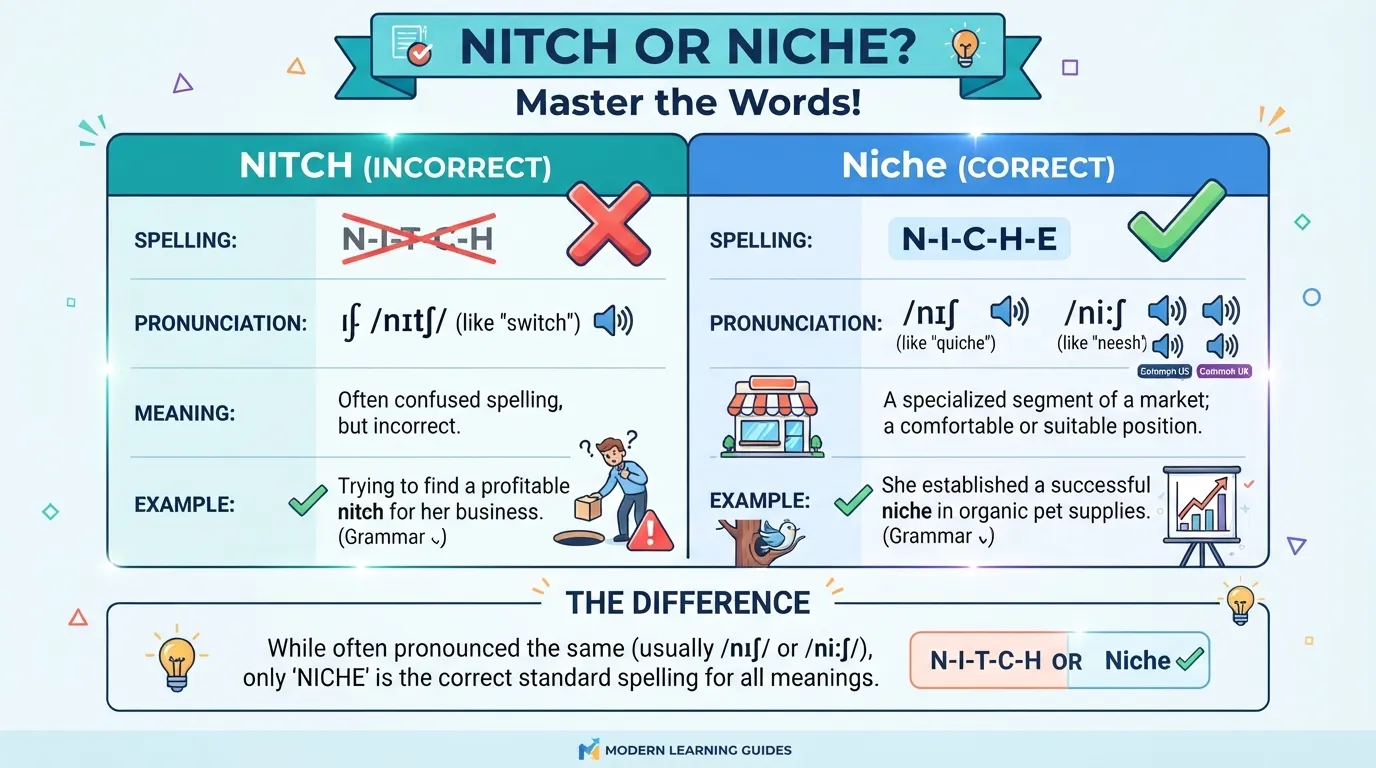
The main difference between nitch or niche is that “niche” is the standard spelling, while “nitch” is mainly an alternate pronunciation.
Imagine a student starting a small YouTube channel about drawing. The student wants to find a special group of viewers who love simple art videos. A teacher may say, “Find your niche.” But when the student hears the word, it may sound like “nitch.” This can cause confusion. Many English learners wonder whether the correct word is nitch or niche. Both forms sound similar in some accents, but they are not used in the same way in writing. Niche is the accepted spelling in standard English. It means a special place, role, or area of interest. It is often used in business, marketing, science, and everyday speech.
Pronunciation
Niche
- US English: /niːʃ/ or sometimes /nɪtʃ/
- UK English: /niːʃ/ or sometimes /nɪtʃ/
The pronunciation /niːʃ/ is very common in modern English.
Nitch
- US English: /nɪtʃ/
- UK English: /nɪtʃ/
“Nitch” is often heard as an alternate pronunciation of “niche.” However, “niche” remains the standard spelling.
You may also likehttps://suitmean.com/unpure-or-impure/
Difference Between Nitch or Niche
1. Niche Is the Standard Spelling
“Niche” is the normal spelling used in dictionaries, books, websites, and formal writing.
“Nitch” is mainly seen as a pronunciation variant.
Examples:
- She found her niche in digital art.
- This business serves a small niche market.
2. Niche Has More Than One Meaning
The word “niche” can mean a special place, a role, or a small area of interest.
Examples:
- The bird found a niche in the forest.
- He created a niche for himself in music.

3. Nitch Is Mostly a Sound Difference
“Nitch” usually does not have a separate meaning from “niche.”
It is often used to show how some people pronounce the word.
Examples:
- Some speakers say “nitch” instead of “neesh.”
- The word “niche” may have two common pronunciations.
4. Niche Is Better for Formal Writing
Use “niche” in school work, business writing, and professional documents.
Examples:
- The company targets a niche audience.
- She works in a niche area of science.
5. Nitch Is Less Common in Writing
Most people write “niche,” even if they pronounce it “nitch.”
Examples:
Correct:
- The company found a profitable niche.
Less common:
- The company found a profitable nitch.
6. Niche Is Common in Business
Businesses use “niche” to describe a small group of customers.
Examples:
- The brand serves a niche market.
- This product fills a special niche.
7. Niche Is Used in Science
In biology, a niche means the role an animal or plant has in its environment.
Examples:
- Every animal has a role in its ecosystem.
- Bees fill an important niche in nature.
8. Niche Can Mean a Special Skill
A person may find a niche by becoming known for one special skill.
Examples:
- She found her niche as a children’s writer.
- He built a niche in photography.
9. Niche Is More Widely Accepted
“Niche” is accepted across standard English varieties.
Examples:
- American English uses “niche.”
- British English also uses “niche.”
10. The Meaning Usually Stays the Same
Whether someone says “niche” or “nitch,” the meaning usually does not change.
Examples:
- Find your niche in the market.
- Find your special area in the market.
The spelling “niche” should still be used in most writing.
Nature and Behaviour of Nitch or Niche
Nature of Niche
“Niche” is a noun.
It can describe:
- A special place
- A special role
- A small market
- A special area of interest
Examples:
- The company found a niche in online education.
- The bird lives in a special ecological niche.
Nature of Nitch
“Nitch” is mainly treated as an alternate pronunciation of “niche.”
It is not normally used as a separate standard spelling in formal English.
When writing, use “niche.”
Why People Get Confused About Nitch or Niche
The main reason is pronunciation.
English words are not always pronounced exactly as they are spelled. The word “niche” is a good example.
Some people pronounce it as:
- “neesh”
- “nitch”
Both pronunciations are heard in English-speaking communities.
Because of this, learners may think there are two different words. In most cases, there is only one main word: “niche.”
The confusion becomes greater when people hear the word before seeing it written.
Comparison Table
| Feature | Nitch | Niche |
| Standard spelling | Less common | Standard |
| Pronunciation | Usually “nitch” | “neesh” or “nitch” |
| Meaning | Usually the same as niche | Special place, role, or market |
| Formal writing | Avoid | Recommended |
| Business use | Rare in writing | Very common |
| Scientific use | Rare in writing | Common |
| Dictionary form | Limited usage | Main dictionary form |
| Best choice for learners | No | Yes |
Similarities
Both forms are connected to the same word.
Both can refer to a special area or role.
Alike pronunciations may be heard in English.
The main difference is spelling and pronunciation preference.
The Origin of the Word
The word “niche” comes from French and Latin roots.
It originally referred to a small hollow or space in a wall where a statue could be placed.
Over time, the meaning changed.
Today, “niche” can mean a special position, role, or area.
In biology, the word became important because scientists use it to describe the role of an animal or plant in nature.
Niche is now used for a small numbers of customers with specific need.
British vs American English
Both British and American English use the spelling “niche.”
The main difference is often pronunciation.
American English
Many American speakers use the pronunciation “neesh.” Some also use “nitch.”
Examples:
- She found her niche in marketing.
- This product serves a niche audience.
British English
British speakers also commonly use “neesh,” though “nitch” may be heard in some speech.
Examples:
- The company has a niche in the luxury market.
- He found his niche as a writer.
Spelling Rule
There is no major spelling difference between British and American English.
The correct written form is:
Niche
Which One Should You Use?
For school, work, websites, and formal writing, always choose niche.
If you hear someone say “nitch,” do not worry. It may simply be their pronunciation of “niche.”
For global English, “niche” is the safest choice.
Examples:
- Find your niche.
- This is a niche product.
- She works in a niche market.
Remember:
Write niche.
You may hear different pronunciations, but the spelling remains “niche.”
Common Mistakes
Mistake 1: Using Nitch in Formal Writing
Incorrect:
- Our company serves a small nitch market.
Correct:
- Our company serves a small niche market.
Mistake 2: Thinking Nitch and Niche Have Different Meanings
In most cases, they refer to the same word.
The difference is mainly pronunciation.
Mistake 3: Misspelling Niche
Incorrect:
- Neach
- Nitch (when formal spelling is needed)
Correct:
- Niche
Mistake 4: Using Niche Without Understanding the Meaning
Some people use “niche” only because it sounds professional.
Make sure you understand its meaning before using it.
Everyday Usage Examples
In Emails
- We are looking for a niche market for our new product.
- Your business has found a unique niche.
On Social Media
- Find your niche and share what you love.
- This page focuses on a small niche of readers.
In News Writing
- The company entered a niche market.
- The product has become popular among a niche audience.
In Formal Writing
- Each species occupies a unique ecological niche.
- The research focuses on a niche area of technology.
Usage Trends
The word “niche” is very common today.
It appears often in:
- Digital marketing
- Social media
- Business
- Blogging
- Science
- Education
The phrase “niche market” is especially common in business.
The pronunciation “nitch” is also heard in some English-speaking communities. However, most written content continues to use “niche.”
For learners, the best approach is simple: learn the spelling “niche” and understand both common pronunciations.
Metaphors and Similes
The word “niche” can be used in figurative ways.
Find Your Niche
This means finding the area where you fit best.
Example:
- She found her niche in teaching young children.
A Perfect Niche
This means a place or role that suits someone very well.
Example:
- He found a perfect niche in the world of graphic design.
Fit Into a Niche
This means to find a suitable role or place.
Example:
- The small company fits into a niche in the technology market.
Connotative Meaning
Positive Meaning
“Niche” often has a positive meaning.
It can suggest:
- Special skills
- Success
- Uniqueness
- Opportunity
Example:
- She found a successful niche in online education.
Neutral Meaning
“Niche” can simply describe a role or place.
Example:
- Every animal has its own niche in nature.
Negative Meaning
Sometimes “niche” may suggest something too small or limited.
Example:
- The product has a very narrow niche market.
The meaning depends on the sentence.
Idioms and Proverbs
“Niche” is not commonly used in traditional English idioms or proverbs.
However, several modern expressions are common.
Find Your Niche
Meaning: Find the area where you belong or work best.
Example:
- After trying many jobs, she finally found her niche.
Niche Market
Meaning: A small group of customers with special interests or needs.
Example:
- The company sells products for a niche market.
Carve Out a Niche
Meaning: To create a special position for yourself.
Example:
- He carved out a niche in the online education industry.
Literature and Movies
The idea of finding a special place or role appears often in literature.
Literature
In literature, characters often search for their place in society. This idea is closely connected to the modern meaning of “niche.”
Books about nature and society also explore the roles of people, animals, and communities.
For example, ecological themes in works such as Silent Spring by Rachel Carson (1962) helped increase public interest in the relationship between living things and their environments.
Movies
Movies about business, careers, and personal growth often show characters finding their special place in life.
The idea of “finding your niche” is common in modern films about entrepreneurship, creativity, and success.
Why This Difference Matters
Knowing the difference between nitch or niche helps English learners improve their spelling and pronunciation.
Correct word choice makes writing clear.
It is especially useful in:
- School assignments
- Business plans
- Marketing content
- Blog writing
- Science lessons
- Job discussions
The word “niche” is used in many fields today. Understanding it helps people communicate better in modern English.
It also teaches an important lesson about English pronunciation: words may sound different in different accents, but their spelling can remain the same.
Usefulness in Daily Life
The word “niche” is useful in many everyday situations.
Business
- Find a niche market for your product.
In Blogging
- Choose a niche that matches your interests.
Social Media
- Build content for a specific niche audience.
Science
- Study the niche of animals in an ecosystem.
Career Planning
- Find a niche where your skills are valuable.
Understanding this word can help students, workers, business owners, and content creators.
Situational Preference
Use niche in all types of writing. It is the standard spelling and works well in school, business, science, and online content. You may hear people pronounce it as “neesh” or “nitch.” Both sounds can be heard in English. However, “nitch” is not the best spelling choice for formal writing. If you are speaking, use the pronunciation that feels natural in your English variety. If you are writing, always choose “niche.” This simple rule helps avoid confusion and keeps your English clear.
Quick Questions and Answers
Is nitch a correct word?
“Nitch” is sometimes used as an alternate pronunciation of “niche.” However, “niche” is the standard spelling for formal English.
Which spelling is correct, nitch or niche?
“Niche” is the standard and most widely accepted spelling.
How do you pronounce niche?
“Niche” is commonly pronounced “neesh.” Some speakers also pronounce it “nitch.”
Does niche mean a small market?
A niche means a small, specific group of customers who want products or services that meet their special needs.
What does niche mean in biology?
In biology, a niche means the role an animal or plant has in its environment.
Is niche used in British English?
Yes. “Niche” is used in both British and American English.
Should I write nitch in an essay?
No. Use “niche” in essays, school work, and formal writing.
Conclusion
The difference between nitch or niche is mainly about spelling and pronunciation. The standard spelling is niche. It is used in business, science, education, marketing, and everyday English. “Nitch” is mainly heard as an alternate pronunciation. Some people say “nitch,” while others say “neesh.” Both sounds may be used in different English-speaking communities. However, when writing, “niche” is the correct and safest choice. A niche can mean a special place, role, skill, market, or area of interest. For example, a business can find a niche market, and a person can find a niche in their career.
Remember this simple rule:
Write niche, but do not worry if you hear nitch.
Learning this difference can improve your English spelling, pronunciation, and writing. It can also help you understand modern words used in business, social media, and science.

I’m Sultan Sikander, an English language specialist, SEO specialist, digital publisher, and researcher. I create clear, accurate, and well-researched content on English grammar, vocabulary, word meanings, and language comparisons, helping readers understand and use English with confidence.