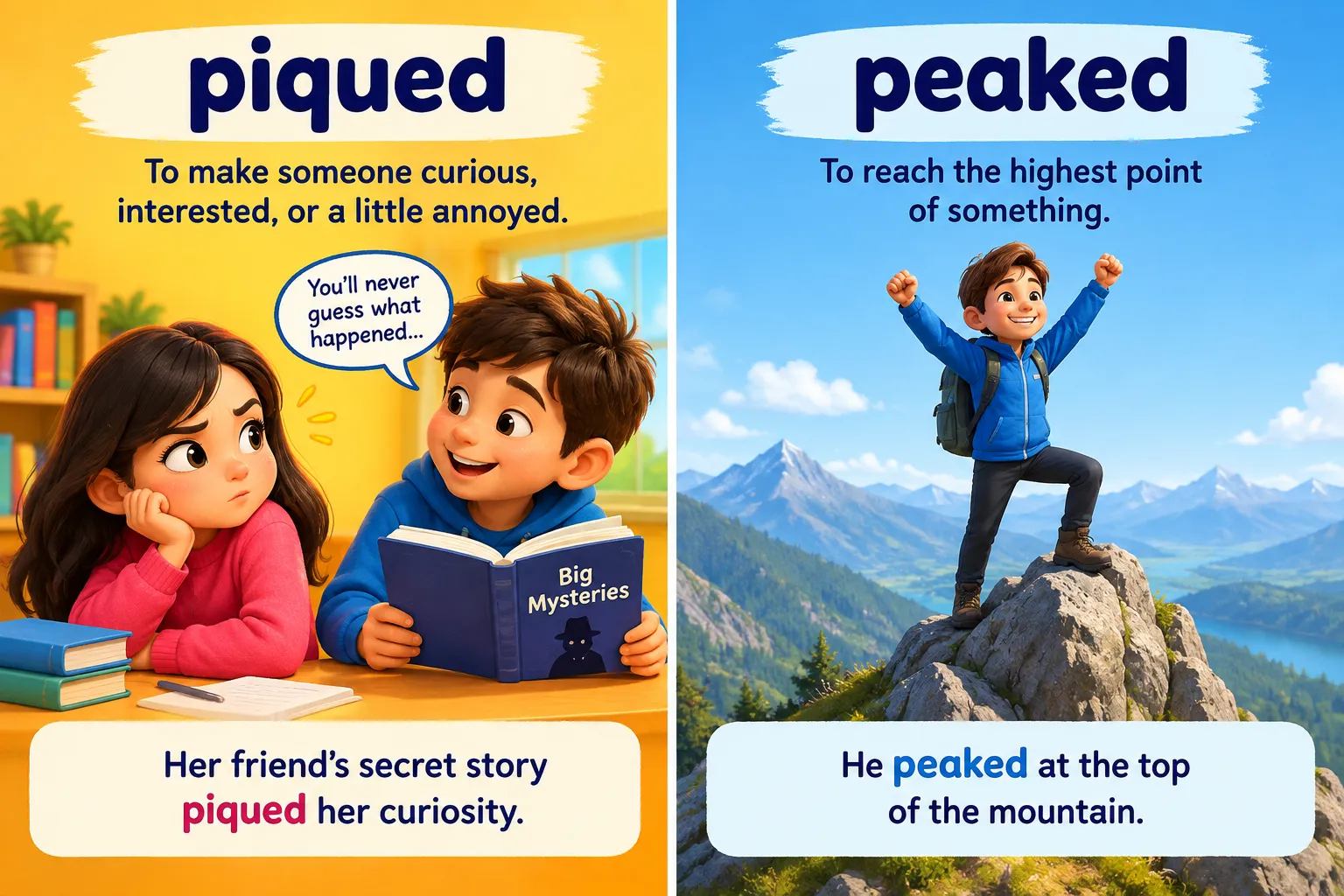
Piqued means interested or curious, while peaked means reached the highest point.
Imagine a student named Ali reading a book about space. One chapter about black holes makes him very curious. His interest is piqued. Later, he reads that a rocket reached its highest speed during a mission. Its performance peaked at that moment. These two words sound almost the same, but their meanings are very different.
People often search for “piqued or peaked” because both words can be confusing when writing emails, social media posts, essays, or articles. Many people also mix up the phrases “piqued my interest” and “peaked my interest.” The correct phrase is “piqued my interest.”
Piqued describes curiosity, interest, or excitement. Peaked describes reaching the highest level, point, or condition. Learning the difference between piqued or peaked helps you write clearly and avoid common English mistakes.
Whether you are a student, writer, or professional, understanding these words can improve your communication. In this article, we will explain piqued or peaked in simple English with examples and useful tips.
Pronunciation
Piqued
- US English: /piːkt/
- UK English: /piːkt/
Peaked
- US English: /piːkt/
- UK English: /piːkt/
Both words are pronounced the same way. This makes them homophones.
A Linking Hook
Now that we know their basic meanings and pronunciation, let us explore the key differences between piqued and peaked.
Read more about:https://suitmean.com/wp-admin/post.php?post=254&action=edit
Difference Between Piqued and Peaked
1. Meaning
Piqued means made someone curious or interested.
Example 1: The strange story piqued my interest.
Example 2: Her question piqued his curiosity.
Peaked means reached the highest level or point.
Example 1: Sales peaked during the holiday season.
Example 2: His energy peaked in the morning.
2. Part of Speech
Piqued is usually used as a verb.
Example 1: The movie piqued her interest.
Example 2: His speech piqued my curiosity.
Peaked is also usually used as a verb.
Example 1: The athlete peaked at age 25.
Example 2: Prices peaked last month.
3. Connection with Interest
Piqued is correctly used with interest and curiosity.
Example 1: The article piqued my interest.
Example 2: The mystery piqued her curiosity.
Peaked is not normally used with interest in this meaning.
Incorrect: The article peaked my interest.
Correct: The article piqued my interest.
4. Connection with Highest Point
Peaked describes reaching a maximum or highest point.
Example 1: The temperature peaked at 40°C.
Example 2: His career peaked in the early 2000s.
Piqued does not mean reaching a highest point.
Incorrect: The temperature piqued at 40°C.
Correct: The temperature peaked at 40°C.
5. Emotional Meaning
Piqued often relates to feelings of curiosity or interest.
Example 1: The unusual painting piqued her curiosity.
Example 2: His strange answer piqued my interest.
Peaked can describe the highest level of a feeling or experience.
Example 1: Her excitement peaked before the concert.
Example 2: Fear peaked during the storm.
6. Use in Questions
Piqued is often used when something creates interest.
Example 1: What piqued your interest in science?
Example 2: The book piqued my curiosity.
Peaked is used when asking about the highest point.
Example 1: When did the company’s profits peak?
Example 2: At what age did his performance peak?
7. Time Reference
Piqued describes an action that creates interest.
Example 1: The documentary piqued my interest yesterday.
Example 2: Her story piqued my curiosity.
Peaked often describes a point in time when something reached its maximum.
Example 1: Demand peaked in December.
Example 2: The athlete peaked during the final match.
8. Common Expressions
Piqued is common in the phrase “piqued my interest.”
Example 1: Your idea piqued my interest.
Example 2: The news report piqued her curiosity.
Peaked is common in phrases such as “reached its peak” or “peaked at.”
Example 1: The temperature peaked at noon.
Example 2: The population peaked in 2020.
9. Business and Academic Use
Piqued is used when discussing curiosity or attention.
Example 1: The research paper piqued the student’s interest.
Example 2: The new product piqued customer curiosity.
Peaked is used in business and academic data.
Example 1: Company profits peaked last year.
Example 2: Student enrollment peaked in September.
10. Spelling and Sound
Piqued and peaked have different spellings but the same pronunciation.
Example 1: The story piqued my interest.
Example 2: The mountain climber peaked at the summit.
Remember that spelling changes meaning.
Nature and Behaviour of Piqued and Peaked
Nature and Behaviour of Piqued
Piqued is connected with curiosity and interest. It describes the moment when something catches your attention.
It is often caused by a mystery, question, surprising fact, or new idea.
Examples:
- The strange noise piqued my curiosity.
- The science experiment piqued the children’s interest.
Piqued usually has a positive or neutral feeling.
Nature and Behaviour of Peaked
Peaked is connected with reaching the highest level. It can describe numbers, performance, emotions, prices, temperatures, or popularity.
Examples:
- The company’s sales peaked in June.
- Her popularity peaked after the movie was released.
Peaked can be used for both positive and negative situations.
Why People Get Confused About Piqued and Peaked
People confuse these words because they sound exactly the same. Both end with the “-eeked” sound.
Another reason is the common phrase “piqued my interest.” Some writers incorrectly write “peaked my interest” because they connect the word with reaching a high level of interest.
However, “piqued” means it caused interest, while “peaked” means it reached the highest point.
A simple memory trick is:
- Piqued = curiosity.
- Peaked = highest point.
Comparison Table
| Feature | Piqued | Peaked |
| Meaning | Made curious or interested | Reached the highest point |
| Pronunciation | /piːkt/ | /piːkt/ |
| Spelling | P-I-Q-U-E-D | P-E-A-K-E-D |
| Main Use | Interest and curiosity | Maximum level or point |
| Common Phrase | Piqued my interest | Peaked at 100 |
| Example | The story piqued her curiosity. | Sales peaked in December. |
| Similarity | Both are verbs | Both are verbs |
| Sound | Same pronunciation | Same pronunciation |
The Origin of Piqued and Peaked
Origin of Piqued
The word “pique” comes from French. It originally meant to prick, irritate, or provoke. Over time, its meaning developed into creating interest or curiosity.
Today, “piqued” is commonly used when something makes a person want to know more.
Origin of Peaked
The word “peak” comes from the idea of a mountain’s highest point. It later became a common English word for the highest level of anything.
For example, people can talk about the peak of a mountain, the peak of a career, or the peak of popularity.
British vs American English
Piqued and peaked have the same meanings in both British and American English.
There is no major spelling difference between the two varieties.
Examples in American English:
- The report piqued my interest.
- Sales peaked in July.
Examples in British English:
- The article piqued my interest.
- Temperatures peaked during the summer.
Both forms are correct worldwide.
Which One Should You Use?
Use piqued when talking about interest, curiosity, or attention.
Example:
- The mystery piqued my interest.
Use peaked when talking about reaching the highest level.
Example:
- The athlete peaked during the final competition.
Common Mistakes
Mistake 1: Using “peaked my interest”
Incorrect: The movie peaked my interest.
Correct: The movie piqued my interest.
Mistake 2: Using “piqued” for the highest point
Incorrect: The temperature piqued at 40°C.
Correct: The temperature peaked at 40°C.
Mistake 3: Confusing sound with meaning
Both words sound the same, but they do not mean the same thing.
Remember:
- Piqued = interested.
- Peaked = highest point.
Mistake 4: Incorrect spelling in formal writing
Incorrect: His question peaked my curiosity.
Correct: His question piqued my curiosity.
Everyday Usage Examples
In Emails
- Your proposal piqued my interest.
- Customer demand peaked last quarter.
On Social Media
- This mystery has piqued my curiosity!
- My excitement peaked when I saw the final results.
In News
- The report piqued public interest.
- Oil prices peaked earlier this year.
In Formal Writing
- The study piqued interest among researchers.
- Economic growth peaked before the recession.
Usage Trends
Piqued is frequently used in articles, blogs, news reports, and professional writing. The phrase “piqued interest” is especially common.
Peaked is widely used in business, sports, science, economics, and everyday conversations.
Both words remain common in modern English. Their similar pronunciation continues to cause spelling mistakes, especially in online writing.
Metaphors and Similes
Piqued
Piqued can be used in figurative language to describe curiosity.
Example:
- The mysterious letter piqued her curiosity like a locked treasure chest.
This means the letter made her want to discover more.
Peaked
Peaked can describe the highest point of success or emotion.
Example:
- His career peaked like a mountain reaching the clouds.
This means his career reached its greatest success.
Connotative Meaning
Piqued
Piqued usually has a positive meaning.
Example: The exciting idea piqued my interest.
It can also be neutral when describing curiosity.
Peaked
Peaked can have a positive meaning when discussing success.
Example: Her career peaked after years of hard work.
It can also have a negative meaning when something declines after reaching its highest point.
Example: The company’s sales peaked and then fell.
Idioms and Proverbs
There are no major traditional proverbs that directly use “piqued.”
However, the phrase “piqued my interest” is a common English expression.
Example:
- The strange painting piqued my interest.
Peaked appears in expressions related to maximum levels.
Examples:
- At its peak, the company employed thousands of workers.
- The athlete reached the peak of his career.
Literature and Movies
Literature
The idea of piqued curiosity appears often in mystery and adventure literature.
For example, mystery novels use unusual events to pique readers’ interest and encourage them to keep reading.
Writers such as Arthur Conan Doyle used curiosity and mystery to engage readers.
Peaked is often used in biographies and literary discussions about a writer’s most successful period.
Movies
Mystery and thriller movies often pique the audience’s curiosity through suspense.
For example, films such as The Sixth Sense (1999, United States) create interest by hiding important information from viewers.
The word peaked can describe the highest point of a movie star’s career or a film’s popularity.
Why This Difference Matters
Understanding piqued and peaked matters because clear language helps people communicate better.
Students need this difference for essays, exams, and assignments. Writers need it for articles and stories. Professionals need it for emails, reports, and presentations.
Using the wrong word can change the meaning of a sentence. For example, “The news peaked my interest” is incorrect and may look unprofessional.
This difference also matters in society because good communication reduces confusion. When people use the right words, their ideas become easier to understand.
Learning small differences like this improves English skills over time.
Usefulness in Daily Life
You can use these words in many daily situations.
When a friend tells you an interesting story, you can say:
- Your story piqued my interest.
When discussing prices, sports, or business, you can say:
- Prices peaked last week.
- His performance peaked during the final game.
These words are useful in conversations, schoolwork, workplace communication, and online writing.
Situational Preference
The choice between piqued and peaked depends on the situation. Use piqued when something creates interest or curiosity. It is best for conversations about books, stories, ideas, questions, and mysteries. Use peaked when something reaches its highest level. It works well in discussions about sales, prices, emotions, sports, temperatures, and careers. In formal writing, choosing the correct word makes your sentence clear and professional. If you are unsure, ask yourself whether the sentence is about becoming interested or reaching the highest point. If it is about interest, choose piqued. However it is about a maximum level, choose peaked.
Regularly asked questions,
1. Is it piqued my interest or peaked my interest?
The correct phrase is “piqued my interest.”
2. Are piqued and peaked pronounced the same?
Yes. Both are pronounced /piːkt/.
3. What does piqued mean?
Piqued means made someone curious or interested.
4. What does peaked mean?
Peaked means reached the highest point or level.
5. Can peaked be used for emotions?
Yes. For example, “Her excitement peaked before the concert.”
6. Is “peaked my curiosity” correct?
No. The correct phrase is “piqued my curiosity.”
7. How can I remember the difference?
Remember: Piqued is connected with curiosity, while peaked is connected with a peak or highest point.
Conclusion
Piqued and peaked are two commonly confused English words. They sound the same, but their meanings are different. Piqued means made someone interested or curious. Peaked means reached the highest point or level. The easiest way to remember the difference is to connect piqued with curiosity and peaked with a mountain peak. For example, a surprising story can pique your interest, while a company’s sales can peak during a busy season. This difference is important for students, writers, professionals, and anyone learning English. Using the correct word helps make your writing clear and professional. The phrase “piqued my interest” is especially common and should not be confused with “peaked my interest.” Whether you are writing an email, school assignment, blog post, or social media caption, choosing the right word matters. Once you understand their meanings, piqued and peaked become easy to use correctly.

I’m Sultan Sikander, an English language specialist, SEO specialist, digital publisher, and researcher. I create clear, accurate, and well-researched content on English grammar, vocabulary, word meanings, and language comparisons, helping readers understand and use English with confidence.









2 thoughts on “Piqued or Peaked: The Simple Difference ”