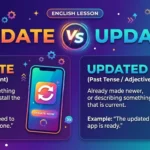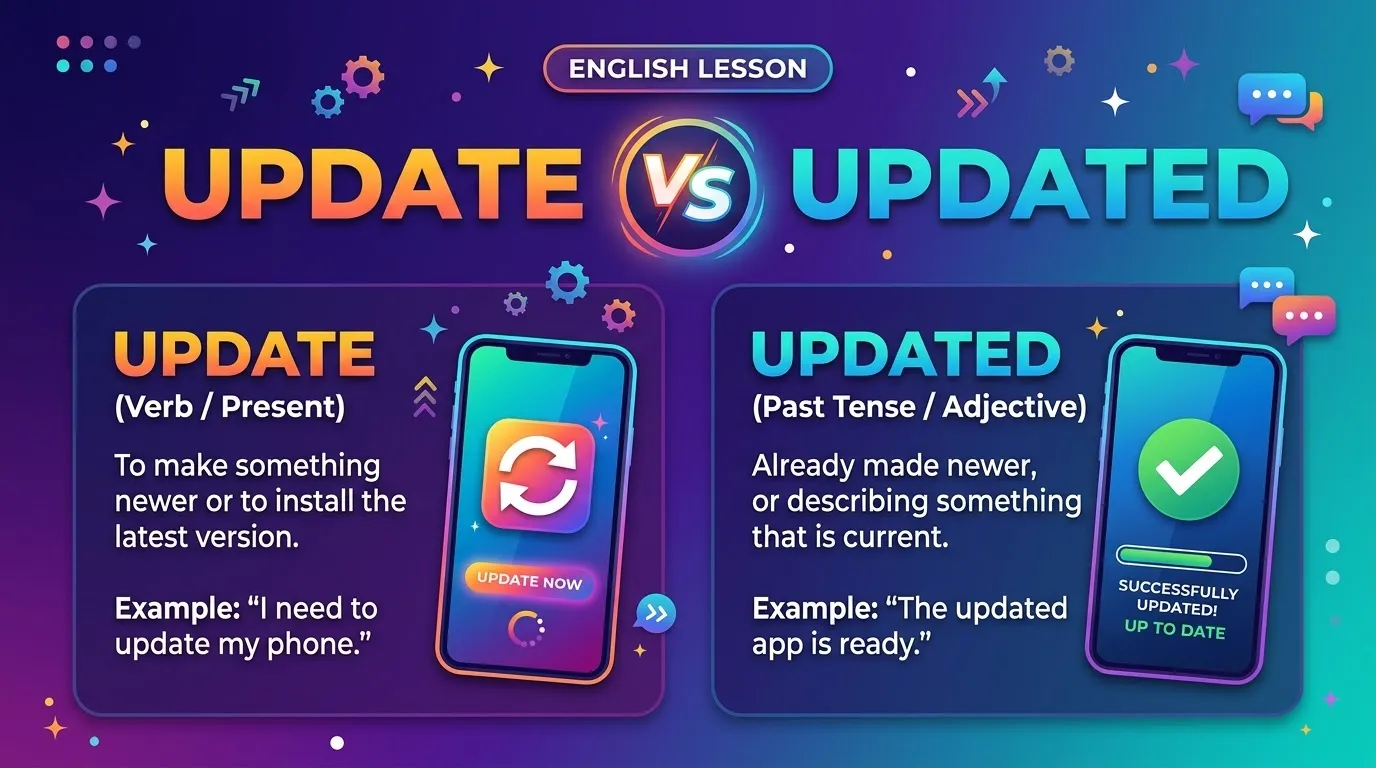
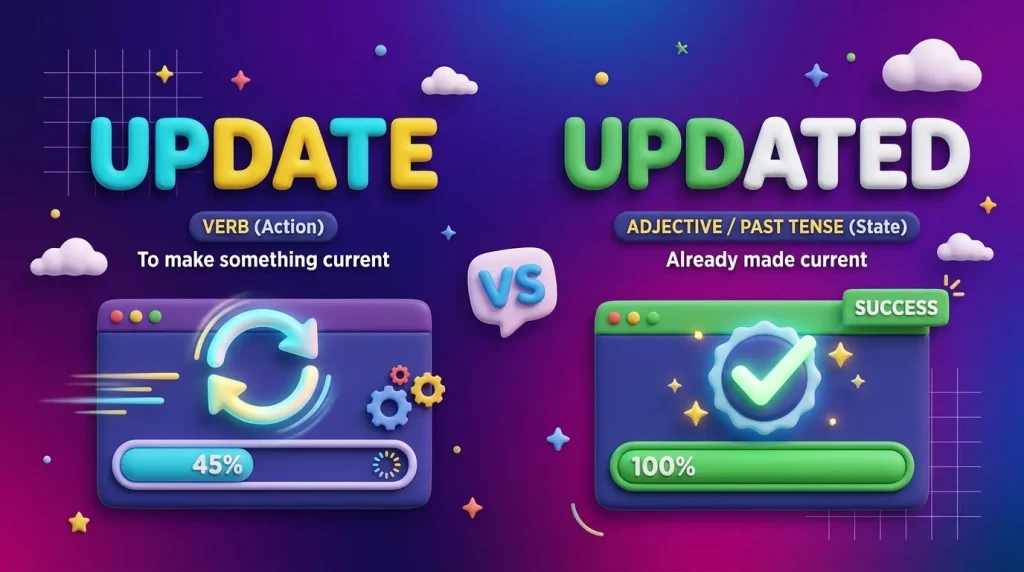
Update means to make something new or current. Updated means something has already been changed or made current.
Imagine you use a phone app every day. One morning, the app asks you to install a new version. You click “Update” to get the new version. After the process ends, the app is “updated.” Both words relate to change, but they have different uses.
People often search for updated or update when they write emails, school tasks, work reports, or online posts. They may not know which word fits the sentence. The good news is that the rule is easy to learn.
Update can be a verb or a noun. As a verb, it means to add new facts or make something current. As a noun, it means new information about a person, event, or task. Updated is the past form of the verb. It can also describe something that now has the latest facts or changes.
Pronunciation
- Update — US: /ˌʌpˈdeɪt/
- Update — UK: /ˌʌpˈdeɪt/
- Updated — US: /ˌʌpˈdeɪ.tɪd/
- Updated — UK: /ˌʌpˈdeɪ.tɪd/
The main stress falls on the second part of each word. The ending of updated adds another short syllable.
Learn more about: https://suitmean.com/annual-or-anual/
A Simple Guide to Their Use
Both words relate to new facts or changes. Their role in a sentence helps you choose the right one. Let us look at ten clear differences.
Difference Between Updated and Update
1. Basic Meaning
Update means to make something current or to give new information. Updated means someone has made a change or added new information.
Examples:
- Please update the file.
- I updated the file yesterday.
2. Part of Speech
Update can be a verb or a noun. Updated is the past form of the verb and can also act as an adjective.
Examples:
- I will update the list.
- This is the updated list.
3. Use in the Present
Use update when you ask someone to make a change or talk about a regular task.
Examples:
- Please update my address.
- We update the website every week.
4. Use in the Past
Use updated when the action happened in the past.
Examples:
- She updated the report last night.
- He updated his phone yesterday.
5. Use as an Adjective
Updated can describe something that now has new facts or changes.
Examples:
- Read the updated guide.
- I saved the updated file.
6. Use as a Noun
Update can mean new information about a person, task, or event.
Examples:
- Please give me an update.
- The teacher shared an update about the test.
7. Use in Technology
Update can mean to install a newer version of an app or system. Updated describes the result after the change.
Examples:
- I need to update my phone.
- My phone is updated now.
8. Use in Business
Update can mean to add new facts to a record or report. Updated describes a record or report that now has those facts.
Examples:
- Please update the sales report.
- The manager checked the updated sales report.
9. Use in Emails
Update can ask someone to change information. Updated can tell the reader that a change has already happened.
Examples:
- Please update your contact details.
- I have updated my contact details.
10. Use in Questions and Instructions
Use update when you ask someone to take action. Apply updated when you ask about the result or describe its current state.
Examples:
- Can you update the list?
- Is the list updated?
Nature and Behaviour of Updated and Update
Update
Update has two common uses.
As a verb, it means to add new facts or make something current.
Examples:
- I update my calendar every Sunday.
- Please update the school records.
As a noun, it means new information about something.
Examples:
- I received an update from my teacher.
- The news report gave an update on the storm.
Updated
Updated is the past form of update. It can also work as an adjective.
Examples:
- We updated the website.
- The updated website looks better.
The first sentence tells us what happened. The second describes the website after a change.
Why People Get Confused About Updated and Update
People confuse these words because they share the same base word. Both relate to changes and new information.
The main difference is how we use them in a sentence.
- Update: asks for an action or names new information.
- Updated: tells us that a change happened or describes something after a change.
Look at these examples:
- Correct: Please update the file.
- Correct: I updated the file.
- Correct: This is the updated file.
- Incorrect: Please updated the file.
The last sentence is wrong because please usually comes before the base verb in a direct request. You should write “Please update the file.”
Comparison Table
| Feature | Update | Updated |
| Main use | Verb or noun | Past verb form or adjective |
| Basic idea | Make current or give new facts | Changed or made current |
| Action | Can name an action | Often shows a finished action |
| Request | Please update the page | Not used for this request |
| Past event | I will update it | I updated it |
| Description | Update the list | The updated list |
| Technology | Update the app | Updated app |
| Business | Give an update | Updated report |
| As a noun | An update arrived | Not normally used as a noun |
| Example | Update your details | Your details are updated |
Similarity: Both words relate to changes, new facts, and keeping information current.
The Origin of Update
The word update came into English from the word date with the prefix up-. It grew in use as people needed a word for bringing facts, records, and information up to date.
The word became common in business, publishing, and technology. Today, people use it for phone apps, websites, news, records, and work reports.
The ending -ed often shows the past form of a regular verb. That is why update becomes updated.
Here are three related forms:
- Update: Please update the page.
- Updated: I updated the page.
- Updating: I am updating the page.
Each form has a different role in a sentence.
British vs American English
British and American English use the same spelling for update and updated. Their meanings and grammar rules are also the same.
| Feature | British English | American English |
| Base form | Update | Update |
| Past form | Updated | Updated |
| Present action | Updating | Updating |
| New information | An update | An update |
| Example | Please update the file. | Please update the file. |
Examples:
- British English: The team updated the website.
- American English: The team updated the website.
- British English: Please send me an update.
- American English: Please send me an update.
The spelling does not change between these two forms of English.
Which One Should You Use?
Choose the word that fits your sentence.
- US English: Use update for an action or new information. Use updated for a past action or a changed item.
- UK English: Follow the same rule. Both words have the same spelling and meaning.
- Global English: Use these forms in emails, reports, websites, and daily messages.
Remember these examples:
- Update the report.
- I updated the report.
- Read the updated report.
These three sentences show a request, a past action, and a description.
Common Mistakes
| Incorrect | Correct |
| Please updated the file. | Please update the file. |
| I update the page yesterday. | I updated the page yesterday. |
| I have update the list. | I have updated the list. |
| Please give me a updated report. | Please give me an updated report. |
| The app need an update. | The app needs an update. |
| I am update the records. | I am updating the records. |
| The report was update. | The report was updated. |
| Send me an updated about the task. | Send me an update about the task. |
Tip: Check the time and meaning of your sentence. Use update for the base verb or noun. Use updated for a past action or a description.
Everyday Usage Examples
1. In Emails
Subject: Updated Project Report
Dear Team,
I have updated the project report with the latest details. Please review the file and share your feedback.
Thank you.
2. On Social Media
- I updated my profile picture today.
- Here is an update about our new project.
3. In News
- The news channel shared an update about the storm.
- Officials updated the public list of safe places.
4. In Formal Writing
- Please update the customer records by Friday.
- The updated report includes the latest figures.
5. In Daily Conversation
- Can you update me about the meeting?
- I updated my phone this morning.
These examples show how people use both words in common situations.
Usage Trends
Both words are common in modern English. People use them in business, education, news, and technology.
Update often appears in app menus, software tools, and requests for new information. For example, a phone may show an “Update” button. News sites may also post regular updates about an event.
Updated often appears in reports, profiles, records, and software descriptions. It tells readers that someone has changed something or added new facts.
Both forms are used in British, American, and global English. Their choice depends on grammar and meaning, not on the country.
Metaphors and Similes
People can use update and updated in creative ways. These examples connect the words with growth and change.
Metaphors
A metaphor describes one thing as another.
- “An update is a fresh coat of paint on an old idea.” It means new information can make an idea feel fresh.
- “The updated plan is a new road to success.” It means the new plan may help people reach a goal.
Similes
A simile compares things using like or as.
- “The updated website shines like a new shop.” It means the website looks fresh.
- “The update spread like a wave.” It means the new information reached many people.
These are creative examples. They are not fixed meanings of the words.
Connotative Meaning
Connotation is the feeling or idea a word brings to mind. Both words can have positive, negative, or neutral meanings.
Positive Meaning
An update may suggest progress, growth, or better results.
Examples:
- The updated app is easier to use.
- The new update makes the website faster.
Negative Meaning
An update may bring bad news or an unwanted change.
Examples:
- The latest update showed a delay in the project.
- The updated rules made the task harder.
Neutral Meaning
The words can simply give facts about a change.
Examples:
- I updated the address.
- The report includes an update on sales.
The words themselves are not good or bad. The situation gives them their meaning and feeling.
Idioms and Proverbs
There are no common idioms that depend only on update or updated. Some familiar sayings still fit the idea of change and new information.
1. Keep Up With the Times
This means to follow new ideas or changes.
Example: We update our website often to keep up with the times.
2. Learn Something New Every Day
This means we can keep gaining knowledge.
Example: I read the daily update to learn something new every day.
3. A Change Is as Good as a Rest
This saying suggests that a change can feel fresh or helpful.
Example: The updated work plan gave our team a fresh start. A change is as good as a rest.
These sayings relate to change, but they are not special idioms for either word.
Literature and Movies
Books and films often show how people respond to new facts, changes, and new plans. These ideas relate to the meanings of update and updated.
Literature
The Circle by Dave Eggers is a science-fiction and social novel published in 2013. It explores technology, online life, and the sharing of information. These themes connect with the way people update their profiles and share new facts online.
Movies
The Social Network (2010) is a drama film from the United States. It tells a story based on the early days of Facebook. The film explores social media, online profiles, and the growth of a digital service.
The Intern (2015) is a comedy film from the United States. It follows a young online business and its team. The story offers a setting where workers may update records, plans, and business information.
These works relate to technology and change. They are examples of themes connected with the words, not claims that the words appear in their titles.
Why This Difference Matters
Correct grammar helps people share clear ideas. The difference between update and updated can change the meaning of a sentence.
Students use both words in school tasks and projects. Workers use them in emails, reports, and meetings. People also see them on phones, websites, and social media.
For example, “Please update the report” asks someone to make a change. “I updated the report” tells the reader that the change happened. “The updated report is ready” describes the new version.
Using the wrong form can confuse the reader. It may also make your writing look less clear. Learning the difference helps you write better messages and follow instructions with ease.
The rule is useful in daily life because people often need to share new facts. A clear update can help a team, a school, or a family stay informed.
Usefulness in Daily Life
You can use update and updated in many daily tasks.
- At school: Update your project before you submit it.
- At work: I updated the sales report.
- At home: Please update the shopping list.
- On your phone: The app needs an update.
- In the news: We received an update about the weather.
- In business: The updated price list is ready.
These words help people talk about new facts and changes. They are useful whenever information needs to stay current.
Situational Preference
Use update when you want someone to make a change or when you mean new information. For example, say, “Please update the list” or “Give me an update.” Use updated when you talk about a change that happened in the past or describe something that now has new information. For example, say, “I updated the list” or “Read the updated list.” In schoolwork, emails, business reports, and online posts, the same rule applies. British and American English use both words in the same way. Choose the form that fits your sentence.
Common Questions
1. What is the difference between update and updated?
Update can mean to make something current or to give new information. Updated means someone changed something or added new information.
2. Is update a verb or a noun?
It can be both.
- Verb: Please update the page.
- Noun: I received an update.
3. Is updated a past tense word?
Yes. Updated is the simple past form of the regular verb update. It can also act as an adjective.
4. Should I write “I update it yesterday” or “I updated it yesterday”?
Write “I updated it yesterday.” The word yesterday tells us that the action happened in the past.
5. Is “updated version” correct?
Yes. It means a version that has new facts, changes, or improvements.
Example: Please read the updated version of the report.
6. Do British and American English use different spellings?
No. Both use update and updated.
7. What is the easiest way to remember the difference?
Use update for the base verb or noun. Use updated for a past action or to describe something that has changed.
Conclusion
Update and updated have a close link, but they do different jobs in a sentence. Update can be a verb that means to make something current. It can also be a noun that means new information. Updated is the past form of the verb. It can also describe something that now has new facts or changes.
You may use update when you ask someone to change a file, share new information, or install a new app version. You may use updated when you explain that you made a change or describe a new version of a report.
Both words have the same spelling and use in British and American English. You do not need to learn a separate form for each country. Remember these simple examples: “Please update the list,” “I updated the list,” and “The updated list is ready.” Each sentence has a different use. Learning this rule will help you write clear emails, reports, school tasks, and daily messages. When in doubt, check whether you mean an action, new information, or something that has already changed.

I’m Sultan Sikander, an English language specialist, SEO specialist, digital publisher, and researcher. I create clear, accurate, and well-researched content on English grammar, vocabulary, word meanings, and language comparisons, helping readers understand and use English with confidence.