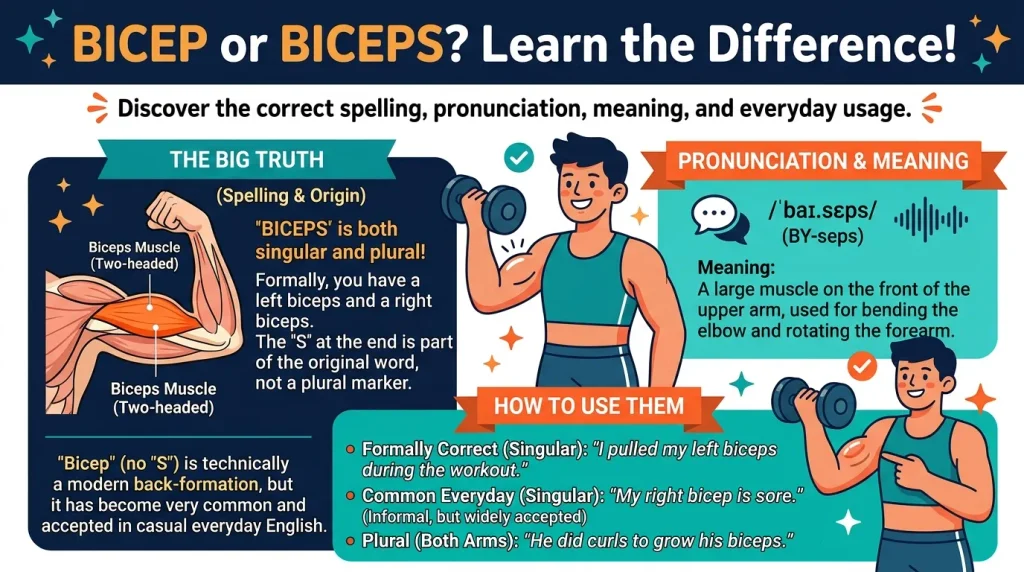
Biceps is the standard word for the muscle in your upper arm, while bicep is a common shorter form.
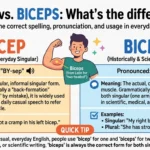
Imagine you are at the gym. Your friend lifts a weight and shows you the muscle in his upper arm. He says, “Look at my biceps!” You may also hear someone say, “Look at my bicep!” Both forms appear in everyday English, but biceps is the standard name used in anatomy.
The word bicep often appears in casual speech, fitness talks, and gym posts. The word biceps appears in health books, science lessons, and workout guides. Both words refer to the muscle at the front of the upper arm. The biceps helps you bend your elbow and turn your palm upward.
People search for bicep or biceps because they want to know which word is correct. They may also want to write a clear workout post, school paper, or health article. The key is to know that biceps is the standard anatomical term. Many people use bicep as a shorter form in daily speech. You can understand both forms and use the right one for your needs.
Pronunciation
Word
US pronunciation
UK pronunciation
Bicep
/ˈbaɪ.sɛp/
/ˈbaɪ.sep/
Biceps
/ˈbaɪ.sɛps/
/ˈbaɪ.seps/
Both words have two syllables. The stress falls on the first syllable.
Read more about:https://suitmean.com/simular-or-similar/
Difference Between Bicep and Biceps
1. Meaning
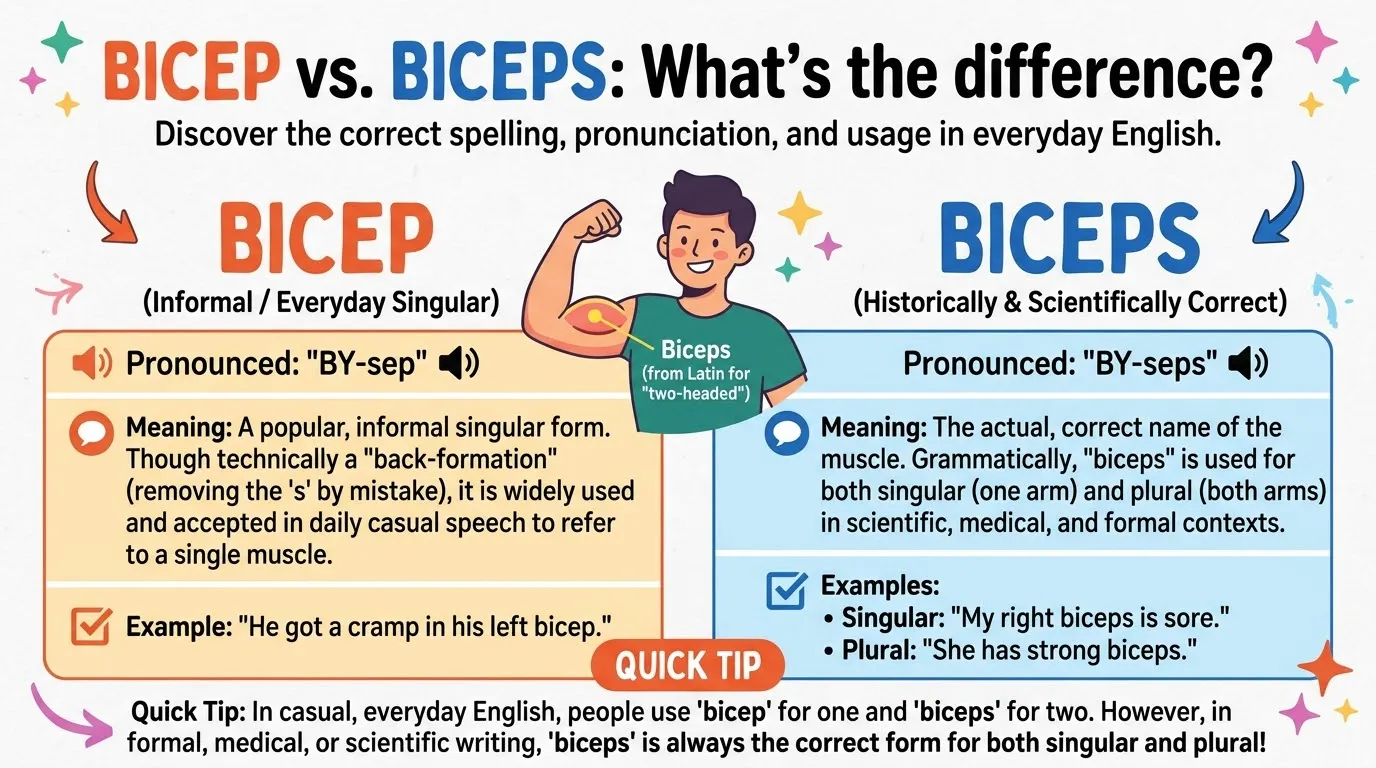
Bicep: A common short form for the upper-arm muscle.
Biceps: The standard name for that muscle in anatomy.
- Example 1: My bicep hurts after the workout.
- Example 2: The doctor checked my biceps.
2. Standard Usage
Bicep: Common in casual speech and fitness talk.
Biceps: Preferred in formal writing and science.
- Example 1: He wants bigger biceps.
- Example 2: The book explains the biceps muscle.
3. Grammar
Bicep: Often works as a singular noun in everyday English.
Biceps: Can refer to one muscle or both upper-arm muscles, based on the sentence.
- Example 1: My left bicep feels sore.
- Example 2: My right biceps muscle feels sore.
4. Singular and Plural
Bicep: Often serves as the singular form in casual use.
Biceps: Is the standard anatomical name for the muscle. The word does not change in the usual way when you talk about one or both sides.
- Example 1: He trained his left bicep.
- Example 2: She trained her biceps.
5. Use in the Gym
Bicep: Common in casual gym talk.
Biceps: Common in workout plans and exercise guides.
- Example 1: I worked on my bicep today.
- Example 2: I added biceps curls to my workout.
6. Use in Science
Bicep: Less common in formal anatomy texts.
Biceps: The accepted anatomical term.
- Example 1: The trainer checked my bicep.
- Example 2: The lesson explains how the biceps works.
7. Use in Health Writing
Bicep: May appear in simple health advice.
Biceps: Better for medical and anatomy writing.
- Example 1: My bicep hurts when I lift a bag.
- Example 2: The doctor examined the biceps tendon.
8. Word Form
Bicep: A shorter form that many English speakers use.
Biceps: Comes from a Latin word that refers to having two heads.
- Example 1: His bicep looks strong.
- Example 2: The biceps has two heads.
9. Use in Social Media
Bicep: Often appears in short posts and captions.
Biceps: Also appears in fitness posts and exercise tips.
- Example 1: “Bicep day at the gym!”
- Example 2: “Building stronger biceps!”
10. Best Choice for Clear Writing
Bicep: Fine in casual speech when the meaning is clear.
Biceps: Best for schoolwork, science, and formal writing.
- Example 1: My bicep is sore today.
- Example 2: The biceps helps bend the elbow.
Nature and Behaviour of Bicep and Biceps
Bicep
Bicep is a common short form. People often use it when they talk about exercise, muscle size, or arm pain. It is easy to say and fits casual talks.
Examples:
- My bicep hurts after lifting weights.
- He wants to build his bicep muscles.
Biceps
Biceps is the standard anatomical term. It names the muscle at the front of the upper arm. Each upper arm has a biceps brachii muscle. This muscle helps bend the elbow and turn the palm upward.
Examples:
- The biceps helps him lift the weight.
- She learned about the biceps in science class.
Why People Get Confused About Bicep and Biceps
People get confused because both words refer to the same upper-arm muscle. Many gym users say bicep when they talk about one arm. They may think biceps means two muscles or more than one muscle.
The word biceps comes from Latin. Its ending may look like a plural ending, but English uses biceps as the standard name for the muscle on each arm.
People also see phrases like “bicep curls” and “biceps curls.” Both appear in fitness writing. This makes the choice harder.
Remember this simple rule: use biceps for formal and anatomical writing. You can use bicep in casual speech when the meaning is clear.
Comparison Table
| Feature | Bicep | Biceps |
|---|---|---|
| Spelling | Six letters | Seven letters |
| Meaning | Upper-arm muscle | Upper-arm muscle |
| Word type | Noun | Noun |
| Standard use | Informal | Standard |
| Formal writing | Less preferred | Preferred |
| Scientific writing | Less common | Common |
| Gym language | Common | Very common |
| Pronunciation | By-sep | By-seps |
| Word origin | Shortened form | Latin origin |
| Main use | Casual speech | General and formal use |
Similarity: Both words refer to the same upper-arm muscle. The main difference is their form and level of use.
The Origin of Bicep and Biceps
The word biceps comes from Latin. It combines words that mean “two” and “head.” This name describes a muscle with two heads, or two points of origin.
The full anatomical name is biceps brachii. The Latin word brachii relates to the arm. This muscle lies at the front of the upper arm.
English adopted biceps as the name of the muscle. Over time, people began using bicep as a shorter form. Today, many people use bicep in daily speech and fitness talks.
Both forms appear in modern English. The full word remains the standard choice in anatomy and medical writing.
British vs American English
There is no major spelling difference between British and American English for these words.
| Point | American English | British English |
|---|---|---|
| Standard form | Biceps | Biceps |
| Informal form | Bicep | Bicep |
| Scientific use | Biceps | Biceps |
| Gym language | Both forms | Both forms |
| Pronunciation | Similar | Similar |
Examples in American English:
- He trains his biceps every Monday.
- My bicep hurts after lifting weights.
Examples in British English:
- She has strong biceps.
- He injured his bicep during training.
Both countries use the same main spelling rules. Biceps remains the better choice for formal and scientific writing..
Which One Should You Use?
Choose biceps when you want the safest and clearest word.
- For the US: Use biceps in schoolwork, medical writing, and science lessons. Bicep is common in casual talk.
- For the UK: Use biceps in formal writing. Both forms appear in daily speech.
- For global English: Choose biceps in articles, reports, and learning materials.
If you write a fitness blog, you may use both words when they fit the sentence. For example, you can write “bicep workout” in a casual heading and explain the biceps muscle in the main text.
Common Mistakes
Here are common errors and their corrections.
1. Wrong: The bicep are strong.
Better: The biceps are strong. Also: The biceps muscle is strong.
2. Wrong: I trained my bicepts.
Correct: I trained my biceps.
3. Wrong: My bicep muscles is sore.
Correct: My bicep muscle is sore.
4. Wrong: The biceps are one muscle in each arm.
Better: Each arm has a biceps brachii muscle.
5. Wrong: Biceps always means two muscles.
Correct: Biceps can name the muscle in one arm or refer to both arms.
6. Wrong: Bicep is the only correct form.
Correct: Biceps is the standard anatomical term. Bicep is a common shorter form.
Everyday Usage Examples
1. Emails
- “My bicep hurts after yesterday’s workout.”
- “Please add biceps exercises to my training plan.”
2. Social Media
- “Time to train my biceps!”
- “A good day for a bicep workout.”
3. News
- “The athlete injured his biceps during training.”
- “The player received treatment for a biceps injury.”
4. Formal Writing
- “The biceps brachii helps bend the elbow.”
- “The study looked at changes in biceps strength.”
5. Schoolwork
- “The biceps is a muscle in the upper arm.”
- “The biceps helps us bend the elbow.”
Usage Trends
Both bicep and biceps appear in modern English. People often use bicep in gym talk, short captions, and casual chats. The shorter word feels simple and direct.
The word biceps remains common in science books, health websites, and workout guides. It also appears in everyday speech.
Fitness websites may use both forms to reach readers who search for either word. This helps people find information about arm workouts and muscle care.
There is no clear rule that limits bicep to one country. Both American and British speakers use it. For formal writing, biceps remains the better choice.
Metaphors and Similes
People sometimes use muscle words to describe strength. These uses can make writing more lively.
Metaphors
A metaphor compares one thing to another without using “like” or “as.”
– “His biceps were pillars of strength.” This means his arms looked strong.
– “She built her biceps through hard work.” This can suggest that she worked with care and effort.
Similes
A simile compares two things using “like” or “as.”
- “His biceps looked like two rocks.”
- “Her arms felt as strong as steel.”
These are creative comparisons. They do not describe the exact shape or strength of a real muscle.
Connotative Meaning
A word’s connotation is the feeling or idea it brings to mind.
Positive Meaning
Both words can suggest strength, health, and hard work.
- “His biceps show years of training.”
- “She feels proud of her strong biceps.”
Negative Meaning
The words can suggest pain, injury, or too much focus on looks.
- “He hurt his bicep while lifting a heavy box.”
- “The post focused only on large biceps.”
Neutral Meaning
Both words can simply name a body part.
- “The doctor checked his biceps.”
- “The trainer showed her the bicep muscle.”
The meaning depends on the sentence, not just the word.
Idioms and Proverbs
There are no widely used English idioms or proverbs that depend on the exact words bicep or biceps. People often use other expressions to talk about strength.
1. Flex Your Muscles
Meaning: Show your strength or power.
Example: “The team flexed its muscles during the final game.”
2. Muscle In
Meaning: Force your way into a situation.
Example: “He tried to muscle in on their business deal.”
3. Put Some Muscle Into It
Meaning: Use more strength or effort.
Example: “Put some muscle into it and move the box.”
These expressions can describe physical strength or power in a wider sense.
Literature and Movies
The words bicep and biceps often appear in fitness books, health guides, and stories about sports. Writers may use them to describe a strong hero, an athlete, or a person who works out.
Literature and Books
- Anatomy and fitness books: These use biceps to explain the upper-arm muscle, its movement, and its role in exercise.
- Sports stories: Writers may describe an athlete’s biceps to show strength or hard training.
- Health guides: These often use biceps when they discuss muscle pain or injury.
A useful example is Strength Training Anatomy by Frédéric Delavier, first published in 1998. This fitness and anatomy book explains muscles and exercises with detailed illustrations.
Movies
- Pumping Iron (1977, United States): This documentary follows bodybuilders and shows the world of muscle training and competition.
- Rocky (1976, United States): This sports drama follows a boxer who trains hard to prepare for a major fight.
These works relate to muscle training and physical strength. They are not famous works specifically about the spelling difference between bicep and biceps.
Why This Difference Matters
Knowing the difference between bicep and biceps helps you write clearly. It also helps you understand fitness and health information.
Students may meet the word biceps in science books. A clear understanding helps them learn how the body works. Gym users may hear both forms from trainers and friends. Knowing that bicep is a common short form helps them understand daily speech.
Writers also need to choose words with care. A health article should use standard anatomy terms. A social media post can use more casual language.
Clear word choice helps readers trust what they read. It also makes it easier for people from different countries to understand the same message.
The goal is not to judge people who use bicep. The goal is to know which form fits each situation.
Usefulness in Daily Life
You may see these words in many places:
- At the gym: Talk about arm workouts and muscle growth.
- At school: Learn about the human body.
- At the doctor: Explain pain or discuss an injury.
- At work: Write clear health and safety notes.
- Online: Read fitness posts and watch exercise videos.
- In daily talks: Describe arm strength or soreness.
For most daily needs, both forms will be understood. Use biceps when you need a standard anatomical term. Use bicep when you want a short, casual form.
Situational Preference
The best word depends on your reader and purpose. In a school essay, use biceps because it is the standard anatomical term. For medical report, use biceps or the full name biceps brachii when needed. In a gym chat, bicep is common and easy to understand. On social media, either form can work. In a fitness guide, use biceps for clear and consistent writing. If you speak to people from many countries, biceps is a safe choice. You do not need to avoid bicep. Just use it where casual language fits.
Common Questions
1. Is bicep or biceps correct?
Both forms appear in English. Biceps is the standard anatomical term, while bicep is a common shorter form.
2. Is bicep a real word?
Yes. Bicep is a recognized English word. It often appears in casual speech and fitness talk.
3. Is biceps singular or plural?
Biceps can be singular when it names the muscle in one arm. It can also refer to the muscles in both arms. The sentence makes the meaning clear.
4. Should I write bicep curls or biceps curls?
Both forms appear in fitness writing. Biceps curls is a clear choice when referring to exercises for the biceps muscles.
5. Do Americans and British people spell biceps differently?
No. Both use the spelling biceps. The word bicep also appears in both forms of English.
6. Why does biceps end in “s” if it can be singular?
The word comes from Latin. Its ending does not work like the usual English plural ending.
7. What is the full name of the biceps muscle?
Its full anatomical name is biceps brachii. It is found at the front of the upper arm.
Conclusion
The words bicep and biceps refer to the same upper-arm muscle. The main difference is how people use them. Biceps is the standard anatomical term. Bicep is a common shorter form in everyday English. You may hear bicep at the gym, in a chat, or in a short social media post. People use it because it is quick and easy to say. The word biceps appears more often in science books, health guides, and formal writing.
Both American and British speakers use these words. Neither country has a special spelling rule that makes one form correct and the other wrong. The best choice depends on your needs.
Use biceps in school essays, medical writing, and formal articles. You can use bicep in casual talk when the meaning is clear. Remember that biceps can name the muscle in one arm or refer to both arms.
Once you know this simple rule, you can use both words with more confidence. You can also understand them when you read fitness tips, study the human body, or talk about exercise with friends.

I’m Sultan Sikander, an English language specialist, SEO specialist, digital publisher, and researcher. I create clear, accurate, and well-researched content on English grammar, vocabulary, word meanings, and language comparisons, helping readers understand and use English with confidence.