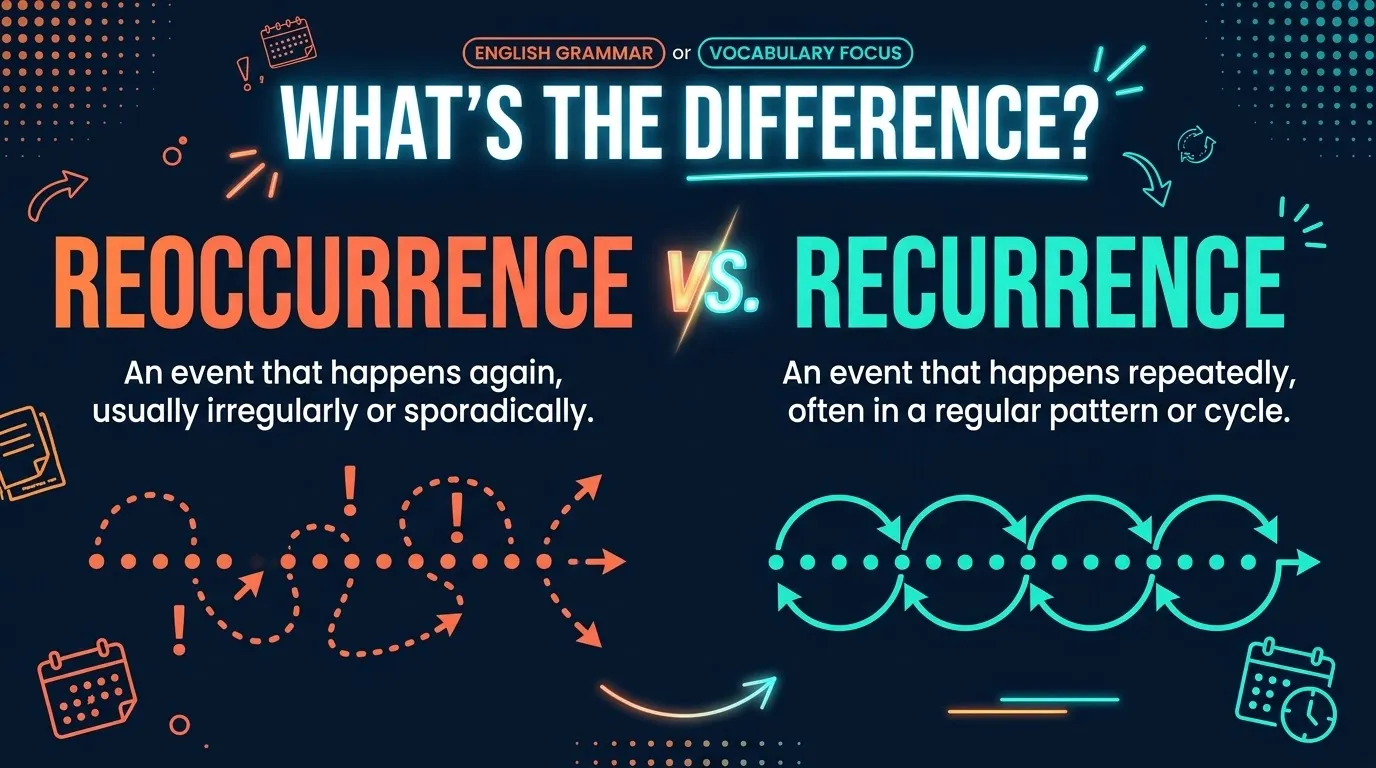
Recurrence means something happens again. Reoccurrence also means something happens again, often after it has stopped.
Imagine a problem at school. A student gets the same computer error twice. The teacher may talk about the recurrence of the error. If the error stopped for a while and then appeared again, someone may also call it a reoccurrence. Both words are connected to something happening again. Recurrence is the more common and established word in many formal contexts. Reoccurrence is also a real word. It is often used when an event happens again. People search for reoccurrence or recurrence when they write emails, reports, school work, or medical texts.
The main problem is simple: the two words look and sound very much alike. Their meanings also overlap. This makes it hard to know which one to choose. Learning reoccurrence or recurrence helps you choose the right word for your sentence.
Pronunciation
Reoccurrence
reoccurrence (ree-uh-KUR-uhns)
Recurrence
recurrence (ri-KUR-uhns)
The main stress falls on the “cur” sound in both words.
Learn more about:https://suitmean.com/simular-or-similar/
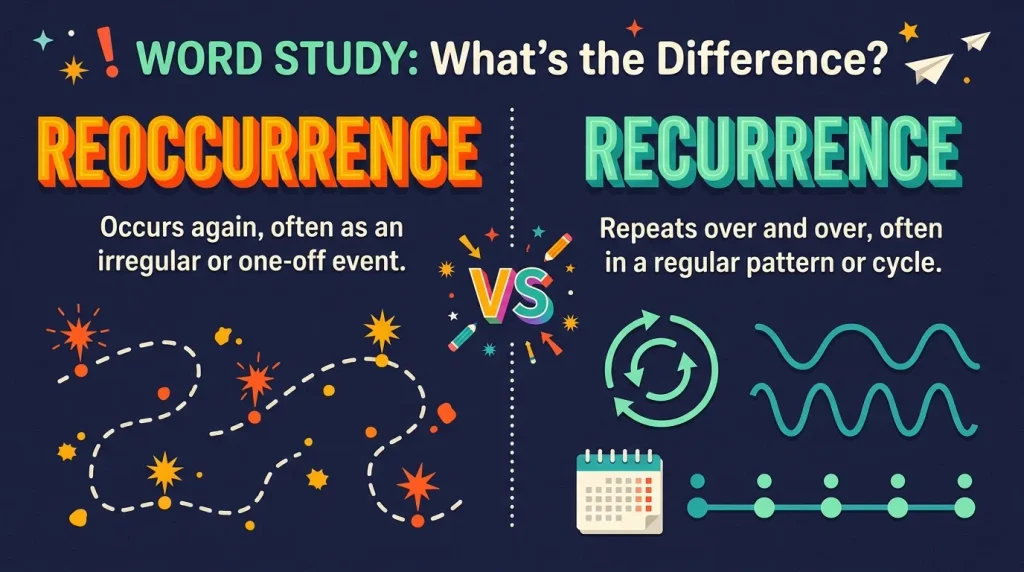
Difference Between Reoccurrence and Recurrence
1. Basic Meaning
Recurrence means that something happens again.
Reoccurrence also means that something happens again.
Example 1: The recurrence of rain delayed the game.
Example 2: The reoccurrence of the problem caused concern.
2. Use of “Again”
The word reoccurrence contains the idea of something occurring again. The prefix re- can mean “again.”
Recurrence also carries the idea of happening again.
Example 1: The doctor watched for a recurrence of the problem.
Example 2: The team worked to stop the reoccurrence of the error.
3. Commonness
Recurrence is widely used in formal English.
Reoccurrence is also used, but it is less common in many contexts.
Reoccurrence means something happens again. Recurrence also means something happens again.
Example 1: The study looks at the recurrence of the event.
Example 2: The report discusses the reoccurrence of the issue.
4. Formal Writing
Recurrence is a strong choice for formal writing.
It is common in reports, research, and professional writing.
Example 1: The study examines the recurrence of the disease.
Example 2: The report records the recurrence of the problem.
5. Repeated Events
Both words can describe a repeated event.
Recurrence often focuses on the fact that something happens again.
Reoccurrence can stress that something has happened again after appearing before.
Example 1: The recurrence of heavy rain caused floods.
Example 2: The reoccurrence of the same mistake surprised the teacher.
6. Medical Writing
Recurrence is very common in medical writing.
Doctors and researchers use it when discussing on disease or problem.
Example 1: The doctor checked for a recurrence of the illness.
Example 2: The treatment may reduce the risk of recurrence.
7. Business Writing
Both words can appear in business writing.
However, recurrence often sounds more natural and formal.
Example 1: We must prevent the recurrence of this error.
Example 2: The manager noticed the reoccurrence of delays.
8. Focus on Returning
Recurrence can suggest that something returns or happens again.
Reoccurrence can make the “happening again” idea more direct.
Example 1: The recurrence of the issue needs attention.
Example 2: The reoccurrence of the issue was unexpected.
9. Noun Form
Both recurrence and reoccurrence are nouns.
They name the act or event of something happening again.
Example 1: The recurrence was difficult to explain.
Example 2: The reoccurrence worried the workers.
10. Best General Choice
When you are not sure, recurrence is usually the safer choice in formal writing.
It is short, clear, and widely used.
Example 1: We hope to prevent a recurrence of the problem.
Example 2: The doctor explained the chance of recurrence.
Nature and Behaviour of Reoccurrence and Recurrence
Nature of Recurrence
Recurrence is a noun. It describes something happening again.
It can describe problems, events, patterns, symptoms, or other things that return.
For example:
- The recurrence of the problem was annoying.
- The recurrence of rain changed our plans.
Nature of Reoccurrence
Reoccurrence is also a noun. It describes an event that occurs again.
It can be used when something appears again after happening before.
For example:
- The reoccurrence of the error caused delays.
- We want to prevent the reoccurrence of the issue.
Why People Get Confused About Reoccurrence and Recurrence
People confuse these words for three main reasons.
First, they have almost the same meaning.
Second, both words describe something happening again.
Third, both contain the word occur.
The extra “re” in reoccurrence can make learners think it must have a very different meaning. In many sentences, however, the meanings are very close.
A useful tip is:
Use “recurrence” when you need a clear and formal word for something happening again.
Comparison Table
| Feature | Recurrence | Reoccurrence |
| Part of speech | Noun | Noun |
| Main meaning | Something happens again | Something happens again |
| Common use | Formal and general writing | General and formal writing |
| Meaning of “again” | Present | Strongly suggested by “re-” |
| Medical use | Very common | Possible |
| Business use | Common | Possible |
| Academic use | Common | Possible |
| Meaning | Repeat or return | Occur again |
| Similarity | Describes something happening again | Describes something happening again |
| General choice | Often preferred | Correct but less common in many contexts |
The Origin of Reoccurrence and Recurrence
Both words come from the verb occur, which means “to happen.”
Recurrence comes from the idea of something returning or happening again. It is related to the Latin word recurrere, meaning “to run back.”
Reoccurrence is formed from re- + occurrence. The prefix re- commonly means “again.”
The base word occurrence means something that happens or an event.
So, both words have a clear connection with the idea of something happening again.
British vs American English
There is no major British-American spelling difference between these two words.
Both recurrence and reoccurrence can be found in British and American English.
American English
American writers commonly use recurrence in formal and professional writing.
Example: The study found a high rate of recurrence.
British English
British writers can also use recurrence.
Example: The report examines the recurrence of the problem.
Reoccurrence can also be used in both varieties.
Unlike colour/color, you do not need to change the spelling for British or American English.
Which One Should You Use?
For US English
Use recurrence when you want a clear and formal word.
For UK English
Recurrence is also a natural choice.
For Global English
Recurrence is often the easiest choice because it is clear and widely understood.
Use reoccurrence when you want to stress that something occurred again.
Common Mistakes
Mistake 1: Using “recurrance”
❌ The recurrance of the problem was strange.
✅ The recurrence of the problem was strange.
Mistake 2: Writing “reoccurence”
❌ The reoccurence was unexpected.
✅ The reoccurrence was unexpected.
Mistake 3: Adding an extra “r”
❌ Recurrance
✅ Recurrence
Mistake 4: Treating the words as completely different
The meanings overlap a lot.
❌ They can never be used in similar situations.
✅ They can often describe the same basic idea.
Mistake 5: Using “reoccurrence” everywhere
Recurrence is often simpler and more natural in formal writing.
Everyday Usage Examples
In Emails
We are working to prevent the recurrence of this problem.
On Social Media
I hope there is no recurrence of yesterday’s problem!
In News
Officials are taking steps to prevent a recurrence of the incident.
In Formal Writing
The study examined the recurrence of the condition.
At Work
We need to find the cause to prevent a recurrence.
At School
The teacher discussed the recurrence of the same mistake.
Usage Trends
Both words are used in English, but recurrence is the more familiar choice in many formal settings. The word is common when people talk about anything that happen again like disease, events etc.
Reoccurrence is also used. It is often chosen when the writer wants to make the idea of “occurring again” clear.
The best choice can depend on the sentence and field. In formal writing, recurrence is often a simple and safe choice.
Metaphors and Similes
These words can also work in figurative writing.
Metaphor
The recurrence of winter was a reminder of time.
Here, winter is shown as something that returns.
Simile
The problem returned like a recurrence of an old storm.
This compares a returning problem with a storm.
More Examples
- Old memories returned like a recurring song.
- The recurrence of fear was like an old shadow.
- The reoccurrence of the sound felt like a broken record.
Connotative Meaning
Positive Meaning
Recurrence can have a positive meaning when something good returns.
Example: The recurrence of spring brought joy to the village.
Negative Meaning
It can also suggest that a problem has returned.
Example: The recurrence of the error caused stress.
Neutral Meaning
It can simply describe something happening again.
Example: The recurrence of the event was recorded in the report.
So, the word itself is mostly neutral. The surrounding sentence gives it a positive or negative feeling.
Idioms and Proverbs
There is no famous idiom that uses recurrence or reoccurrence as a fixed phrase.
However, English has several expressions for something happening again.
“History repeats itself”
This means that similar things happen again.
Example: History repeats itself when people make the same mistakes.
“Here we go again”
This informal phrase shows that something is happening again.
Example: The computer has stopped again. Here we go again!
“Back to square one”
This means going back to the beginning after a problem.
Example: The plan failed, so we are back to square one.
Literature and Movies
The idea of recurrence is common in literature. To make a story exciting, writes use things that happen again.
For example, The Great Gatsby by F. Scott Fitzgerald was published in 1925. The book shows repeated hopes and attempts to go back to the past.
In movies, repeated events are also a common story device.
Groundhog Day (1993), produced in the United States, uses a repeated day as its main story idea. The same day happens again and again.
These stories show how repetition can be important in storytelling.
Why This Difference Matters
Knowing the difference between recurrence and reoccurrence helps learners write clearly.
It is useful for students, writers, bloggers, workers, and researchers.
A small word choice can make formal writing sound clearer.
For example:
The recurrence of the problem was reported.
This sounds clear and formal.
Good word choice also helps readers understand your meaning quickly. This matters in schools, workplaces, news reports, and public information.
Difference guide us about different level of use and style of both words. But both words have similar meanings.
Usefulness in Daily Life
You may see these words in many places.
- School: recurrence of an error
- Work: recurrence of a problem
- Medicine: recurrence of a condition
- News: recurrence of an event
- Science: recurrence of a pattern
- Technology: recurrence of a system error
- Writing: recurrence of a theme
- Business: recurrence of delays
Knowing recurrence makes it easier to understand reports and formal information.
Situational Preference
In most situations, recurrence is a simple and safe choice. Use it when something happens again in School. Reoccurrence can also be correct. It may be useful when you want to stress that something occurred again. In medical writing, recurrence is especially common. In everyday writing, either word may work when the meaning is clear. If you are unsure, choose recurrence. It is short and widely understood. Always read the full sentence before choosing. The best word is the one that makes your meaning clear.
Common Questions
Is recurrence the same as reoccurrence?
They have very similar meanings. Both can describe something happening again.
Which word is more common?
Recurrence is generally the more common choice in formal English.
Is reoccurrence a correct word?
Yes. Reoccurrence is a real English word.
Is recurrence used in medical English?
Yes. It is very common in medical writing, especially when talking about a condition that returns.
Should I use recurrence in formal writing?
Yes. Recurrence is a clear and widely used choice for formal writing.
Is there a British spelling of recurrence?
No separate British spelling is needed. Recurrence is used in both British and American English.
Can I use reoccurrence in an email?
Yes. It is grammatically possible. However, recurrence may sound simpler and more natural in many formal emails.
Conclusion
Recurrence and reoccurrence both describe something that happens again. This is the main reason they are easy to confuse. Recurrence is a common and useful word. It works well in formal writing, school work, reports, research, business writing, and medical writing. It can describe a problem, event, pattern, or condition that happens again. Reoccurrence also means that something happens again. The word can place more focus on the fact that something has occurred again. It is not a spelling mistake. There is no major British-American spelling difference between the two words. Both can be used in both forms of English. When you are unsure, recurrence is usually a simple choice. It is clear and widely used. Still, reoccurrence can be correct when it fits the sentence. Understanding reoccurrence or recurrence can help you write better English. It can also help you understand formal reports, news stories, school texts, and professional writing more easily.

I’m Sultan Sikander, an English language specialist, SEO specialist, digital publisher, and researcher. I create clear, accurate, and well-researched content on English grammar, vocabulary, word meanings, and language comparisons, helping readers understand and use English with confidence.