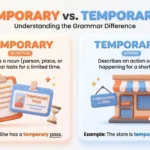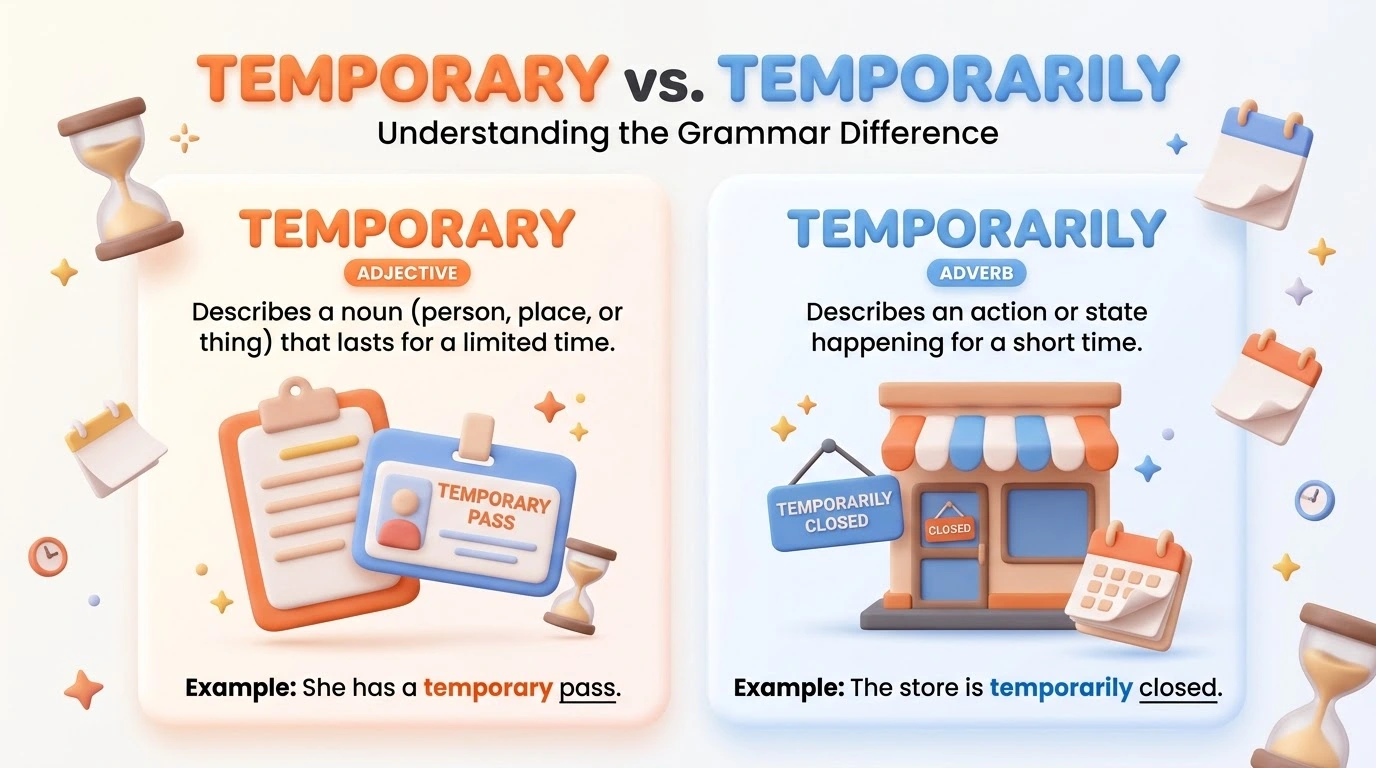
Temporary describes something that lasts for a short time. Temporarily tells us that an action or state lasts for a short time.
Imagine your school closes for two days because workers need to fix a broken roof. A notice says, “The school is temporarily closed.” The word temporarily tells you that the school will open again. Now imagine the notice says, “This is a temporary closure.” Here, temporary describes the closure.
Both words relate to time. They have almost the same meaning, but they do different jobs in a sentence. People often search for temporarily or temporary because they want to know which word fits their sentence. This question comes up in schoolwork, emails, business reports, and daily messages.
The main rule is easy to learn. Use temporary to describe a person, thing, job, or situation that will not last forever. Use temporarily to describe an action or state that lasts for a short time.
Pronunciation
Both words have the same main stress. The first part gets the most stress.
- Temporary — US: /ˈtɛm.pəˌrɛr.i/
- Temporary — UK: /ˈtɛm.pər.ər.i/
- Temporarily — US: /ˌtɛm.pəˈrɛr.ə.li/
- Temporarily — UK: /ˈtɛm.pər.ər.əl.i/
The exact sounds can vary by speaker. In temporarily, the stress often falls on the part that sounds like “RAIR.”
Related article: https://suitmean.com/wp-admin/post.php?post=453&action=edit
A Simple Guide to Their Use
The two words share a meaning, but they have different roles in a sentence. Let us look at ten clear differences.
Difference Between Temporarily and Temporary
1. Part of Speech
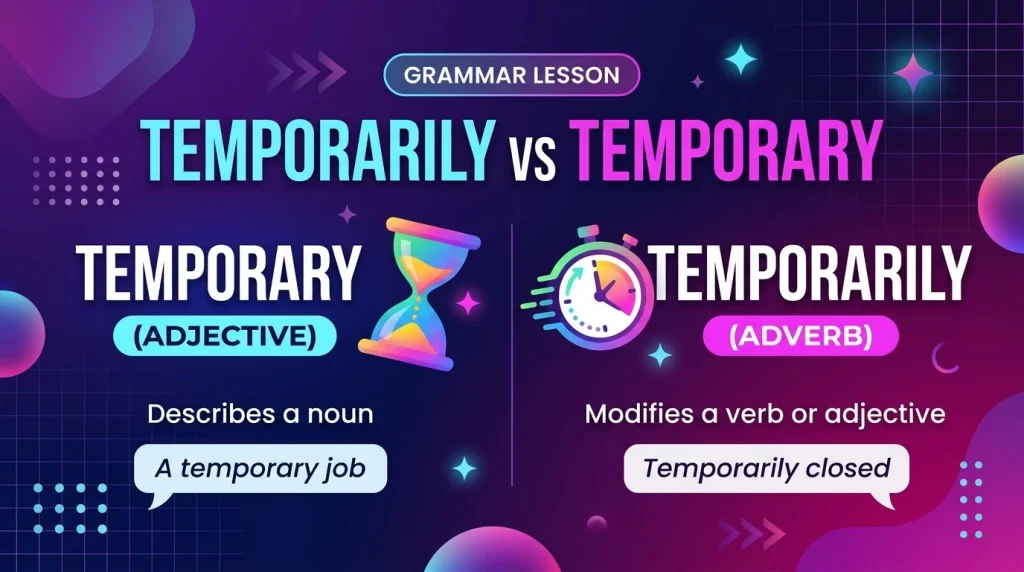
Temporary is an adjective. It describes a person, thing, or state.
Temporarily is an adverb. It tells us how long an action or state lasts.
Examples:
- I have a temporary job.
- I will work here temporarily.
2. Main Use
Temporary describes something that will not last forever. Temporarily tells us that something happens for a short time.
Examples:
- This is a temporary change.
- The shop is temporarily closed.
3. Word Ending
Temporary ends in -ary. Temporarily ends in -arily.
Examples:
- We need a temporary worker.
- The worker will stay temporarily.
4. Place in a Sentence
Temporary often comes before a noun. Temporarily often comes before an adjective or verb phrase.
Examples:
- She found a temporary home.
- She is temporarily living with her aunt.
5. Use With Jobs
Temporary describes a job that lasts for a short time. Temporarily describes working for a short time.
Examples:
- He got a temporary job.
- He will work here temporarily.
6. Use With Places
Temporary describes a place or home that is not permanent. Temporarily tells us that someone stays somewhere for a short time.
Examples:
- They built a temporary shelter.
- They moved temporarily to another town.
7. Use With Problems
Temporary describes a problem or condition that will not last forever. Temporarily describes how a problem affects something for a short time.
Examples:
- The delay is temporary.
- The delay temporarily stopped the work.
8. Use in Business
Temporary describes a short-term change, job, or plan. Temporarily tells us that an action or service will last for a short time.
Examples:
- We hired a temporary worker.
- We temporarily stopped the service.
9. Use in Formal Writing
Temporary describes a noun in reports and official letters. Temporarily explains an action or state in these texts.
Examples:
- The company made a temporary change.
- The company temporarily changed its hours.
10. Meaning in a Full Sentence
Temporary names the kind of thing or state. Temporarily explains how long something happens or remains true.
Examples:
- The road closure is temporary.
- The road is temporarily closed.
Nature and Behaviour of Temporarily and Temporary
Temporary
Temporary is an adjective. It gives more information about a noun. It often describes something that may end or change later.
Examples:
- We live in a temporary home.
- Dad has a temporary job.
The word does not always tell us the exact length of time. Something temporary may last for a few hours, days, or even years.
Temporarily
Temporarily is an adverb. It tells us that an action or state lasts for a limited time.
Examples:
- The road is temporarily closed.
- She temporarily left her job.
It often appears with words such as closed, unavailable, stopped, and moved.
Why People Get Confused About Temporarily and Temporary
People confuse these words because they share the same base word and meaning. Both relate to something that does not last forever.
The main difference is grammar. Temporary describes a noun. Temporarily describes an action or state.
Look at these examples:
- Correct: This is a temporary problem.
- Correct: The problem will temporarily stop our work.
- Incorrect: This is a temporarily problem.
- Incorrect: The shop is temporary closed.
The endings can also cause confusion. Learners may forget when to add -ly. A simple way to check is to ask what the word describes.
If it describes a thing, use temporary. If it explains an action or state, use temporarily.
Comparison Table
| Feature | Temporary | Temporarily |
| Part of speech | Adjective | Adverb |
| Main meaning | Lasting for a limited time | For a limited time |
| Common role | Describes a noun | Describes an action or state |
| Word ending | -ary | -arily |
| Example | A temporary job | Work temporarily |
| With a closure | A temporary closure | Temporarily closed |
| With a home | A temporary home | Stay temporarily |
| With a change | A temporary change | Temporarily change |
| Can describe a noun? | Yes | Usually no |
| Can describe an action? | No, not directly | Yes |
Similarity: Both words relate to time and describe something that is not permanent.
The Origin of Temporary
The word temporary comes from the Latin word temporarius, which means lasting for a time. The Latin word tempus means “time.”
English later formed temporarily by adding -ly to temporary. This ending often changes an adjective into an adverb.
Here are three related words:
- Temporary: a temporary plan.
- Temporarily: the plan is temporarily on hold.
- Temporariness: the state of not lasting forever.
The words share a link to time. Their grammar tells us how to use them in a sentence.
British vs American English
British and American English use the same spellings and meanings for these words. Neither country uses a different form.
| Feature | British English | American English |
| Adjective | Temporary | Temporary |
| Adverb | Temporarily | Temporarily |
| Short-term job | Temporary job | Temporary job |
| Short-term closure | Temporarily closed | Temporarily closed |
| Spelling rule | Add -ly | Add -ly |
Examples:
- British English: The road is temporarily closed.
- American English: The road is temporarily closed.
- British English: She has a temporary job.
- American English: She has a temporary job.
The grammar stays the same in both forms of English.
Which One Should You Use?
Choose the word that fits the sentence.
- US English: Use temporary before a noun and temporarily to describe an action or state.
- UK English: Follow the same rule. The spelling does not change.
- Global English: Use the same rule in schoolwork, emails, reports, and online posts.
Remember these two patterns:
- A temporary change.
- The rules changed temporarily.
The first word describes the change. The second tells us how long the rules changed.
Common Mistakes
Here are common errors and their corrections.
| Incorrect | Correct |
| A temporarily job | A temporary job |
| A temporarily home | A temporary home |
| The shop is temporary closed | The shop is temporarily closed |
| The road is temporary blocked | The road is temporarily blocked |
| We live temporary here | We live temporarily here |
| A temporarily solution | A temporary solution |
| The service is temporary unavailable | The service is temporarily unavailable |
| She will stay temporary | She will stay temporarily |
Tip: Look at the word after the blank. If you need to describe a noun, choose temporary. If you need to describe an action or state, choose temporarily.
Everyday Usage Examples
1. In Emails
Subject: Temporary Office Closure
Dear Team,
Our office will be temporarily closed on Friday for repairs. We will open again on Monday.
Thank you for your patience.
2. On Social Media
- I am staying with my family temporarily.
- We have a temporary change to our opening hours.
3. In News
- The city has set up a temporary shelter for families.
- Officials have temporarily closed the bridge for repairs.
4. In Formal Writing
- The company offered a temporary contract.
- The service will be temporarily unavailable during the update.
5. In Daily Conversation
- This is only a temporary problem.
- I am temporarily using my brother’s laptop.
These examples show how both words fit into daily life.
Usage Trends
Both words are common in modern English. People use them in schools, offices, news reports, websites, and daily messages.
Temporary often appears with nouns such as job, home, solution, change, and closure. Temporarily often appears with words such as closed, unavailable, stopped, and moved.
Online searches for these words often come from people who want to check grammar or spelling. The extra -ly can make learners unsure about which form to use.
Both words work in British, American, and global English. Their use depends on grammar, not on the country.
Metaphors and Similes
These words can help writers talk about change and the short nature of life. The examples below use creative language.
Metaphors
A metaphor describes one thing as another.
- “This problem is a temporary storm.” It means the problem will pass.
- “The job is a temporary bridge to a better future.” It means the job may help someone reach a new goal.
Similes
A simile compares things using like or as.
- “The pain passed like a temporary storm.” It means the pain did not last.
- “The change came and went like a short summer rain.” It means the change lasted for a short time.
These are creative examples, not fixed meanings of the words.
Connotative Meaning
Connotation means the feeling or idea a word brings to mind. Both words can have positive, negative, or neutral meanings.
Positive Meaning
They can suggest hope, growth, or a short break before better times.
Examples:
- This temporary job will help me gain skills.
- The team will temporarily rest before the next game.
Negative Meaning
They can suggest trouble, loss, or a lack of stability.
Examples:
- The family lives in a temporary shelter after the flood.
- The road is temporarily closed after an accident.
Neutral Meaning
They can simply give facts about time.
Examples:
- She has a temporary contract.
- The system is temporarily offline.
The words themselves are not good or bad. The situation gives them their feeling.
Idioms and Proverbs
There are no common idioms that depend only on the word temporarily or temporary. Some familiar sayings still help explain the idea of short-term change.
1. This Too Shall Pass
This saying means that a hard time will not last forever.
Example: This is a temporary setback. Remember, this too shall pass.
2. Nothing Lasts Forever
This saying means that all things change with time.
Example: My temporary job may end soon. Nothing lasts forever.
3. A Blessing in Disguise
This phrase describes something that seems bad at first but later brings a good result.
Example: Losing that temporary job was a blessing in disguise because I found a better one.
These sayings connect with the idea of change, but they are not special idioms for either word.
Literature and Movies
Writers and filmmakers often explore change, short-term problems, and brief stages of life. These themes connect with the meaning of temporary and temporarily.
Literature
The Temporary Wife, a phrase found in romance and fiction titles, reflects the idea of a relationship or role that may not last. The exact book, author, and publication year depend on the work being discussed.
A well-known literary example of a short stage of life is The Great Gatsby by F. Scott Fitzgerald, published in 1925. This novel explores wealth, dreams, and change in American society. Its story shows how success and happiness can be short-lived.
Movies
Groundhog Day (1993) is a comedy and fantasy film from the United States. It follows a man who relives the same day again and again. The story explores a strange period that changes his life.
The Terminal (2004) is a comedy-drama film from the United States. It follows a man who becomes stuck in an airport terminal. His stay becomes a temporary way of life.
These works explore change and limited periods of time. They do not rely on a special difference between the two words.
Why This Difference Matters
Correct grammar helps people share clear ideas. The difference between temporary and temporarily may seem small, but it can change how a sentence works.
Students need this rule for homework, essays, and exams. Workers use both words in emails, reports, and plans. Businesses may describe temporary jobs, temporary offices, or services that are temporarily unavailable.
A mistake such as “the shop is temporary closed” can make a sentence sound wrong. “The shop is temporarily closed” is correct because the adverb describes the state of the shop.
Good grammar also helps readers understand notices and public messages. A clear notice can tell people if a road, office, or service will return to normal soon.
Learning this rule helps English learners write with more care. It also makes daily messages easier to read.
Usefulness in Daily Life
You can use these words in many common situations.
- At school: “We have a temporary classroom.”
- At work: “The manager is temporarily away.”
- At home: “This is a temporary fix.”
- While travelling: “We are staying here temporarily.”
- Online: “The website is temporarily unavailable.”
- In business: “The shop hired a temporary worker.”
These words help explain that something may change or end later. They do not always tell us the exact date when it will end.
Situational Preference
Use temporary when you describe a thing, person, job, or situation. It fits phrases such as “temporary job,” “temporary home,” and “temporary solution.” Use temporarily when you explain an action or state. It fits phrases such as “temporarily closed,” “temporarily moved,” and “temporarily unavailable.” In schoolwork, use the word that matches the grammar of the sentence. In emails and formal reports, check whether you are describing a noun or explaining an action. The same rule works in the US, UK, and around the world.
FAQs
1. What is the difference between temporarily and temporary?
Temporary describes something that lasts for a limited time. Temporarily tells us that an action or state lasts for a limited time.
2. Is temporary an adjective or an adverb?
Temporary is an adjective. It describes a noun.
Example: She has a temporary job.
3. Is temporarily an adjective or an adverb?
Temporarily is an adverb. It describes an action or state.
Example: She is temporarily working from home.
4. Is “temporarily closed” correct?
Yes. It means that a place is closed for a limited time.
Example: The library is temporarily closed.
5. Is “temporary closed” correct?
No. In standard English, write “temporarily closed.” The adverb temporarily describes the state of being closed.
6. Do British and American English use different spellings?
No. Both use temporary and temporarily.
7. What is an easy way to remember the difference?
Use temporary before a noun, as in “a temporary job.” Use temporarily to describe an action or state, as in “working temporarily.”
Conclusion
Temporary and temporarily share the same main idea. Both words relate to something that does not last forever. The key difference is their job in a sentence.
Temporary is an adjective. It describes a noun, such as a job, home, change, or problem. You can say, “I have a temporary job” or “This is a temporary solution.”
Temporarily is an adverb. It tells us that an action or state lasts for a short time. You can say, “I will work here temporarily” or “The shop is temporarily closed.” Both words have the same spelling in British and American English. You do not need to learn different forms for different countries. You only need to choose the word that fits your sentence.
Remember this simple rule: use temporary to describe a thing and temporarily to explain an action or state. This rule can help you avoid common grammar mistakes in schoolwork, emails, reports, and daily messages. With a little practice, you will know which word to use.